Sunrise~Sunset~Sunrise~Sunset….Swiftly Go the Days…Saturday May 4

Day 7 D Valley_051DSC_0051 Many of the more well known sites in Death Valley are around the Furnace Creek area, where we finally managed to work up the nerve to leave the swimming pool and air conditioned MoHo to venture out into the heat.  By 5pm it was only 96F or so, and even with the air going full blast, the inside of the MoHo was at 86F, cooling from the afternoon interior high of 91.  Yeah, we are only 30 amps in the MoHo, nice when trying to find a spot to hook up in remote areas, but not as good as those big 50 amp rigs with two air conditioners in hot country.  Getting outside and into the Tracker was a test in endurance until the air conditioning in the car finally caught up.

Day 7 D Valley_020DSC_0020 We only had a short mile to the Old Borax Mine works just north of the ranch.  Even though I had been to Death Valley before, I was surprised to be reminded that the famous 20 mule team borax wagons only operated out of the valley for 5 short years.  We drove through Mustard Canyon, but the overcast skies muddied up the mustard yellow color of the Furnace Creek Formation mud and silt left over from the 3 million year old lake sediments. 

Day 7 D Valley_013DSC_0013 Of course, we had read the memo, and knew that sunset would be a great time to drive the 27 miles to Dante’s View.  As we continued south past Zabriski Point toward Dante’s View, we took the one way side road into 20 Mule Team Canyon. It was just a short 5 mile loop, but incredibly fascinating to see the old sediments and the beautiful colors against the darkening skies. The storm looked like it could really do some damage, in spite of the fact that the valley only gets 2 inches of rain annual at the most.

Day 7 D Valley_034DSC_0034 Along the way south to the view point we passed huge open pit mines that were just outside the boundary of the park.  On the narrow road we kept seeing signs saying “no trailers allowed” and then a few miles in, there would be more signs proclaiming “trailer parking”.  Sure enough, at the top of the very narrow winding road, we saw a motorhome.  It was a small one, a rental of course, but still the sign DID say no motorhomes or trailers.

Day 7 D Valley_070DSC_0070 We read the memo about sunset, but neglected to remember that we were again traveling from below sea level to more than 5,000 feet elevation.  Hmmm.  We are in sea level clothes at cloudy high mountain temperatures.  We weren’t the only ones at least.  There were some carloads of hardy souls waiting for the sunset, and some of them even had the foresight to bring along some fleece.  Not us.  The wind was blowing hard, the skies were dull and smoky from the huge Camarillo fires, and it was cloudy.  The most fun was watching the sunset watchers.  Several carloads gave up and left, but there was this thin line of clarity just over the mountains to the west that made me think that something wonderful might happen if we were patient enough.

Day 7 D Valley_074DSC_0074 It did.  It wasn’t what I would call a spectacular sunset, but it certainly was a magical one.  We watched the glowing red orb appear in the opening in the clouds as it dropped toward the mountain and then something funny started happening.  As we watched, a thick, black, solid image appeared on the lower part of the sun.  It didn’t look anything like a cloud, but something was definitely in the sky there between us and the sun that was really cool.  Looked kinda like a coyote sun to me.  It was worth the wait to then watch the clouds along the mountain horizon light up as though they were rimmed with Christmas lights.  Maybe not whole sky spectacular like some sunsets I have seen, but definitely different and definitely amazing.

Day 7 D Valley_091DSC_0091 We slept well considering the heat, and again the air conditioner ran all night with lows in the mid 70’s.  The pre-dawn alarm was set and woke us to skies that were still a bit gloomy, but the eastern horizon looked as though light might find a way through.  Zabriski Point is one of the more famous viewpoints in the park, the one closest to the Furnace Creek Inn where people have come to marvel at the desert since the early part of the last century.  Now the parking lot is down low and you must walk to the viewpoint, but old photos show old cars all lined up there to see the sunrise.  Taking photos of a Zabriski sunrise is probably a requirement for any landscape photography course.

Day 7 D Valley_109DSC_0109 Once again it was fun watching the watchers.  It tickled both of us to see all the different morning bed hair, on both men and women.  Some people even hauled chairs and thermoses of coffee to wait for the light.  Of course there were lots of cameras, lots of languages being spoken, and lots of tripods.  I didn’t have mine, and instead used the interpretive signs as a makeshift tripod.  Next to me, however, was a photographer.  In capital letters.  He had some kind of large format camera, the kind that always excites me and yet is so intimidating.  I don’t even know if these cameras still use film, but I assume so.  Do they have large format digital cameras now?  It looked like a Hasselblad 4×5, the coveted camera of my university photography classes.  I have no clue what they cost now. 

Day 8 D Valley_005DSC_0005 I wanted to pick his brain but he was concentrating of course, using meters and such, and taking lots of prep photos as he waited for the light.  I’ll bet his photos are better than mine, but a lot more expensive as well!  I had fun fooling with exposures, and did a lot of really slow shutter speeds playing with the light. 

Day 8 D Valley_040DSC_0040 Once again, as the light brightened and flattened out the shadows, it was time to return to the MoHo for a nice breakfast and a long, lazy swim in that fabulous pool before we checked out at noon to leave the valley.  We will definitely go back, I am sure, probably a bit earlier in the season, however.  Our drive north was a return over the two big grades that we drove in on, and we both agreed it would be a lot easier to just unhook the Tracker.  We unhooked in Stovepipe Wells and ground our way up the hills.  I drove the MoHo and Mo followed in the Tracker.  The ups were definitely not as scary as the downs.  I had to put it in 2nd because the automatic downshift just didn’t go low enough on the long 9 percent grade dropping into the Panamint Valley.

Day 8 D Valley_055DSC_0055 We hooked up again at the top of the grade, a few miles east of highway 136, still a bit dicey but nothing we weren’t used to traveling in the MoHo hauling the Tracker. The skies were cloudy and as we left the valley the temperatures cooled to the 70’s and the winds were getting really strong.  We we descended into the Owens Valley the dust from the dry alkali lakebeds made eerie dust devils and we worried about the paint getting blown of the rig.

Day 8 D Valley_057DSC_0057It was still early when we reached Bishop, and there was plenty of time to take the drive up Sabrina Canyon which we had missed the last time we passed through a few days previous.  The light was opening up a bit, still cloudy, but at least a bit of sunlight to make the mountains glow.  The canyon was lovely, and Bishop Creek has a lot of forest campgrounds along the way.  The creek was full and there were lots of folks fishing.  Once at the dam, we negotiated some construction barriers before rounding the corner to the ‘lake’.

Day 8 D Valley_084DSC_0084 The lake was gone.  We found a huge pile of boulders, lots of sand, and a couple of small puddles where the lake used to be.  The water rights are owned by Southern California Edison Co, and the water goes to LA via the aqueduct along with al the other water in the Owens Valley.  There was a boat launch and resort with private docks, signs saying “keep off dock” and they were about 30 feet in the air, the boats al lined up at the closed resort in the dirt.  There are no plans at this time to refill the lake.  I can’t imagine just how awful this must be for the owners of that lodge, much less the people of Bishop who probably loved the fishing and boating on “their” mountain lake.  It was a dam, and dams are being removed everywhere. I do get that part in some respect, but we can’t undo the damage that we have done by just pulling out the dam.

dust storm at Owens Lake It is a bit like the controversy at Hetch Hetchy.  That valley will never again be the pristine valley that once rivaled Yosemite, even if the dam is removed and the water let out.  Here in the Klamath Basin, we have ‘reclaimed’ wetlands that have been unreclaimed, but they are nothing like the original natural wetland system that was once here.  One of the most controversial proposals in the Klamath Basin is the removal of 4 dams on the Klamath River.  I support that proposal, but looking at Sabrina Lake I can see what a hypocrite I can be as well.  I wish there was still a lake there. 

Sabrina Lake has gone to LAAfter that little disappointing side trip, we arrived at Brown’s Millpond Campground in time to snag the last hookup site. We had unhooked again before driving up to Sabrina Lake, so Mo took the Tracker to get groceries while I took the MoHo to check in and set up.  Once again I ran into some lovely Germans from Munich in a rental rig.  They were very sweet when they came over to ask, “Maybe you know this answer?”.  It seems that they saw the “city water” inlet for shore water and thought it meant water in the city, so they hooked up the water to the sani flush outlet and were in a panic because their toilet was filling up and almost overflowed.  I explained the difference between the two inputs to them as best I could, and once again Stacy at the campground came to the rescue with a bucket and bag saying they could empty bucketfuls from the black tank and dump them in the restroom toilets.

After all was good, they came over to thank me, and brought a big chocolate bar all wrapped up nice.  Ahh, European Chocolate!!!  Yum.  I would imagine that they might have a stash of those bars to thank people that they meet along the way in the twelve week adventure in the United States.  They had traveled from San Francisco to Yosemite and over Donner Pass and were on their way to Nevada and then to Bryce Canyon, but no desire to see Death Valley!Abby wants to know, where is the water, Mom?

Our sunset was accompanied by high wailing winds and wildly bending trees that we ardently hoped wouldn’t fall on the MoHo during the night.

Dawn at the Dunes May 4

Current Location: home in Rocky Point with thunderstorms, sun and rain.  It is good to be home.

dawn at the dunes Escaping the heat isn’t the only reason for rising at dawn when visiting Death Valley.  Reading Galen Rowell’s book, “Mountain Light”, reminds me again and again about that “magic hour” when taking a photo worth remembering is possible.  He said, “I almost never set out to photograph a landscape.  My first thought is always of light”.  In spite of the fact that I am still photographing landscapes, and sometimes photographing in forgettable light because I want to remember where I have been, reading his words has reminded me to at least think of the light more than the “thing” I am trying to photograph.  With that in mind, I set the alarm for 5:30 am, even though I am usually awake by then, I didn’t want to miss the sunrise over the Mesquite Dunes near Stovepipe Wells in Death Valley.

dawn at the dunesWe even skipped a morning beverage, running a quick brush through our hair, and putting on shorts and tank tops to fit the 70 plus degrees outside in the thin light.  The dunes are just a mile from where we were camped, so getting there wasn’t an issue.  The parking lot is big, and in the comparative coolness and lack of sunshine, it was OK to let Abby wait for us while we wandered into the dunes.  The hardest part about visiting a National Park is the lack of dog friendly space. There isn’t anyplace at all where a dog can walk except on the hot barren gravel around the parking lots.  Obviously heat is an issue as well, which is part of the reason we didn’t hike much in Death Valley.  We couldn’t leave Abby in the rig because she would bark and we couldn’t take her on the trails because of the rules, and we couldn’t leave her in the car because of the heat.  A problem. But on this sort of cool morning, she was fine, and although we could hear her barking from the distant dunes, there weren’t enough people yet around for it to be a big problem.

dawn at the dunes  The last time Mo and I climbed these dunes in 2004 it was in the middle of the night to the light of a full moon.  Today we read the interpretive signs warning of sidewinders, and wondered if we had even thought of that danger when we hiked out there in the dark.  The sun wasn’t to rise until just after 7, but there were other folks out there who had also read the memo.  Just about every single brochure about Death Valley talks about getting the best photos at dawn and sunset.  We saw more people on the dunes than we had seen anywhere in the park so far, except for the check-in office in Stovepipe Wells.

dawn at the dunes Another delight of early morning dune walking is discovering all the little tracks of the night animals that live in this amazing environment. We found trails of the kangaroo rat and some other interesting little tracks that I never managed to figure out.  At first we thought they were sidewinder trails, but when we saw photos of the real thing, we knew better.  Hiking in the dunes is a bit like walking on a sandy beach, times ten.  I wouldn’t want to spend a long day trying to go anywhere very distant in this sand.  We laughed a lot just trying to get up on a crest so I could wait for the coming light.  We saw a few hardy souls out on the highest dune, all of 140 feet high.

dawn at the dunes Comparatively, the remote Eureka Sand Dunes rise nearly 700′ from their base and the Panamint Dunes rise 340 feet.  We didn’t manage to get to either of these sand dune fields on this trip, but next time around we plan to drive in from Big Pine on a long northern route that will lead us to the Saline Valley and the Eureka Dunes. I can’t quite imagine climbing a 700 foot sand dune, since I didn’t even manage to get out to the 140 foot dune at Mesquite!  Still, the light was wonderful, and watching the shadows shift and change was beautiful.  Our morning was a quiet one, with no wind and a bit of softness to the light from the filtered haze and smoke sifting into the valley from the Southern California fires.

dawn at the dunes When the sun was high enough to flatten out most of the shadows, we made our way back to the car and Abby.  Just west of Stovepipe Wells is a short  road leading 2.5 miles to a beautiful treasure called Mosaic Canyon.  At the head of the canyon is a day use area, and we knew that Abby couldn’t go there, so we hadn’t made it a priority.  With the cool morning light, however, we thought we should at least go look at it.  There were already a couple of rental RV’s parked there, but signs everywhere saying “no camping”.  Mo said go ahead, and she stayed with Abby while I wandered up the canyon trail for a look at the narrows just 1/4 mile distant. 

Mosaic Canyon in early morning I am so glad I did.  I am a hiker of Utah’s slot canyons, and a lover of slickrock.  Instead of sandstone, though, this canyon is a study in metamorphic rock that has been polished and smoothed by wind and water in much the same way as the red sandstones of Utah.  The canyon narrowed nicely, but not so much that it required moving sideways to get through.  Still, it felt magical and I meandered along climbing slickrock here and there in spite of the silly Keen flip flops I had worn to hike the sand dunes.  They didn’t work quite as well on the polished dolomite stone. 

Mosaic Canyon in early morning After my foray into the canyon, we headed back to camp for a nice breakfast and a bit of reading and photo management before our required 11am departure from the campground.  When we walked outside to disconnect and hook up the Tracker, it was breathtakingly hot.  Maybe only in the high 90’s, but at 10:30 in the morning, believe me, that is breathtaking!

Our move was a short 27 miles south to the Furnace Creek Ranch RV Park where we had made a reservation a few days previous.  The national park campground at Furnace Creek now has 21 hookup sites with electricity and water, but the campground was closed on April 16 for repairs.  Furnace Creek Ranch is quite the establishment, with a gift shop, a general store, a post office, a borax museum, a golf course, palm trees, grass, and water.  And yes, a swimming pool.

By the time we were settled into our site, it was 102 degrees, and the walk to the pool was just long enough to make that water feel fantastic.  The pool at Furnace Creek is fabulous, fed by warm spring water, crystalline and fresh and clear.  Most of the chaises were taken, but we found one to share because I had no desire to come out of the water at all.  It was a perfect way to end a hot afternoon in the hottest place on the planet.  A tidbit: It used to be thought that there was a site in Libya hotter than Death Valley, but it was recently determined that the 136 F temperature recorded there was in error, and the 134 degrees F recorded on July 10, 1913, at Furnace Creek in Death Valley is the hottest recorded temperature on earth.  You might not want to visit in July, although last week we heard the hottest temperature was 110 degrees F and That was in April.


Afternoon in Titus Canyon

Titus Canyon RoadCurrent Location: Topaz Lake RV Park, Nevada on 395

Current Temperature: 45 degrees F Cloudy with thunderstorms. Lo tonight: 39F

(we drove through snow today)

Titus Canyon RoadAfter our amazing morning at the higher elevations on the road to Wildrose, the heat at sea level was breathtaking.  Literally. There is a swimming pool at Stovepipe Wells, but it was too hot to walk across the street to get into it.  Besides it was very full with all those lodge guests who also needed to be somewhere cool during the middle of the afternoon.

When Mo and I traveled to Death Valley in 2004 we rented a car in Las Vegas and stayed in Beatty, Nevada.  The upper end of Titus Canyon road isn’t far from Beatty and the old ghost town of Rhyolite, and we gave it a try.  Of course we weren’t supposed to have that little sedan on dirt roads, but we took our chances.  It was gorgeous and fun, and we decided that it might be worth a repeat trip.  I figured that the canyon would be shaded this late in the day.

…………………………………………………………………………………………………………………………………………………………………………………….

Titus Canyon RoadIn early April of 2004, the valley was hot down at Badwater, but quite cool elsewhere.  The photos show us in shorts, long sleeves and warm vests.  No vests on this trip, no way no how.  Just a month later makes a big difference, but then again I don’t think much is predictable about visiting Death Valley, and missing out on the biggest crowds seems to be a nice benefit to coming a bit later and braving the heat.  According to the literature, don’t come on a holiday or in January and February if you want to find a parking spot at any of the popular sites.

Titus Canyon RoadIt is about 28 miles from Stovepipe Wells to Beatty, and the turnoff for the canyon road is just 3 miles west of that little town.  We remember something about ice cream at Beatty, but we were on a mission and ice cream wasn’t on this particular agenda.  The road starts at the bottom of a very long, very rough, alluvial fan, graded dirt and gravel with a LOT of rocks.  Nothing daunting, just a big pain in the patootie.  It seems to go on forever, and right into the western sun.  I was reconsidering my timing for this trip by the time we finally reached something that was at all interesting.

Titus Canyon RoadThe park brochure also says to allow at least three hours for this trip, and when we set out we couldn’t imagine it would take that long.  We left at 4 and it was after 7 when we dropped out of the canyon onto the paved highway.  The time in between, however, was timeless.  Once we maneuvered the narrow winding curves and drop-offs, and descended into the main part of the canyon, the afternoon light did all that I imagined it would.

Titus Canyon RoadWe saw a very few flowers growing from the canyon walls, and bits of vegetation here and there, but the heat was still pretty strong even in the shady canyon.  We stopped to let Abby walk and Mo moved ahead with the car so I could have a bit of alone walking time in the depths of this lovely place.  Abby was pretty concerned, though, and kept running ahead and sniffing the ground to try to figure out what I had done with Mo.  It wasn’t a long walk, but I treasured it.  There really aren’t many places to hike in Death Valley where there aren’t a lot of people around. Once again, we had the entire canyon trip to ourselves without one single car marring the magic.

Titus Canyon RoadThe wildly contorted geology of Death Valley is no more evident anywhere than it is in the depths of Titus Canyon.  Metamorphic rock is folded and bent, lifted and curved in ways not often seen.  Huge boulders brought down canyon are erratic, and cemented conglomerates filled with shiny smooth rounded stones are piled up under dolomite cliffs.  This canyon is definitely worth a repeat trip, even though at the beginning we were wondering about our decision to try it again.

Titus Canyon RoadThe return highway dropped into the valley below and we passed the Mesquite Dunes just after sunset, missing the “magic hour” of light that would have made photos memorable.  It was definitely too hot to think about wandering around in the dunes, especially when photos would have looked dull and flat.  Instead we decided to rise at dawn, as suggested in the park brochure, and walk the dunes when the air was reasonably cool and the morning light would be fun to photograph.

Home to the full blast air conditioner, gravel parking lot sites all filled up again with rental RV’s and a swimming pool too darn crowded to even attempt a swim.  After a very full day, we were perfectly happy to close up the shades and read ourselves to sleep.

Mesquite Dunes at sunset

Into Death Valley, Stovepipe Wells and Aguereberry Point

Current Location, Browns Millpond Campground, Bishop, CA , on our way north on 395 toward home

Current T 47 F, Hi 70 Lo 39 Cloudy and 50 percent chance of rain and thunderstorms

descent into the valleyTraveling toward Death Valley from the west is an education as to just what Basin and Range landscapes are all about.  Up.  Down.  Up.  Down.  Lots of it.  This was the first time we have entered Death Valley from the west, traveling highway 136 from the junction at Lone Pine, following along the back side of nearly dry Owens Lake, and connecting with highway 190 into the park.  The MoHo is only 26 feet, but with the Tracker in tow it makes sense to pay attention to grades.  We knew there were grades, and the road has two serious climbs, and 2 more even more serious downhill stretches on the way to Stovepipe Wells.

descent into the valleyWe did see one big rig pulling the first big hill as we geared down for our descent, but he wasn’t pulling anything.  (Neither were we when we left the valley three days later, we unhooked!) Considering that the elevation on the east side of the Sierra along 395 ranges from 4,000 to 8,000 feet and that Death Valley is below sea level, there are bound to be some considerable grades.  I think if you enter the valley from the south, either from Ridgecrest or from Nevada and Las Vegas, you could drive just about anything without having to think about your gears and your brakes and unhooking.  The grades exceed 9 percent, but it isn’t the grade percent that is the issue as much as how long they are.  The grade from Stovepipe Wells is close to 20 miles long.

morning at Stovepipe WellsThere aren’t a lot of camping options with hookups in the valley, but we decided to stay at Stovepipe Wells initially since we wanted to see some of the area in parts of the park we hadn’t seen before.  It is hot, even in early May, and hookups are a requirement for us since we preferred not to use generator power to run the air conditioner. 

Skidoo RoadWe arrived around 5 and I was surprised to find the lodge office jam packed with folks getting rooms.  Very few of them spoke English, and I think German was the language of choice, although I did hear a bit of French from the Canadians, and some others.  The other notable thing was the number of RV rentals on the road.  The 14 sites at the gravel parking lot with hookups were filled mostly with rentals.  Some of these folks aren’t too good at understanding their holding tanks, I think, because the smells near them were not the best.  Sure would hate to travel like that!

Skidoo RoadCheck-in was easy.  I knew from the Death Valley paper that our fee would be 32 per night, but we would at least have water and sewer.  We decided to stay two nights.  The man at the desk asked if I had a Golden Age Pass, and I said, yes, of course, does that matter?  Imagine my surprise when I got a bill for $16.00.  For both nights!  I guess we are out of the season (ended on April 30th), this park is actually a concession park for the National Park, and then we got our half price discount for being old!  Best rate I think we ever paid for full hookups anywhere!

Wildrose RoadWe enjoyed the air conditioning since the temps were still in the high 90’s even after the sun set, but by 2 in the morning sometime I finally turned it off.  I stepped outside and for a moment couldn’t figure out what the bright orange triangle was over on the mountain to the east.  It was the moon! just a crescent of vermillion orange edging up over the horizon.  I woke up Mo and in minutes we watched that thin moon rise and illuminate the desert landscape. The stars were beautiful as well, with the curve of the Milky Way visible clearly.  We don’t see the Milky Way at home.

Wildrose RoadWe hadn’t quite yet figured out the pre dawn requirement for this park, so our first day here we had a normal 7 am breakfast and by 8 we were on the road back toward the Wildrose Road to find something we hadn’t seen on our last trip to Death Valley.The Wildrose Road is narrow, but completely paved all the way to the Wildrose Charcoal Kilns.  Along the way the road follows a broad valley, winds through some colorful canyons and is the connecting point for two dirt/gravel roads that lead to an old town site and to a view of the valley from the west.

Skidoo RoadMost visitors to the park see the sights that are close to Furnace Creek, but this drive is worth every mile.  We first wandered up to the old town site of Skidoo, wondering as we went why the town would be named for a snowmobile.  Skidoo was actually named for a slang word popular in the early 1900’s that meant to get out quickly.  Ok then! Old ghost towns are great fun, even if there isn’t a thing left.  The old dumps are fascinating, and the rusted cans and broken glass are reminders of just how ephemeral things can be in the wild west when the gold is no longer there.

old glass at SkidooWinding back down to the main road, we stopped often for photos of wildflowers.  As it turned out, this was the best wildflower viewing of our three days in the park.  They were few and far between, nothing like the sometimes brilliant spring shows that come after rainy winters.  Still a bright surprise in the desert as we rounded a bend in the road. 

Skidoo RoadWe continued south a few miles on the main road to the turn for Aguereberry Point.  Along the way are abandoned mining sites, and the hills are peppered with old mine holes and leftover buildings.  I read that there are more than 600 abandoned mine areas in Death Valley and Obama’s recovery act passed out some cash for the park to try to deal with the safety issues surrounding these old mines.  We are warned to stay out, that the air can kill you, timbers can fall in, and hanta virus is everywhere.  Gee, sounds fun! Think we will skip the mines and head for the view.

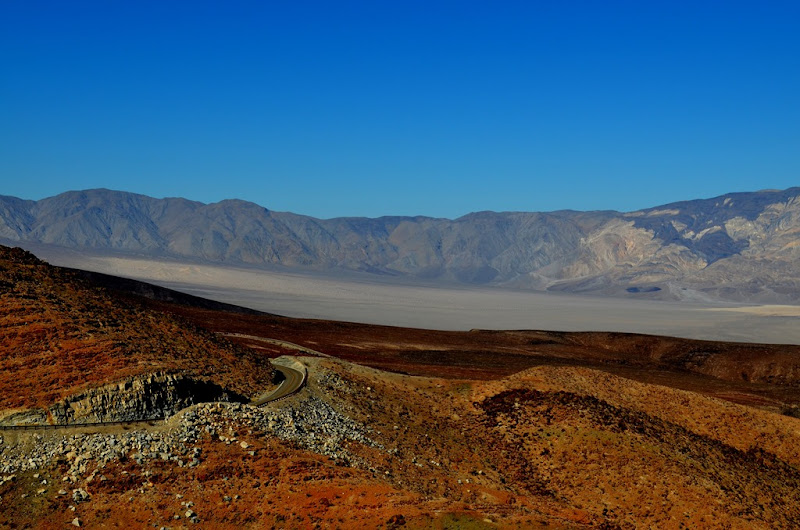
Aguereberry Point RoadThe road to the top is a bit scary, after all it is only a 4,000 foot drop or so on a narrow little dirt track up a very steep hill.  Driving is MUCH easier than being the passenger in these situations and today I was the passenger.  The view opened up before us, and even with the smoky haze generated by the southern California fires, the valley was breathtaking. We could see the oasis of Furnace Creek far below and the white hot playa of Badwater reflecting the sunlight.

Aguereberry Point RoadAnother worthy mention is that we had this entire complete trip to ourselves.  We saw one other car early on the Wildrose Road but they must have continued on the paved road and we never saw them again.  The town of Skidoo, and the viewpoint were completely our own, silent and gorgeous. 

most amazing find of the dayWe hiked around a bit, nagging Abby to stay away from the edges, when just around a rocky corner I found the most brilliant orange calochortus (Desert Mariposa Lily) I have ever seen.  There was just one on this rocky slope.  Later I read that these little flowers can wait for years for the right conditions to bloom and sometimes they cover entire hillside with orange glory.  What a sight!Aguereberry Point

The drive back down the hill seemed uneventful, until once again we rounded a curve and saw one of those wildly painted rental rv’s in the road.  It seemed to be in a weird position, and then suddenly we thought we saw smoke billowing up from beneath the rig and people bailing out.  Turned out the smoke was only dust, but scary anyway.  The big rental rig was seriously stuck with the back wheel spinning in a hole and the back sidewall of the rig firmly planted in dirt, rock. and shrubs.

uhoh on Aguereberry Point RoadWe stopped to help, thinking we would have to drive someone back to Stovepipe Wells, but the young German family was determined to get the rig out on their own. Remember that in all this time we hadn’t seen another vehicle, and none were traveling the paved road that we could see off in the distance.  In Death Valley it is a long way to nowhere, and cell phones don’t work.  We wouldn’t have left them there, of course, but neither of us were very optimistic that this wiry, small young father was going to get that thing unstuck.

yay! European family unstuck on Aguereberry Point RoadAfter more than an hour, suddenly dust billowed in the west and a big red pickup drove up with two big guys ready to help.  The one guy hollered at our little German guy, “It says cruise America in an rv, not bury it in the desert!”.  The German guy said, no, no, I think I can drive it out, and the big American guys just shrugged.  Sure enough, he has dug enough and in one hit on the accelerator he had that rig out of the hole.  The red truck drove off, and then the family was all happy and excited and we all hugged and cheered together. 

Wandering off in the desert is not something to take lightly.  Make sure you have water, a shovel would be smart of course, and none of us had one so the digging was done with hands and rocks.

Death Valley is so huge, and of course these stories are picture heavy, and we aren’t done for the day.  By the time we got back to camp it was over 100 degrees at sea level, even though the temperatures up on Wildrose Road had been in the mild mid 80’s.  We settled in for an afternoon nap under the air conditioning, and waited until 4 in the afternoon to head out on our next adventure: Titus Canyon.

map  to Aguereberry Point

Ambling around Bishop and Lone Pine

Current location: Furnace Creek Ranch, Death Valley, California; Current temperature: 101 degrees F Hi 102F Lo 70F
We are at the Furnace Creek Ranch RV Park hiding in the MoHo shelter with the air going full blast.  It isn’t very cool in here, but it is a good place to be at the moment, and lots better than outside.  The swimming pool is great as well.
desert peach in the SierrasWednesday morning May 1 in Bishop, CA
It is great to wake up in the morning after a good night’s sleep to know we have absolutely nowhere to be at any time at all.  We are hanging out in Bishop, a town we have traveled through often, but never really stopped to visit.  We knew that a few things were on the list, including a visit to a famous bakery and a drive into the mountains.  The rest of the day would be fleshed out after we checked out the lovely visitor center directly across the street from the previously mentioned bakery.
Day 4 Bishop_013DSC_0015The visitor center didn’t open until ten, and since it was only 9:30 we had no choice but to spend time in Schat’s Bakkery.  Awww…too bad.  even though the place was established in 1904, it is clear that now it caters to the tremendous tourist industry that plies the road between LA and Reno.  There is no way a tiny town of under 4,000 people could begin to support a bakery of this size and quality.  They are famous for their sheepherder bread, but the rest of the choices are fun as well.  We had a great pastry and sipped perfect coffees while we watched the tourists come and go with their big bags of bread and pastries.  I left with a bag of bread as well.
Day 4 a day in BishopMo parked at the visitor center, adjacent to the city park, with a large sign once again proclaiming “No Dogs”.  We keep seeing these signs in most of the small city parks along this route and it is a bit discouraging.  Mo waited in the car while I picked the brains of a very informative young woman, a local resident for her entire life.  She told us about some of the places to go, but more important she knew the history of the little Rovada Village that we had seen yesterday afternoon.  It was built by the owners of the Tungsten Mine up Pine Canyon, now closed because even though it was the largest tungsten mine in the US, it is cheaper to mine tungsten in China.  The village is a leftover, and consists of old, somewhat poorly kept rentals.  The young woman lived there until very recently, and didn’t think it was nearly as charming as it appeared to us yesterday as we drove through.  On our list today: drive the canyon to the tungsten mine.
great Bishop Dog ParkFirst things first, however.  We needed an Abby place, and just around the corner from the visitor center and city park we found a wonderful dog park.  There were even toys lying around, lots of doggie bags, grass and trees for shade.  Another young woman there with her dog told us that the locals all take their dogs on the road on either side of the canal, just 1/4 mile east of the park, where there are old cow wallows that are perfect for doggie swims.  Hmmm.  Maybe not today, but good to know.
galen-rowell-0By the time Abby had played to her heart’s content, it was time for the opening of the Mountain Light gallery down on Main Street.  No one except maybe Ansel Adams has photographed the Sierran light the way that Galen Rowell did.  His images are breathtaking, and the gallery was incredibly beautiful.  I have wanted his book, Mountain Light, since forever, and a 25th anniversary edition was right there in front of me.  Yes, I bought it.  Galen and his wife were killed sadly in small plane crash right here at the Bishop airport in 2002, but his legacy lives on, not only for the Sierra, but for all the other magical mountains in the world that he climbed and photographed.  I stayed in the gallery a long time while Mo waited patiently with Abby in the car and read brochures about more things to do in the area.
Round ValleyMid day we went back to the campground to enjoy the beautiful sunshine and rustling breezes before wandering off in the  opposite direction north of town to find Pine Canyon and the tungsten mine.  Bishop has a long history in cattle and mining, and the valley was once magnificent with the waters of the Owens River.  Now that river has been diverted for the thirsty developers in Los Angeles, and the valley looks nothing like it did before the 1920’s when the LA water district bought up all the water rights.  Our helpful history woman at the info center told us that Round Valley, on a narrow road west of 395, still was naturally sub irrigated, and looked like it did when her family ranched there 4 generations previous. 
Rovana village built by the mining companyWe drove through Rovada again with different eyes.  Yesterday we came through the town trying to find our campground, but that was just a little mistake.  Today it was on purpose.  Pine Canyon was beautiful, with huge glacial boulders strewn on the canyon floor and the steep crest of the eastern Sierra directly above us.  The natural stream has been diverted by the mining company, and according to our local resident, there is something in the soil, left over from mining, that interferes with growing veggies to any decent size. 
found a place where she could get in at least a little bitWe looked for a place to let Abby go swimming, and took some bumpy hidden old dirt paths that looked like they went to the river.  Once down there, we found some perfect spots, except they were completely taken over by large groups of campers.  Not RV types, but more like the kind of campers who might be living there permanently.  So much for a swim, Abby.  Near the diversion gate we did finally find a little place where she could at least get her feet wet, but the water was much too fast to let her get even knee deep.
desert peach on the east side of the SierrasThroughout the canyon we saw desert peach in full bloom.  Somehow I knew nothing of this common eastern Sierra shrub, in the prunus family, that has a bitter small fruit and blooms all over the hillsides in spring.  It stands out because it is so rare to get desert flowers that are this shade of pink.
Home in the afternoon to chicken quesadillas at our picnic table with cards and wine and more beautiful breezes.  I loved this little wayside park and am so glad that we decided to stay here more than just overnight.
Thursday morning we knew our travels to Death Valley would be less than 150 miles so we decided it was a good day to see some of the sites along Highway 395 we never seem to have time for.  Sabrina Canyon was first on the list, but after missing the turn in Bishop we ended up driving out to Keogh Hot Springs Campground and Resort.  A drive around was enough, and  I don’t think we really need to think about staying here.  The pool is developed from the spring and the place didn’t look very clean.  I would much rather have a natural spring or a really clean pool, no in between for me, I guess.
the cemetery at ManzanarA few more miles south and we passed the small town of Big Pine and then arrived at Manzanar.  This was our day to actually stop and go to the visitor center and drive the grounds.  The story is daunting, and the visitor center is filled with eloquent words and evocative photos and exhibits.
Day 4 D Valley_009DSC_0070There were ten “relocation centers” for American citizens who happened to be Japanese, and the largest of them was near where we live now in Tulelake.  Can you imagine having to suddenly leave your home and business with only what you could carry?  The homes and businesses were almost completely gone years later when the people were allowed to return after the war. Much to think about as we viewed the center and drove the now empty sites. 
Continuing south to our beloved Alabama Hills, we finally made the stop at the Film Museum in Lone Pine. The Hills are a primo boondocking site, and lots of RV folks have written about them, but once again, the museum was something we just hadn’t made time for in the past.  We parked in the nearly empty huge parking lot, in the shade of some big cottonwoods, and paid our 5. entrance fee to see the museum.
Day 5 Manzanar and into Death ValleyThe short movie about the area was fascinating.  As we went in and Mo saw all the huge movie posters, she was skeptical that there were really THAT many movies made in this area.  But there were.  Literally hundreds of them, especially in the heyday of the B westerns and then the TV era that was so dominated by western series.  My first radio memory was The Lone Ranger, and then TV brought old black and white films of Hopalong Cassidy, the Cisco Kid, and so many more.  It would be fun to have a list of all the movies made in the hills, but I didn’t actually see that anywhere amid the displays of posters and old cars and gun belts and sequined outfits that belonged to Roy Rogers and Dale Evans.  An era long gone, I am afraid.  It was a fun stop, but the only photos I took were of the murals on the outside walls.descent into the valley
The afternoon was waning and it was time to head east from Lone Pine on Highway 136 toward Death Valley.  Tonight, Stovepipe Wells and hopefully a site with hookups.  Reservations are not taken after April 30 at this park, but a phone call assured us that only 1 or 2 of the 14 available hookup sites were taken. 
We are ready for a few days in the beautiful valley of death, or as the Paiute’s and Shoshone’s called it, the Valley of Life.