My Turkish bath

One of the things I promised myself was a true Turkish bath. What better place to have this treat than near Heiropolis, the place where people have treated themselves to spas for a very long time. I read about the Turkish baths online at home, so had a general idea what to expect, but it still was an experience I wouldn’t have wanted to miss.

Here at the hotel, they have big fat Turkish terry bathrobes for everyone, and people just walk around in these robes, padding through the lobby and halls on the way to the spa. The spa is filled with cute little Turkish guys very skilled at selling you all the treatments, but I still managed to stay within my budget with a bath and Auyervedic massage.

I walk in, feeling a bit awkward in my robe, but my cute little Turkish guy leads me to a dressing room and then on to another room where a very tiny girl leads me to the bath. She will be my massage therapist as well, so she is my guide through the process. The bath itself is made of marble, with a huge marble slab in the middle of the room and deep marble basins with old copper pipes along the sides. It is quite dark and very steamy in the room, and very warm. She gestures to me to remove my robe and has me lie on the slab. I am the only one in the room besides her, so it is little less uncomfortable lying out there on a marble slab face up in my birthday suit. Hmm.

Next thing I know, she is running the faucets and filling two large metal bowls with very hot water and pouring them on my body rhythmically in pairs, arms, legs, sides, back, pouring over and over. The sheer volume of water and the height from which she pours is an experience in itself. Then she begins to scrub with a small loofa, until I have no skin left. I think, gee maybe enough in that spot, and just when I think I might have to say something she moves to another spot. Then more water, huge volumes of water again. Silence. Steam. Then she is back doing something strange with a Turkish towel and bubbles. I am on my stomach by this time so I can’t actually see what she is doing, but suddenly I am enveloped in thick, foamy, whip cream textured bubbles. She turns me over and covers me in more foam, soapy foam, again from the towel where she makes the bubbles somehow. The foamy bubbles as they hang over me from the towel are a huge clump about 1 foot in diameter and 2 feet high. They are warm as they fall on my body. Then she rubs in all the foam and in the dim light I look down at my foam covered body and the foam covered slab and laugh to think this is the best bubble bath I ever had! She then drops bubbles in my hair and washes my hair. Finally more water, many bowlfuls of water to get all that foam from my body and I am cleaner than I think I have ever been.

Wouldn’t have missed this experience for anything! The massage was wonderful, with hot oils and chakra balancing, gentle massage just firm enough to heal, but it wasn’t anything I hadn’t felt before. Huge clumps of bubbles falling from the sky on my body is definitely something I haven’t felt before. Great end to a relaxing day in Pamukkale.!

Eating and politics in Turkey

One of the interesting parts of this tour is our guide Suleyman. He is Turkish, and we found out yesterday, part Kurd, and Muslim. We get a view of his country from the inside. His knowledge of the history and politics of Turkey is truly impressive, and yet in no way is he any kind of intellectual. He’s really down to earth, and often very funny, with a dry wit that makes us laugh a lot. He also demands respect, standing at the front of the bus talking about one thing or another, if someone is chatting away he will clear his throat, look incredibly displeased, and say, “Excuse me, excuse me!!” before he will continue his stories.

One of his stories is regarding Turkey and the European Union. Its one thing to read in the guidebook and quite another to hear his version. Turkey has been in conversation with the EU for several years, with many people thinking that it would be a great thing to be part of the EU. However, it seems that the population of Turkey is about 75 million, and unlike many other European countries, Turkey still has a positive population growth. And of course, Turkey is 95 percent Islamic. This seems to make a lot of Europeans very uncomfortable, since Turkey would become the largest country in the EU in population, and would make the EU dominantly Islamic. Suleyman thought this was somewhat insulting, and said basically he didn’t want to be part of anything that didn’t want him for stupid reasons, aka “I don’t want to go to a party where I am not invited”. So the jury is still out on Turkey becoming part of the EU, but Suleyman thinks its not likely to happen in the next 10 years at least.

Another of Suleyman’s political discussion has to do with the Turks and the Kurds. He insists that Kurds are not a particular ethnic group, they are simply people who live in a particular part of the geography of Turkey, Iraq, and other parts of the Middle East. He says most Turks are Kurdish in some way or another, since people from the Kurdish part of Turkey have migrated to other parts of Turkey, especially Istanbul. He said his grandmother was Kurdish. Then he discussed the fundamentalist terrorist group in Eastern Turkey who is attempted to create a Kurdish state, and he dismissed this with a harrumph, and then under his breath in a very rapid comment mentioned that Turkey, with the support of the US, recently bombed some Kurdish outposts in western Iraq. He then changed the subject.

Television. All the big hotels boast cable TV. We think that is great, because it will give us a bit of something in English to help keep track of the world. Cable TV consists of the BBC, and sometimes the international version of CNN, and so far there has been very little news of anything at all except the terrorist attack in Mumbai, so we check in occasionally to get some news from the US. Here we have the BBC and 2 other channels in Turkish. Haven’t watched them much, although we aren’t in our room much either. I’m glad for the internet, since its great to be able to have a note from my kids to keep me connected and a bit grounded.

Food. I need to try to talk about the food. We have been eating fairly traditional Turkish food at the large buffets that are offered at our hotels for the evening meal most of the time. Of course, some versions are better than others and last night’s meal was really impressive. It is very nearly impossible to remember everything, but I am going to try to at least describe what it’s like to be eating here.

One thing that is a big part of Turkish meals are the cold salads, what Suleyman calls the “beginnings”. These often seem to be my favorite choices for the meals anyway, and the one thing always present is eggplant. The eggplant is thinly sliced lengthwise and grilled so it looks like a roasted pepper and served with cool tangy yogurt. There are long huge green beans seasoned with lots of olive oil. A fava bean salad with some onions and olive oil. A tomato salad that looks a bit like pica de gallo without the cilantro, lots of chopped tomatoes, some cucumbers, onions, and lots of broad leaf parsley. Dolmas. The dolmas last night were made of seasoned rice rolled into a softened cabbage leaf. The main seasoning in the rice is lemon and I think cumin, but I couldn’t identify it, even though it was really good. Then some kind of deep fried cauliflower, but not crisp, soft and lumpy, also served with yogurt. Shredded carrots and shredded beats drenched in vinegar, many kinds of olives and triangular cuts of goat cheese, some with red pepper, some with dill, others with more olive oil. Piles of diced very dark green lettuce and spinach that is really good. Huge red radish slices as big as a baseball if it were sliced, covered with chopped dark parsley. Cold boiled potatoes with mild seasonings that need a lot of salt to be good. Some kind of potato salad that has yogurt as the dressing with little cubes of potatoes, carrots, and peas.

Many kinds of bread, most of it fairly soft and not crusty, even though it looks as though it should be. The butter is usually not very good, so we use more dark green olive oil for the bread. Then the main dishes at the buffet are usually several kinds of stews, with lamb and beef and chicken and unidentifiable vegetables, often eggplant and mushrooms which I love and are the two things Mo doesn’t. Almost always are the meatballs, maybe beef, maybe lamb, and also in a tomato and eggplant stew. There is usually some kind of rice pilaf, quite dull without much flavor. Turkish flatbread, something like Indian nan, or a flour tortilla, filled with goat cheese and spinach and roasted on a hot pan like a quesadilla. In the midst of all this complicated food is a large pan of “chips”, great fat French fries that are light as a feather and perfectly cooked inside and crusty outside.

Desserts are all sorts of things with honey in common. Little cakes and madelines, soaked in honey, something like a pistachio baklava, but not as crusty, soaked in honey, little chocolate cakes, that aren’t sweet and stick to the roof of your mouth like peanut butter. Beautiful little lemon cakes that look wonderful and taste a bit like glue. Tangerines that are tart and fresh from the local trees. Once I had a pistachio vanilla custard that was to die for and a chocolate pudding that was equally wonderful. The big thing here is called “Turkish Delight” and is in all the stores. It is the present that you take when you go visiting, and Suleyman insists that whomever has the front seat in the bus is required to bring a box of pistachio Turkish delight. Now I know where Washington State’s applets and cotlets came from. They are nothing more than Turkish Delight Wenatchee style.

I am sure that the buffets are not the best to be found in Turkey, but no matter where we go this seems to be the style of food that we find. Even when we stop at “real” Turkish restaurants they have this buffet style of eating. The first day in Istanbul, when we ate at the Pudding Café, I think I had the best food I have had so far.

Day 9 Pamukkale and Heiropolis and the Spa

http://picasaweb.google.com/kyotesue/Day9PamukkaleAndHeiropolis#

Relaxing in Pamukkale with an afternoon appointment for a Turkish Bath and an Auruvedic Massage. Yes!

The travertine pools at Pamukkale have been a site for healing for a few thousand years or so. The geology of travertine wasn’t something I fully understood, so I had to go look it up.

Travertine is a kind of limestone deposited by springs. Groundwater traveling through limestone beds dissolves calcium carbonate, an environmentally sensitive process that depends on a delicate balance between temperature, water chemistry and carbon dioxide levels in the air. As the mineral-saturated water encounters surface conditions, this dissolved matter precipitates in thin layers of calcite or aragonite, two crystallographically different forms of calcium carbonate (CaCO3). With time, the minerals build up into deposits of travertine. It is an odd geological resource that can be harvested and renewed.

The region around Rome produces large travertine deposits that have been exploited for thousands of years. The stone is generally solid but has pore spaces and fossils that give the stone character. The name travertine comes from the ancient deposits on the Tibur River, hence lapis tiburtino.

Today we are at the Lycos River Hotel in Pamukkale. It’s the first fairly quiet day we have had since we left on this tour. Pamukkale is in a very rural part of Turkey near the city of Denizli, but the hotels are not even in Pamukkale. The hotels are associated with the springs and there are many here, of varying qualities and amenities, and all a mile or so from the village where most businesses are closed since the normal travel season ended back in October. I can see why as I viewed the snow on the mountains around the Meander River Valley were we are traveling. As has been the case all along on the trip, our hotel is adequate but certainly not luxurious. This morning was a bit dicey when I couldn’t get any hot water for about half an hour. Funny, since there are hot springs all around with water at 117 degrees F. Finally managed a lukewarm shower and out in a cold foggy morning for our visit to the famous travertine pools and hot springs, and the ruins of the city of Heiropolis.

In Hellenistic times, between 200 and 300 BCE or so, the thermal springs at Heiropolis made the city a popular spa area. Later on the Romans developed the city even more into a spa retreat, with huge baths and pools, libraries, and temples. There is a pool there now that is littered with marble columns where you can swim and dive, but on this day it was too cold to think of such a thing. The ruins are extensive here as well, and the artist rendition of what the city looked like in Roman times is amazing. The city is perched above the travertine terraces shaped like a semicircle, with another huge stadium on the hill, and a Necropolis outside the city that has the highest number of existing sarcophagus from ancient Anatolia. It has been quite a revelation to be in Turkey seeing so many ruins of ancient cities of Greek and Roman culture. Another interesting cultural note is that Suleyman insists that we refer specifically to Hellenistic culture aka 300 BCE, rather than “greek” culture. I think the Turks and the Greeks are not so friendly. Some of Suleyman’s wisecracking little remarks have been directed towards Greeks.

The skies were very gray and boring, and the wind was cold and the rain started while we were walking the ruins, so the photos are a bit dull. But even the dull skies couldn’t really detract from the physical geologic wonder of the travertines. Although I did buy postcards that show how gorgeous they are in the brilliant sunlight, all white against brilliant blue skies. No blue skies today, however, so we were glad to return to the hotel and our room, turn up the heat and do a bit a relaxing for a change. Tomorrow is another long day of travel back south to the Mediterranean coast and Antalya.

Day 8 Miletus and Didyma

http://picasaweb.google.com/kyotesue/28NovMiletusAndDidyma#

For some reason this day slipped by without leaving a lasting impression. Another day of ruins and blue skies and riding in the bus. The morning started again with bags outside the door at 630, breakfast at 7, on the bus by 8 and off we go again. This group is much too large, actually, with 43 people traveling together. It’s interesting to watch the interactions and the patience shortening, including mine. I’m still not impressed with this tour company, although Suleyman our guide is pretty impressive.

First thing on the road and we stopped at a leather factory. Once more an opportunity for the tour company to get their cut off what the tourists are willing to buy. Again, though, the show was fun, with all of us lined up along the runway while they played very loud rock music and flashed the lights and the models so we felt like we were at a real fashion show. The leather was beautiful as well, great craftsmanship, and of course, very expensive. Most touchable was the “silk” leather, as thin as a shirt, soft and buttery, and still strong and guaranteed waterproof. Several people bought nice coats and jackets, but in spite of how delightful it felt to try on the silk leather coat, I didn’t succumb to 700 American dollars for a jacket. Give me a break! It is fun watching the group buy things though, and everyone cheers when we get back in the bus and show our “stuff”.

We rode along the coast to the Hellenistic ruin at Melitus, most interesting for the view of the valley that was a bay at the time the city was built, but has since silted in to become a fertile agricultural landscape, much like the valley around Troy. The theater was again Hellenistic in style, built into the natural contours of the landscape.

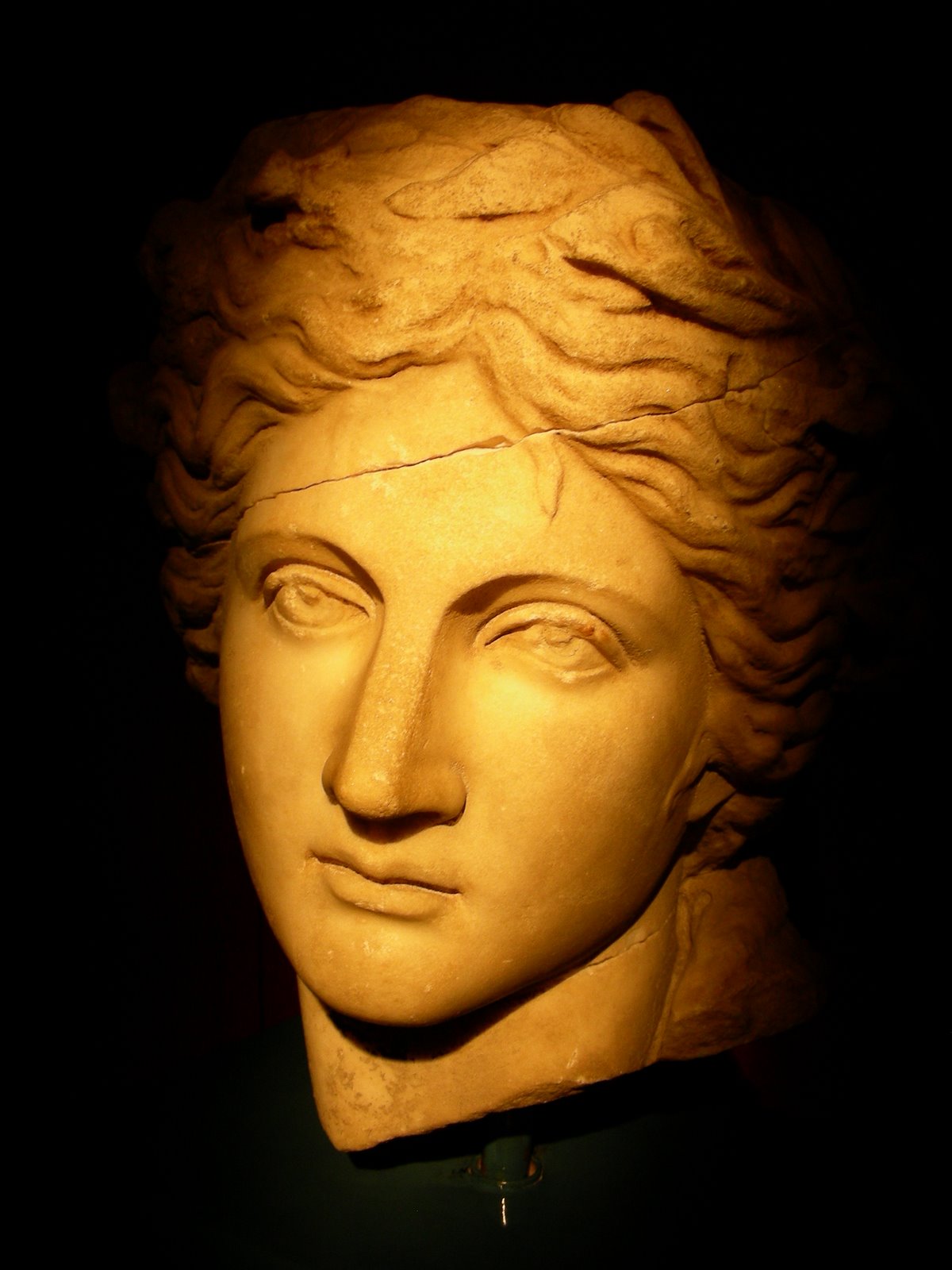
We then traveled to Didyma, a small village, noticing how simple and small most of the houses in Turkish villages are. Right in the village, behind a fence, is what is left of the Temple of Apollo at Didyma. Standing outside looking in doesn’t quite prepare you for how it feels inside this temple. The columns are huge, and the artwork is dramatic, including a gorgeous sculpture of the face of the Medussa that is beautiful. This temple was used to honor the god of prophecy and oracles and is thought to have been associated with the temple at Delphi, with priestesses dreaming and prophesying. After the prophesies, they would be written down and the books were stored here as well. The temple is constructed entirely of marble quarried from the nearby Lake Bafa area. The temple was built in the 7th century BC, and was one of the leading oracle shrines in the world. The temple was destroyed by the Pesians in the mid 6th century BC but was restored by Alexander the Great in 350 BC. With the coming if Christianity, the temple was converted to a church and was destroyed in 1493 by an earthquake. It is interesting that in Turkey, much of the history of these ruins and cities includes some kind of a statement, “destroyed by an earthquake in etc”.

As I have been traveling through this country I have been feeling often as though I was back in California. Today, searching the internet, I found that the San Andreas and the Anatolian fault are so similar that the USGS is studying the Anatolian Fault and sharing information hoping to understand both faults. Here in Turkey we have traveled through serpentines and metamorphic and metavolcanic rocks that are the identical twins of what I am working with in the foothill metamorphic belt back home in Sonora. Even the accreted terranes are every bit as complex as anything I am dealing with at home in my current soil survey. An accreted terrane is basically a little continent traveling and slamming up against another continent, and terranes are the main building blocks along the foothills of California and right here where I am in Turkey. It’s fascinating and fun for me, especially.

We had lunch at a small restaurant with another buffet and a Turkish “Efes” beer, (very good!) and more driving up the Meander River Valley to arrive at the Lycos River Hotel in Pamukkale after dark once more. I hate arriving anywhere after dark, with stacks of luggage and people milling about. Ugh. Did I mention the patience thing?

Day 7 Ephesus and Turkish Carpets

http://picasaweb.google.com/kyotesue/Day7EphesusAndTurkishCarpets#

Every year when we gather for
Thanksgiving, I ask my family to go through the ritual of saying what we are most thankful for that has passed in the previous year. I am sitting at the moment in a generic looking lobby of a resort hotel in Kusadasi, Turkey, thinking of my daughter in Klamath with the turkey in the oven and safe in a warm house. I am thankful that my family, each of them, has a safe warm home to live in, and good food to eat, and that I have a family. Truly thankful.
I am much less tired this evening than I was when we arrived here in Kusadasi. It’s nice to spend more than one night in a row in a place. Today Mo and I decided to skip out on one of the optional tours and just walk around town and check things out on our own. Nice. Kusadasi is a very popular beach resort town during the summertime, but at this time of year, things have quieted down a bit and it’s really quite lovely.
After breakfast today we all loaded up for the trip to Ephesus. In addition to the ruins, we saw the final home of Mary, Mother of Jesus, at least according to local legend and tradition. This is supposedly the place the John the Disciple brought the mother of Jesus to keep her safe and cared for until she died peacefully many years later. True or not, the shrine was lovely, beautiful and peaceful. Again, it was perched on top of the highest mountain around, with amazing views of the countryside and the distant Aegean Sea. From the road the ruins of Ephesus are visible, as a city much larger than what has been excavated so far.
I had no idea what to expect from Ephesus. I knew it was a cultural center during Hellenistic times, that it mentioned in the bible, that Paul wrote letters to the Ephesians, which I read several times as a teenager, but to be in the city of Ephesus was a surprise. At first, it was a bit of a disappointment. It would take a lot to outdo the magnificence of those huge white columns we saw yesterday at Pergamon, and from the upper road, Ephesus isn’t very impressive. But as we continued to walk the old roads, deeper and deeper into the city, it was more and more obvious what a large, impressive, and civilized city this once was. We saw the baths, the latrines were good for a laugh, with our tour guide demonstrating how they were used as gathering places for the men. The library at Ephesus is truly impressive, magnificent, although much smaller than the one at Pergamon, where there were 200,000 volumes. Here at Ephesus, there were merely 20,000 books, but the edifice is incredibly beautiful. It amazed me to see how the archaeologists manage to piece the puzzle together as they reconstruct this city from the rubble and tumbled pieces of marble and stone.

The theater at Ephesus seated 22,000 people, and was built again in the Hellenistic style that fits the contours of the landscape. For my daughter, Melody, and for her friends in the theater, I took pictures of the backstage area at the theater in Ephesus, the place where there were only comedies and tragedies. Only later with the Romans were the lions and the gladiators brought in. The Greeks were so civilized. The pillars supporting the stage were still there, but after the Romans came, the lower seats were converted to a wall so that the wild animals wouldn’t harm the people in the stadium. You could see the doors where the lions entered the arena. It was interesting seeing the evolution of this magnificent city from a place of learning and culture to a place of Roman sports and indulgence. Ephesus was a surprising wonder.
After our tour of the ruined city, we went to a carpet dealer. I know it might be fun to sit in a little shop in Istanbul and buy a carpet, but I’m still not so sophisticated that I didn’t appreciate a little help. Of course the tour company gets a cut of whatever we buy, it’s like that no matter where we travel, but it still was a lot of fun and a great show. They had carpet weavers making several different kinds of carpets and explained the details of those differences, including the number of knots, the fibers and dyes used, and where the different styles originate. Then while we had a great lunch of Turkish pizza, cheese rolls and beer, we were wooed with a display of Turkish carpets that took my breath away. The emcee started simply, with a discussion of the simplest killims, and went on to talk about silk carpets that have hundreds of knots per inch and the skill needed to make these kinds of carpets. Then the show began. Men came out in groups with carpets, throwing them out on the floor with a flourish, one after the other, more and more, all on top of each other. The colors were thrilling, and then he said, take of your shoes and walk on them, so of course, sensory me again, was walking barefoot over thick silk carpets that went for 32,000 US dollars. What fun! I came on this trip, knowing down inside me somewhere that I would buy a carpet, and sure enough the silk ones caught my heart. Also they caught my breath when the one I truly loved was priced at 4400 US. Maybe not. So then the tiniest one, a lovely piece of silk artistry that I could hang on the wall, maybe a foot by two feet, was 1100 US. Maybe not. Ahh well, they were lovely to look at and wonderful to feel beneath my feet. And yes, I did buy a carpet, a keepsake for a lifetime from this delightful country. Only my carpet is wool on wool with only a couple hundred knots per inch, but it isn’t even dyed, it is made from the natural colored wools of the sheep. I am tickled. Included in the price is the customs, the taxes, the shipping, and in a couple of months my carpet will be delivered to my door fedex. Another nice thing about settling for the tourist carpet thing. It was surprising to see how many people in our group bought carpets, some more than one, and my fellow soil scientist bought one that was 10×12 for their lovely hardwood floors back in North Dakota. Glad I don’t have to pay that bill!!

After the carpet venture, we sipped on Turkish coffee and waited for our van. The van driver’s name was Abdul, and he turned out to be our very own scenery man, a much better trip than the bus to the “village” would have been. He took the 6 of us around the hills to high points over the sea and we got some gorgeous photos of the Aegean we wouldn’t have seen any other way. Home to our hotel, we unloaded our bags, and headed back out to walk the promenade, find a supermarket and a pharmacy, and enjoy the feel of the city, and the gorgeous views along the beach. It was a wonderful way to end the day, with the long walk, and back to the hotel room for a rest before dinner.
This hotel room is way too big, with two rooms, a suite actually, a huge hall, and still you can’t get two people in the bathroom at once. Very funny. But we have big windows that we can open, fresh air, and a view of the sea from the balcony if not from the room itself. Tomorrow we continue on to Pamukkale, although what else is on the menu is completely gone from my memory. Guess we will just get up, put the bags outside the door, and see what the day has to offer.