Currently we are in Summer Lake Oregon Cloudy High 64 low 32 currently 48 We are heading back to Rocky Point this afternoon
Saturday May 25 Mostly Sunny High 58 Low 37
 When the animal alarms went off at 5:30 this morning I looked outside to see crystal clear skies and a sun already nearly over the eastern face of the mountain. The magic hour, morning light. Rather than dawdle around, we got up and dressed, had our morning coffee and breakfast and were on the road east to Hart Mountain by 7am.
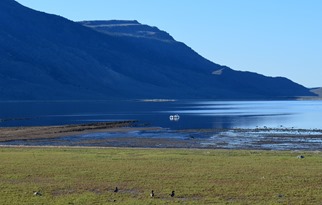 The road to Hart Mountain follows a track east from Plush, past old homesteads and hay ground, through the Warner Wetlands and along the northern edge of Hart Lake before turning to gravel. I am a sign junkie, so was tickled to find the wetland interpretive sign I had seen somewhere in a brochure. I didn’t realize that the Visitor Information Center was simply a series of kiosks and some shade shelters with signs.
 I discovered once again why I need a fast! and much better telephoto for my Nikon 5100 than the cheapie one that I have. Those birds just refuse to come into proper focus no matter how many shots I try. No tripod probably doesn’t help, but I think it has something to do with the autofocus as well. When I manual focus it isn’t any better. Ah well, an Erin I will never be. Still, I included some of the photos just for fun to remember who was hanging around the wetlands.
 We continued north along the road, coming to the Hart Mountain Antelope Refuge entrance sign, with a small campground just inside the boundary called Camp Hart Mountain. Surprisingly, this nice little camp is just a step up from boondocking, and still free.
 The host couple told us that the Fish and Wildlife Service can’t figure out what to charge, so they left it free. There is potable water at the main shelter with picnic tables inside, very large open sites, and as I mentioned, a camp host. Nice for those long days when you leave your rig to go exploring on roads you might not want to take the big shiny RV.
 Continuing up the road as it passes along the east side of the Warner Wetlands, we saw a few other boondocking opportunities on some BLM land along the lakes, but the east side of the road is all refuge and not open to parking. As we started up the steep hill east into the refuge, we saw a small sign, “Warner Overlook”. Perfect place for a short hike to the viewpoint on a gorgeous morning.
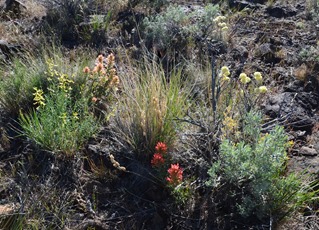
 The desert stretches to the west, and the complexity of the Warner Wetlands follows the base of the ridge as far north as we could see. An interesting phenomena was the “bathtub ring” left along Poker Jim Ridge left behind when the huge Miocene lake receded as the climate went from moist tropical to dry desert over a few million years. There were lots of flowers blooming on the ridge, mostly varieties of Indian Paintbrush and buckwheats. It was a delightful walk.
 Continuing east into the refuge, the road is still gravel, but very steep until it tops over the uplifted ridge and the eastern desert stretches to the distant Steens. The Scenic Backway continues along this gravel and dirt road for many miles, all the way to French Glen at the base of the Steens. It is a beautiful drive. I have a friend from Rocky Point who said she and her husband towed their fifth wheel all the way to French Glen across this road, nearly 100 miles, but they would probably never do it again. I have no desire to ever take the MoHo even as far as the Refuge Headquarters just 20 miles or so from the valley!
 We decided to drive the Blue Sky road along the eastern edge of the refuge early in the day in order to see more wildlife and catch the early light. We hoped that this time we would be able to continue all the way around and connect up with the Hot Springs Campground in a full loop. We were a bit too early for many of the side roads which were still gated closed, including Skyline Drive, Black Canyon Road, and Old Military Road.
 It was on the southernmost edge of our drive that we saw the most wildlife. Pronghorn are not technically an antelope, although the refuge is actually called an antelope refuge. This time of year the herds are fawning and so are more dispersed than usual when hundreds of individuals can be seen racing across the hills. Pronghorn actually developed their incredible speed during a time when there were two species of cats similar to cheetahs that were their main predators. They can run up to 45 miles per hour. Combined with keen vision and speed, they are usually only subject to predation when very young or ill.
 The other wildlife species that is especially important on this refuge are the sage grouse, with a drumming chest and elaborate spring strut that is a renowned spectacle in the high desert springtime. We were a bit late for the courtship rituals, which occur in March and April. We didn’t see any sage grouse, but what we did see was gorgeous desert habitat thick with abundant grasses, healthy because no livestock grazing has been allowed in this refuge since 1994. We also saw areas that had been burned, as part of the habitat management to encourage more grasses and to stop sage from encroaching on the lush meadows, so important for the pronghorn.
 Continuing west toward the base of Hart Mountain’s east slope, we saw only 2 other people, a couple of guys on 4 wheelers. There are stern rules about not going off road, and it appeared that these guys were obeying the rules. The rest of the morning we had to ourselves. Keep in mind that this was Memorial Day Weekend, and people were few and far between. The last time we camped at this refuge was Labor Day in 2004, and back then it was just as quiet, with just a few campers in the Hot Springs campground.
 At the turn to what is called Blue Sky Camp and the road to Warner Peak, we were again stopped by road closed signs, and most disappointing of all, the road to Hot Springs was closed as well. Seems as though the only time of year to make this loop in a vehicle would be after August and before the fall snows. We had hiked the road from the campground end when we were here before, but this was just a day trip, and that hike wasn’t on the agenda for us.
We returned the way we had come, stopping to try out another side road that was open and on the map appeared to continue across the ridge. Instead it stopped at a small rather nondescript little meadow at a place called Robinson Draw Day Use Area. Ok then. We used the day use area to have our snacks in the car and then drove back out to the main road and headed back toward the turn to Hot Springs Campground.
 The road into the campground was as we remembered, more decently maintained gravel for a few miles before you rise over a ridge and see the campground and meadow hot springs spread out beautifully below the snowy mountain above. I was excited about the hot springs, with wonderful memories of the white sandy bottom of the natural spring out in the meadow.
We drove around the campground a bit, checking out the camp sites, including the one we used so many years ago. With the recent burning of sagebrush, it didn’t look very appealing, and another area had been opened up along another draw that seems a bit claustrophobic along the brushy creek.
 Finally we parked at the beautiful hot spring, surrounded by a stone wall erected many years ago by the Order of the Antelope. The spring itself is about a 8 x 10 foot rocky hole in the ground and the water is only about 97 degrees F at this time of year. It didn’t look particularly inviting at the moment, although I do remember great soaks there when we were here before. Instead, I wanted to wander out into the meadow to find my favorite little spring. There is was, a bit bigger than it used to be and a lot siltier. I ran back to the car to get a suit on and by the time I got back to the spring there was a bather already settled into the little pool.
 Hot Spring culture is often dominated by natural sorts of folks who really like to soak sans clothing and this was no exception. The nice guy floated in the water and was very friendly and conversational with me while his parts floated conveniently just below the surface. I wasn’t too anxious to jump in with him, but I sat on the edge of the grass and dangled my legs while we talked for some time about the springs and he pointed out the next small spring up the meadow.
 I wandered off to check out the spring, but it was incredibly small, with three different streams entering of different temperatures, and the only hot clean spot was about 2 feet wide and surrounded by saturated deep grass. Nah, maybe not. Then, as I turned around to walk back, I saw that the single bather at the first pool was leaving. Mo had been walking around with Abby, (she isn’t much of a hot springer), and I called her to bring the camera. I was getting in that pool and wanted the photo to prove it! Sure enough, it was warm, about 103 or 104, and while the silt on the bottom made it seem a bit murky, just under the silt was that nice hard sand I remembered.
 Abby decided that the pool was a little bit strange, with all that warm water, and I got her in, but not for long. It was wonderful to be in the hot water, with great minerals and no smell at all. There wasn’t a sign of sulfur in the water. and after it settled a bit, the water was crystal clear. My friendly bather had stirred up all the silt, I guess just to get a mud bath or something, but by the time I finished soaking the water had cleared beautifully. ahhh.
 We drove back out of the campground road, stopped at the refuge headquarters to talk about antelope and weather, and found that it had been 11 degrees F the morning before. Sure am glad we didn’t try to camp there then! It can be cold in these deserts! I picked up some brochures about the local birds and wildlife, and found a nice little brochure that lists 12 different day hikes that are available. There are also more than 200 bird species that have been recorded in the refuge and another brochure has a handy bird checklist.
 We decided to take the road north to Petroglyph Lake with a short 4 mile hike that leads to petroglyphs on the basalt walls on the north side of the lake. Instead, we found that the rough basalt rocks in the road were too much to try to do with a patched spare tire, and with several cars parked just beyond where we could drive, we decided that it wasn’t worth it. There were a bunch of hikers getting ready to do the trip with packs and walking sticks and it wasn’t exciting enough for us to deal with the people. I guess we are getting spoiled with all this alone time and space and people seem like a jarring intrusion somehow.
 We drove back down the steep gravel road with the gorgeous vistas of the Warner Wetlands and the desert, overlooking the distant sunstone digging area where we were yesterday, the white trailers just tiny dots on the horizon. On the way down, we saw a little sign to Warner Pond Day Use Area, and flipped a quick turn to follow a steep dirt road back up the face of the mountain slope. This road was really steep, and even in 4 wheel drive, the little Tracker did a bit of slipping and sliding. At the end of the road, however, was a precious jewel of a tiny fishing pond, even with a dock to launch a boat! We wondered just how anyone would haul a boat up that road unless it was on the top of their pickup.
 Our hiking on this trip has been limited for reasons not mentioned until now. When cleaning house before we left, I was rushing around the kitchen and slipped on the wet floor and slammed my foot into something or other, who knows. Mo was gone, I laid on the floor for a few minutes feeling sorry for myself, and my foot turned blue half way up the midstep. I think I broke my big toe. Not particularly fun, and not particularly conducive to any kind of lengthy hiking trips. At least I can still walk, but thought I might mention why we haven’t been doing much hiking on this trip.
 We traveled back home along the same route to our lovely boondock site, still empty and quiet and cool enough for Jeremy. The weather had cooled quite a bit and it looked like rain, so we settled in to relax, read, and nap till dinnertime. It would be Jeremy’s last day of desert freedom since our next stop will be in Summer Lake at an RV park, not likely a place where we can just let Jeremy out to play so easily. By late afternoon a few pickups and 4 wheelers drove past our campsite, waving to us, but no one attempted to infringe on our nice open boondock site. The site is big enough to easily accommodate several rigs, so I am glad no one decided to bother us.


 Several times in the last few years we have cancelled an August camping trip to one place or another due to smoke, and some of you may remember our travels last summer in the upper West that were marred by smoke from huge fires in Idaho and Montana. There are many good resources to help keep track of fires and smoke, the best of which is found at the Incident Information website, http://www.inciweb.org. This year, however, it was several days before the webmasters of this amazing site were able to keep up to date with all the rapidly changing information for the Douglas Complex fires. Another very helpful website related to fire and smoke is on Weather Underground, where the WunderMap for an area has a layer for active fires that shows the current fire situation and the extent of smoke cover.
  Our main goal for the trip was to make sure we got the wood split from the trees we took down last month before it got too dry. Mo loaded up the splitter in the big trailer and hooked it up to the truck for the trip. We took the MoHo since daughter Deb is now living in the little cottage (one bedroom only) and we didn’t want to completely invade her space.
  It turned out to be an incredibly productive trip, in spite of the heavy smoke. We got all the wood split, with close to a cord of oak and about 3/4 cord of madrone, probably the best firewood around in Oregon. The big rounds were heavy, but with the three of us working, (Mo does the splitting part) we managed to get it all done on the first day we were there. We have a good ten cords stored here at home already, so plan to let the hardwood dry at the cottage before bringing it back here in a year or so. We heat with wood in Rocky Point, but the cottage has a gas heater that works just fine. No fireplace.
 Deb and I managed to get a full load of metal for the recyclers and made almost enough money to pay for the full load that we took to the dump the next morning. I have no idea how many dump loads we have hauled out of that place, but sooner or later we will get it all cleaned up. In the midst of all the work, we cooked some good meals and enjoyed sitting at the table in the old fashioned kitchen in front of the windows. Deb and I took time to play some rousing games of Hand and Foot, my favorite! I taught her how, but she is fast catching up to me. Dang!


 So my afternoon soak with Nancy was the second of the day for me. What an amazing treat! After paddling back to the campground, we all settled in on the beach with the dogs and balls, and Nancy and I even braved the chilly waters for some swimming. A bit later I thought it might be interesting to see how Jeremy was in the kayak and that turned out great. He did really well, but finally decided that he wanted to leap back to shore. It is said that Turkish Angora kitties love to swim and Jeremy may have not loved it, but he definitely was a great swimmer. He kept his head above water and just swam into shore. He may have been a bit indignant, and he was definitely a bag of bones with all that wet fur, but he didn’t seem to mind that much. I took him in a couple more times and he proved his swimming abilities quite well.


 The Hogback road goes north from our boondock site near Plush and eventually will hook up to Highway 395 near Abert Rim, famous for hang gliding jumps. The Sunstone area is east of the Hogback, and the several roads and turns are actually well marked if you pay attention. Nice sized signs saying “Sunstone Area” are at each turn. The roads are all gravel, not dirt, and they are rough, with sharp stones. We had a spare tire, but if we did this again we might think about bringing two spares.


 The MoHo and Other Traveling Tales


