07-16-2020 Exploring the Lakes and an Evening Kayak

Our plan when we went to bed was to rise early, eat a decent breakfast, and get on the road quickly.  We wanted to arrive at Elk Lake, our chosen location for a morning kayak, before the winds started up and the sun got too hot.  Even though the temperatures in this part on the east side of the Cascades are a bit more moderated than the part of Southern Oregon where we live, it can still get hot.  Predictions were for another gorgeous sunny day with highs in the upper 80’s.

Elk Lake Sunset  View Day Use Area

I completed a lot of internet research on most of the lakes in the chain before we left home.  There was no way to do any last minute research however, since I had no access to the internet at the campground.  I had 2 bars of 4G which could manage telephone calls and text messages, see emails but not their complete contents, and see some posts on Facebook for random moments in the early part of the day.

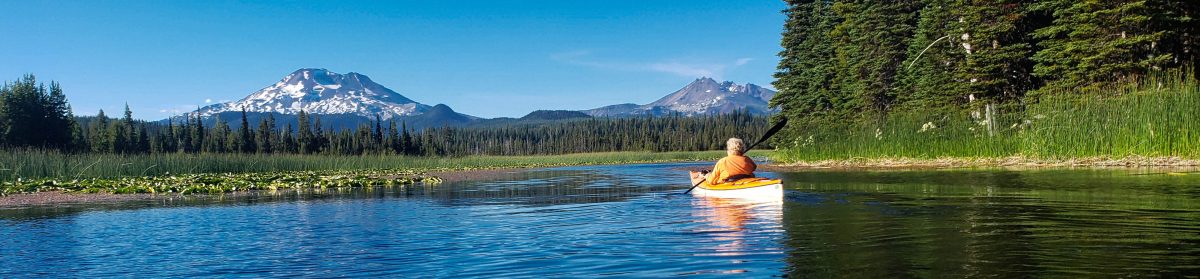
My research pointed me to Elk Lake, which in internet photos looks deep and blue surrounded by the gorgeous peaks of South Sister and Broken Top.  I was at least smart enough to download the google maps for the area before we left home in Grants Pass so we could navigate properly along the entire length of the Byway. 

We were on the road by 8:30, with only a slight breeze, and decided to skip exploring any of the lakes and campgrounds along our route so that we could get on Elk Lake early.  The road into Elk Lake Sunset View Day use area from the north is rough gravel, with some steep areas and sections of washboard.  I’m glad we didn’t plan to take the MoHo back there.

When we arrived at the site, it was gorgeous as expected, but the winds were kicking up and to our great surprise, there were a lot of people already in the parking lot, at the picnic tables, and launching all manner of kayaks and paddle boards.  I had no clue that many paddle boards are now of the blow up variety, and the whooshing sound of the pumps was a bit startling. 

We looked around a bit, checking out the outlandishly beautiful people with their beautiful rigs and boats and thought, “Hmmm, a LOT of well to do people around here.”  That was to be our refrain for the entire day as we traveled to the several lakes and view sites along the Cascade Lakes Highway, and the closer we got to Bend, it seemed the people were even more fit, attractive, and on the young side.  I have nothing against young, attractive, fit people, in fact it is great to see so many humans enjoying outdoor pursuits, but it was still a bit daunting, and not particularly our scene.  In addition, the lake was another big round body of water without a lot of interesting shoreline. 

We decided instead to continue south back toward the Hosmer Lake Loop and check out some of the campgrounds along the way.  We thought maybe we could launch on tiny Hosmer Lake before continuing our explorations.  We checked out Little Fawn campground on the south end of Elk Lake, but it was dusty and rocky, completely full, and quite a distance from the water.  The day use area by the campground was also full of cars, and more people packing their paddle boards and kayaks the several hundred yards across exposed lakebed toward the waters of Elk Lake.  Nope, not our spot for either kayaking OR camping.

When we arrived at the South Campground near Hosmer Lake we found more dusty, rocky, gravel roads and more people packed into the cramped sites with all sorts of watercraft.  Ah well, we weren’t planning on camping, just hoping to get on the waters with our boats before the day got too warm to enjoy.

What a surprise when we arrived at the tiny, cramped boat launch to discover at least 50 cars, all packing in and lining up one by one as we arrived all the way back to the intersection between the launch and the campground.  The lake looked like a playground of boats, paddleboards, fishermen, and people!  I walked down to the launch and talked to a few people, asking if they knew the lake. Five of the several people I talked to said it was their first time on this particular lake, and 3 said they had never kayaked before and this was their first kayak!.  Much like RVing, I think active people who want to get out and about have discovered kayaking.

Sadly, we decided to let this lake go as well, but as we were leaving Mo said, “I wonder when all these people will go home?”.  Since it seemed most were on day excursions from Bend, the likelihood of the place being this crowded in late evening was slight.  We decided to take our chances and finish our explorations of the other lakes and campgrounds in the area before going back home to our camp. 

We checked out the campgrounds and RV resorts at Lava Lake, at Little Lava Lake where the Deschutes River begins, and then turned back north to find Sparks Lake at the base of Mt Bachelor near the northern end of the Cascade Lakes Scenic Byway.

Little Lava Lake

Little Lava Lake was quite lovely, and a few campsites were a bit tempting.  We also thought if we didn’t find somewhere else to kayak we might return to the shallow beach at the boat launch site. I started keeping track of the campsites that we would choose at Little Lava Lake Campground if they became available for the next time we wanted to camp and kayak in the area.  If one should wish to camp, the good level sites at Little Lava Lake are #10, #11, #13, and #15.  Others are small and very uneven.

Lava Lake

The Lava Lake campground also had just one site along the edge of the lake but I didn’t write down the number because the lake was a lovely shade of green!  Maybe we didn’t want to camp there ever. 

Back north again toward Elk Lake, we checked out the Elk Lake Campground and found sites #7, #8, and #13 to be the only acceptable sites that would tempt us away from our home base at Crane Prairie some time in the future.  

We drove on north again toward Sparks Lake, and there was a beautiful wide viewpoint at the Green Lakes trailhead that climbs toward South Sister.  Only problem was that cars were lined up all along the road for about a mile on either side of the trailhead. 

A very popular place on a Thursday in July!  We pulled into the parking area across from the trailhead, noticed the sign saying parking allowed for 15 minutes only, and took every precious minute to hike into the meadow full of penstemon and sedges with Mattie.  The view of South Sister to the north and Mt Bachelor to the southeast were breathtaking.  No wonder this is such a popular place only 30 some miles from Bend, Oregon.

After our little walk, we traveled the very rough and rocky road from the highway to Sparks Lake.  The campground is called Soda Creek, and is a few miles from the lake.  We chose sites #4, #6, #10, and #13 for future reference.  We discovered a few rigs parked in a dispersed camping area on the extremely dusty and busy road to the boat launch on Sparks Lake.  Even free, with a view of the lake, wouldn’t tempt us to camp there in all that dust and noise. The lake itself was also incredibly crowded with kayakers and paddleboarders, and the water was quite low.  Pretty, but not for us.  With the crowded parking lot and thick dust, we didn’t get out of the car for photos, but this website has some lovely pictures of the lake and the area nearby.

As the day progressed, and we viewed so many lakes and campgrounds, we decided that we were really lucky to be in the lovely, spacious, open, and reasonably quiet campground at Crane Prairie Reservoir.  From the internet research, I never would have chosen Crane Prairie, but after visiting, it will no doubt be the campground to which we return in the future.  Just for reference, our favorite sites at Crane Prairie are #103, the ADA site #107, and #113.  All of these sites are on the Blue Loop, but for big rigs and family groups the Red loop at the upper edges of the park have the most privacy and space, but no view of the water or easy access to the beach. The Red loop also has several large nice pull through sites.

By the time we returned back to camp, it was 1 or so, and again we settled in with our books and cool drinks to enjoy the breezes and shade as we read.  I spent more time gazing at the water than actually reading I think.  We also took Mattie for another swim.  She went in at first, but wasn’t as enthusiastic this time as she was yesterday.

We ate an early supper and planned to leave after dinner in time to arrive at Hosmer Lake around 6:30. This time our plans worked out perfectly.  When we arrived at the boat launch there were less than half a dozen cars and only a few people coming off the lake, and only a very few launching for an evening on the water.

Hosmer Lake turned out to be everything I had expected to find in the Cascade Lakes.  The water was crystal clear, and the lake meanders from a small lower lake, through a narrow channel lined with bullrush and wocus and then meanders northeast toward a rugged area of lava which hides a waterfall. 

We didn’t get out of the boats to see the waterfall.  A fellow boater told us that it was pretty, but not spectacular, and required some hiking through the rocky jumble to see it.  We sat awhile trying to hear it to no avail.

We continued back to the main channel and continued north to the lake.  I asked a couple of returning kayakers if the lake was very far away.  One person said it was a long distance, and another said it was just ahead.  My trusty google map wasn’t exactly visible in the bright late evening light and the lake shows quite dark and green on the current google image.  To our surprise we arrived at the large part of the lake within 15 minutes and it was truly gorgeous.  The water was clear and somewhat shallow, surrounded by nothing except timber, mountain views, and marshland. 

One lone boat with two men fly fishing were spotlighted by the early evening sun.  Hosmer Lake is exactly the kind of place we love to kayak, and we will definitely return in the future, hopefully during a time of year when there are a few less visitors.

After only an hour and a half on the lake, we were back home at our camp by 8:30, as the winds started to die down and the sun set at 8:47.  I knew the exact time of the sunset because I also knew that the comet Neowise was expected to be visible in the northwest sky about 90 minutes after sunset.  Mo built another nice campfire and we sat with our wine and marshmallows waiting for darkness and a chance to see the comet.

We weren’t disappointed.  Walking down to the beach, we hunted the skies for the Big Dipper which seemed to be in the wrong place compared to what we are used to in Grants Pass.  After a bit of searching, we saw the comet. It was somewhat faint in the still glowing northwestern skies, but we could see the comet and the tail if we looked carefully.  There was no way I could get any kind of photo, but there are so many great ones that people have posted that I didn’t feel like we missed much.  At least we got to see in in person.  Later, when we returned to Grants Pass, even though the comet was supposedly visible, we never saw it again.  In Grants Pass we are in the western part of the time zone and at the time that the comet is visible, there is still considerable light.  There also was a bit of haze from a California fire and of course the lights from the small city of Grants Pass are still bright enough to cause some interference.  I was glad we were in the mountains with less ambient light for at least one night so that we saw the comet.  I doubt either of us will be around in just under 7,000 years when it returns.

After three days we deemed our Cascade Lakes National Scenic Byway trip to be a great success. We settled into bed after our long day and evening knowing we had until noon to have a leisurely breakfast the next morning before breaking camp and traveling south toward Klamath Falls for another night out before going over the pass toward home.

07-15-2020 A Day at Crane Prairie Reservoir

Crane Prairie Reservoir is a large, shallow reservoir  created in 1922

We woke slowly after such a dark and quiet night.  There are so many different lakes in the chains of Cascade Lakes that we had to make a decision whether we wanted to explore or to stay home on our firs day.  After spending yesterday driving, we decided that we would stay home and enjoy our local campground and lake for a day before attempting to explore any more of the beautiful Cascade Lakes that were scattered along the Cascade Lakes Highway
Kayaking in the early part of the day always seems best.  Usually the winds aren’t strong and the sun is still not high overhead.  It can get really hot out on the water in a kayak without much protection.  We launched right after morning coffee with a plan to stay out on the water for a reasonable amount of time and then return home for a more substantial breakfast.

It was a personal test for me.  Could I still manage to get in and out of the kayak?  On the previous day, when we loaded up the boats at home, I was relieved to find out that lifting the boat and strapping it down didn’t cause me any problems.  My arms are still strong enough and my legs can still hold me up ok for that job, especially early in the morning when I am strongest.  The test yet to come was getting back out of the boat, and that thought was in the back of my mind as we slid out onto the water.  Getting into the boat wasn’t a problem at all with the shallow, sandy beach. 

Notice the underwater fire pit

South Sister on the left, Broken top in the middle, and Mt Bachelor (famous ski mountain) on the right

Before the dam was built in 1922, the area was covered by prairie and served as a habitat for cranes, which was the inspiration for the name of the lake. The construction of the original rock-filled dam flooded most of Crane Prairie and parts of the nearby forest, killing many trees. In order to recover timber, the reservoir was drained on a regular basis. Because of leakage through the original rock-filled dam, in 1940 the Bureau of Reclamation rebuilt the dam as an earthfill structure 36 feet in height and 285 feet in length. When full, the reservoir has a capacity of 55,300 acre feet.

Crane Prairie Reservoir is part of the larger Deschutes Project by the Bureau of Reclamation, which also includes Wickiup Reservoir, Haystack Reservoir, the Crooked River Pumping Plant, and North Unit Main Canal. The project was created to supply irrigation water for a total of 97,000 acres of land in the vicinity of the town of Madras which is north of Bend, Oregon.

In late summer, the reservoir is lowered as water for irrigation is withdrawn from it, leaving large areas of the lakebed exposed. We were especially lucky on this trip because our timing was just right.  The lake was very full, and yet as we drove past Wickiup on our way south, that reservoir was so low there was no water at the west end. Both lakes have moderately alkaline water with a high mineral content, slightly higher than the waters of other lakes in the region. Sometimes during the summer the water’s pH level is exceptionally high, caused by the algae that often reach bloom proportions. Much like Klamath Lake, phosphorus concentration in the lake is high and the lake will sometimes turn green as pea soup.  Our camp host told us that about two week previous to our visit the lake was completely green. One of the issues with having to make reservations to camp at any of the local campgrounds is that there is no way of knowing when you make the reservation whether the lake will be low and the water might be green. 

We discovered that Crane Prairie Reservoir is one of the most important wildlife viewing areas in central Oregon. The lake is dotted with tall stumps of the flooded trees which now provide nesting places for osprey and the reservoir is home to the largest nesting colony in the Pacific Northwest. Other species of birds include bald eagles, cormorants, blue herons, kingfishers, sandhill cranes, and Canada geese. In 1970, the Crane Prairie Osprey Management Area was established here to protect this special haven.

On our first morning kayaking the lake, we paddled south toward the outlet of the Deschutes River.  Our plan was to stay out only an hour before turning back, making sure that all my parts were working properly and that I wouldn’t get worn out so much I couldn’t get out of the boat.

It was a lovely paddle, with mostly calm winds and clear water until we approached the southern end of the lake where algae was accumulating in the water and the bugs found us.  As the sun rose higher, it was time to turn around.  We didn’t make it all the way to the river, but there is always next time.  We did see an eagle, cormorants, ospreys, and several types of ducks. 

Once we got back to our little beach, I made a small attempt to rise from my boat, and realized that my original plan for getting out of the kayak was needed.  I simply slid my legs over the side and rolled into the water on my knees.  It worked perfectly.  Looks like I will be able to continue kayaking for a bit longer without having to worry about getting in and out as long as we find nice smooth launch sites with no current to take the boat away while exiting.  I was thrilled to say the least, and all that underlying worry was gone.

We settled in after our late breakfast in our chairs, opening our awning for some nice shade and read our kindles to while away the hours until we decided it was time to do a bit of exploring in the car.  Cultus Lake wasn’t too far from where we were camped and it looked like an inviting place.  Within a few miles, we were driving up the graveled road to the resort and were shocked to find a completely different atmosphere from our laid back family campground.  Cultus Lake Resort was busy and crowded, and the beach was full of people with all sorts of water craft and kids.  It was noisy. 

The lake itself was quite lovely, deep and dark blue and I would imagine with it being a lake rather than a reservoir it might not turn green or lose water to an irrigation project.  We checked out the nearby campground, which was incredibly tight and crowded, and completely full.  I think it might be a nice place at a different time of year, but in spite of the beautiful lake, we weren’t particular entranced and made no plans to return.  Our favorite kind of kayaking includes inlets and side streams and waterways that we can explore and this pretty blue lake seemed to have every shoreline completely visible from where we stood at the parking area.

Back to camp after our foray we had another easy supper of great food brought from home.  As evening approached the afternoon winds died down a bit and we again launched at our little beach.  This time we paddled in the opposite direction, around the small peninsula at the other end of the campground toward the Crane Prairie Resort and a full hookup RV campground.  The camp looked quite extensive through the trees, and the little store was small and tidy.  We had visited the resort the previous afternoon so had no need to get out of the boats.  When we checked it out we saw that on the door was a sign saying only 4 people at a time were allowed inside and only if they were masked. 

It was a perfect sunny warm day in a quiet campground with a great view and a sweet little beach.  Perfect kayak weather, dark night skies, and a roaring campfire and roasted marshmallows to complete the evening. We needed a good night’s rest because our adventure for the next day included an early departure with plans to kayak the beautiful Elk Lake as early in the morning as we could manage.


Shifting Sands

Current Location: Crescent City, California 53 degrees and raining

The title says more than you might think.  Isn’t it funny how life sometimes can be a metaphor of itself?  On the surface, the shifting sands that I refer to, are the famous Oregon Dunes. Our life is doing a bit of shifting as well, like the dunes, nothing stays the same.camping at Honeyman (17 of 54)

Mo and I needed an escape.  If we go more than a month without a MoHo getaway, that hitch-itch thing sets in and no matter the season, no matter the weather, getting on the road for a bit is a good thing.  Just to change the daily scenery now and then keeps things fresh.

camping at Honeyman (21 of 54)In spite of predicted rain, a trip to the coast sounded like the best plan.  Even without a “real” winter behind us, the deserts east of Klamath Falls that we love are much too cold, and the wildflowers in the southern deserts are just too far away.  Neither of us was up for another marathon trip south.

Instead, we decided to escape again to the Oregon coast and then travel south toward the beautiful Lost Coast region of Northern California.  Some of the shifting dune life thing has to do with some surgery coming up for me in April.  Nothing serious, but needed, and with the best surgeon for the procedure located in Springfield, we are making several trips there for pre-tests, consultations, and all the hoopla that goes along with this kind of stuff.  Boring.

We spent a night at the mall in Eugene between appointments, and then quickly made our escape after the last early morning doctor visit.  Eugene is just a little over an hour from Florence, and there are many campgrounds in that vicinity that we haven’t yet explored.

camping at Honeyman (2 of 54)One of the reasons we wanted to stay in the Florence area has to do with the amazing kayaking opportunities.  This time, no kayaks, for several reasons, predicted hard rain among them, and thinking about doctor visits and loading up kayaks didn’t seem to go together. 

Checking the maps and the campsites, we decided on Jessie M Honeyman State Park.  We have avoided this area in the past, choosing to stay away from all the ATV’s that come here for the dunes.  With Spring Break beginning, we had no clue what to expect, but in spite of having no reservation, we managed to find a sweet little spot in Loop F, just down from the ATV loop H, completely booked and reserved and already teeming with ATV’s, big trailers, and lots of little kids and little bikes.  It looked like great family fun.

We learned that unless you are actually camped in H loop, there is no public ATV access to the dunes via the trail that leads west from the campground.  That limits the crowds somewhat.  There are no ATV’s allowed beyond the H loop, and the background noise in the rest of the campground really is quite minimal.  camping at Honeyman (35 of 54)

Honeyman is a wonderful state park, second only in size to the huge Fort Stevens State Park near Astoria where we stayed a couple of years ago.  At Honeyman, the trees are huge, but access to the ocean is across more than 2 miles of dunes, and not something to undertake lightly.  camping at Honeyman (33 of 54)

camping at Honeyman (42 of 54)We didn’t even try, although we did manage to crawl around on the dunes a bit from the access trail near our campsite.  Literally crawl, I might say.  The dune was so steep I could no longer get up standing up and had to resort to climbing on all fours to get to the top.  Fun stuff!  Going down was interesting as well.  Seems as though sandboarding could be fun, but for me not worth the effort of trying to get back up!camping at Honeyman (24 of 54)camping at Honeyman (53 of 54)camping at Honeyman (27 of 54)

We spent a couple of days enjoying nearby Florence, once again exploring Old Town along Bay Street, having coffees on the protected patio of the Suislaw Coffee Company, and browsing the cute little shops.  We also explored both North and South Jetty roads, enjoying the gorgeous beaches and sand dunes in the beautiful sunshine. Structure construction with driftwood seems to be a big “thing” on the north beach.camping at Honeyman (10 of 54)

The predicted rains gave us a bit of a break on both days, coming only in late afternoon when we were through exploring and then again at night to drum on the roof with soothing sounds that make sleeping a treat.

On another day we explored the historic area of the park, with stone buildings and walls built by the CCC in the 30’s.  There are three fresh water lakes within the boundaries of Honeyman State Park, and while small, they would still be delightful to paddle and explore the inlets and byways.  There are actually more than 30 freshwater lakes nearby in the Florence area.camping at Honeyman (46 of 54)

camping at Honeyman (47 of 54)After a couple of days we headed south along our favorite stretch of the Oregon Coast, between Florence and Brookings.  Just north of Gold Beach there are several huge wide graveled overlooks that just beg for boondocking, without a single sign saying “no overnight camping”.

We used one for a great extended lunch stop, listening to the ocean and watching the light change on the waves.

lunch stop north of Gold Beach (5 of 9)Our goal this trip was to stay in places we haven’t yet, but we couldn’t resist making a quick drive through Harris Beach State Park, just to see how full it was on this pre Spring Break weekend.  Every. Single. Hookup site was either filled or booked, not a place to park anywhere.  Don’t even try to get a place at Harris Beach without a reservation this time of year.  Most of the sites were booked through the following week, so arriving on a weekday wouldn’t necessarily assure you a spot.lunch stop north of Gold Beach (8 of 9)

The sun was gorgeous for the rest of the trip south, with brilliant green everywhere and beautiful blue skies.  By mid afternoon, when we arrived at Crescent City, there was still no sign of the coming storm.lunch stop north of Gold Beach (7 of 9)

There are three RV campgrounds near town, and we chose what appeared to be the best of them.  Mo wanted to have a day to explore around Crescent City, something we haven’t done much in the past, simply driving through on our trips south. We settled in at Sunset Harbor RV Park, using the after hours/weekend check-in process.  The park advertises free WiFi, but we won’t have access to that, or to the bathrooms because no one is around to give out the codes.  The place is clean enough, and quiet, a simple stopover place while in Crescent City before we continue south on Monday.

In the mean time, we have a few plans for the rainy day ahead, including some writing and reading and probably a card game or two.  At least it is a break from all the shifting sands back home.

Those shifts have to do with our plan to eventually live on the property in Grants Pass.  We have begun the process.  In addition, I have decided to sell my house in Klamath Falls where my daughter has lived for the last almost 8 years.  She is ready to downsize and my granddaughter is ready for her first apartment.  Voila!  Mo has some apartments!  Just a small group of units outside of town that she has rented over the years, but they needed a ton of work before the next renters could move in.  We have been busy!  And now Melody and Axel will be moving there and Mo and I will be doing a ton more work on my house in town getting it ready for sale.  Hence the needed break!

Over the next couple of years, we will get Rocky Point ready for the change as well, and are already enjoying the process of looking at plans for the house that will eventually be our home in Grants Pass, land of no snow.  Although Rocky Point seems to be the land of no snow for the last couple of winters, but that can’t last forever.

11-10-2014 Cape Blanco and Humbug Mountain

Current Location: Rocky Point, Oregon 42 degrees F and raining with snow tonight

I feel rather lucky to think that the most I might have to deal with tonight are a few snow flurries amidst the rain.  I have been keeping up the walking plan, logging between 10,000 and 17,000 steps per day.  I have walked in rain and wind but so far haven’t had to walk in snow.  Cape Blanco

That blue pyramid in the distance on the left is Humbug Mountain from Cape Blanco

The best way to keep up a walking plan, however, is to spend a few days on the Oregon coast, driving short distances between campgrounds, setting up camp, and then exploring on foot.  Often when we go to the coast, we have the kayaks, and spend much of our time finding fun places to launch the boats and explore by water.  This time it was different, and I was delighted to enjoy the parks and trails at a slower pace, with a different perspective.

Our goal after spending one night near Bandon at Bullards Beach State Park, was Humbug Mountain State Park, just 69 miles south on Highway 101.  Between our park destinations, however, was the mystical, magical world of Cape Blanco, written about with such beauty by the Cape Blanco lighthouse queen, Nina.   Ah yes, I know there are other kings and queens at that lighthouse, many of them friends of Nina and Paul, but in my opinion, Nina still reigns supreme when it comes to writing about Cape Blanco.

cape Blanco  I had never been out on the Cape, although Mo camped once at the state park campground and remembered most how very high above the ocean it is located.  Not an easy walk to the beach, by any means.  We drove the few miles from 101 toward the state park, and I must say, in spite of reading about it and seeing all the photos, I was surprised at the wild, remote beauty of Cape Blanco.

With the lighthouse closed since the end of October, we knew there would be no access, no great lighthouse tours, but it was still worth the beautiful walk up the road from the gate to the lighthouse.  Looking in the windows of the little gift shop I knew that I really wanted to come back again sometime during “the season”, and take the tour. 

cape Blanco The view from the headlands high over the ocean on all sides was magnificent.  We hiked a bit of distance on a portion of the Oregon Coast Trail that is on the north side of the park road.  Even with dark gray clouds and windy weather, the coastline was beautiful.  Driving through the campground, I was surprised at the number of people tucked away into the very dark, very tree shrouded campsites.  This is not a campground for someone who needs open skies and space.  It is Northwest Forest rain country dark, and on this dark rainy day, I was glad I wasn’t camped there.

Cape Blanco (9 of 19) Continuing south toward Port Orford and just six miles beyond the little town to Humbug Mountain State Park, we arrived at the campground early enough to take the trail that leads under the highway to the small but lovely beach.  The tide was in, so we couldn’t walk far toward the north before we were stopped by big waves and rocks.

Humbug beach (4 of 12)Small but lovely beach at Humbug Mountain State Park

The biggest surprise of all was 4 bars on the phone and a strong Verizon signal on the iPad.  Then, wonder of wonders, we got not only the major satellite channels, but our local channels as well.  We settled in comfortably to site 44 without incident and with no neighbors. Chilly night, good food, internet, and TV.  Can’t beat that combination nestled up in a cozy motorhome on the Oregon Coast.

site 44 Humbug Mountain State park l hoped the weather predictions for a sunny if chilly day to come were correct.  Humbug Mountain looms above the campground, very nearly completely blocking the southern sky with its massive steep northern slope.  We could see the mountain all the way from the Cape Blanco Lighthouse.

Site 44 Humbug Mountain State park Humbug Mountain was created about 130 million years ago, when ocean arc islands collided, uplifting primordial mountains composed of mostly sandstone.  The arc islands then collided with the North  American continent, uplifting Humbug Mountain in the process.  At 1,756 feet above sea level, it is one of the highest mountains in the Oregon Coast Range to rise directly from the ocean.

Humbug Mountain trail Our hike to the summit of Humbug Mountain began at sea level, and rose to that lofty elevation in just 3 miles in one direction and 2.5 miles in the other direction.  The hike was 5.5 miles round trip, following the longer eastern route on the way up and the steeper and shorter western route on the way down.

humbug Mountain trail I was so happy for a gorgeous, sunny day, even though the shadows on the northern slope of the mountain were long and dark.  We hiked through ancient Douglas-fir old growth forests, with huge trees that showed deep fire scars at the base of their trunks.  The views from the trail were few and far between thanks to the very thick forests, but a couple of times we could see to the east over the Coast Range, and as we descended from the summit, there was one spot where the entire coast lay before us.

humbug Mountain trail With the curve north toward Port Orford, we could see Cape Blanco beyond in the distance, with the tiny lighthouse just visible in the brilliant sunlight. The view from the top of the mountain is rather nondescript, with trees blocking most of the view except for a brilliant patch of sun drenched ocean toward the south.  We didn’t linger long at the summit, knowing we had that long downhill hike ahead of us.

humbug Mountain trail As most hikers know, going up takes energy, but can be managed.  Going down is an entirely different story, and even with my hiking poles, I was extremely glad to see the end of that trail.  It seemed like we were suspended high above the highway for a very long time, and the switchbacks just kept on going. 

humbug Mountain trailSomehow this huge Douglas-fir fell UP the hill.  Must have been one of those famous Oregon coast gales.

Our planned treat for the evening after our great hike was a trip to Port Orford for some fish and chips at the Crazy Norwegian.  Sadly, the highly rated little cafe was closed on Mondays and Tuesdays.  With a recommendation from the quilt shop across the street, we drove a bit north to find supper at a place called Port and Starboard. It was a huge disappointment.  There was only a single waitress trying to manage everything, so service was minimal, and worst of all, Mo’s clam chowder was lukewarm and tasted terrible.  Mo ate about two bites and gave up.  I had fish and chips that was pretty greasy, a bit like that cheap frozen stuff at the grocery store.  Not what we had hoped for at all. 

humbug Mountain trailView from the summit of Humbug Mountain.  Brilliant sunshine on that ocean to the south.

We drove home in the dark, glad that our camp wasn’t far away, that we had TV and heat and everything we needed right there.  I know I can cook a great meal, but it is nice to go out now and then, but not so much when it is money thrown away.  In fairness, the waitress did not charge us for the soup.  It might be that it was just a bad night, based on the reviews of people who seem to love the place.

Humbug Mountain iPhone (2 of 3) The Humbug Mountain State Park was a lovely place to camp, with the surrounding mountains giving it a more wilderness feeling than many of the well groomed Oregon State parks we have visited.  We had no reservation, but didn’t have any problem getting a decent site, although there are far more sites without hookups in this park than in many Oregon State parks. 

Before we left for our ill fated supper, Mo laid out the fire, ready to light when we returned.  The stars were brilliant without a cloud anywhere and without any sign of fog or mist to dim their light.  I loved the feeling of the mountains surrounding us.  Some people complain of the road noise at this campground, but we only heard it early in the morning, and the nighttime was wonderfully quiet. We had wonderful campfires both nights we were at Humbug.

campfire at Humbug Mountain SP With our coast trip coming to a close, we took the easy route south toward Gold Beach and Brookings, noting the big signs that proclaimed that the Harris Beach campground was definitely closed.  Stopping for a bit of time at the Crissy Field Recreation Site, I walked south along the beach, wondering if those deep sand steps counted more than regular steps.  After our hike on the previous day, I had insisted on walking somewhere flat, but then flat beaches aren’t any easier on the calves than steep mountains!

Humbug beach (11 of 12) We arrived at the cottage in Grants Pass, and the MoHo’s winter home by early afternoon, ready for a few days working on little projects and visiting with Deborah.  We celebrated Veteran’s Day with a free dinner for Mo at Applebee’s Restaurant in Grants Pass, thanks to their special giveaway for veterans.  Dinner was great, especially that Perfect Marguerita that is one of my favorite things at Applebee’s.  It was a great way to end our little coastal vacation.

11-09-2014 Bullards Beach and Bandon

Current Location: Humbug Mountain State Park, 50 degrees F at 5:30 AM and clear starry skies

I have been awake for far too long, deciding that since I couldn’t seem to sleep, I might as well process photos.  Great way to spend the early dark hours of the day.  One thing about camping on the coast is the constant moisture.  Even on sunny days, things don’t dry out much, and at the moment, almost all the clothes that I brought on this trip are in some stage of dampness, including night clothes.  Geez.  Better to just get up and sit by the cozy space heater with my one completely dry tee shirt and jammie bottoms on and dry out a bit.

Bandon (20 of 24)After three lovely days at Sunset Bay, it was time to move south toward our next destination along the coast.  With only 69 miles to go all the way to Humbug Mountain, we decided instead to drive the short 22 miles to Bullards Beach and spend a night in that very large park, with all the amenities. 

camping route coast 2014Bullards Beach State Park not only has a dump station, which we used on the way in, it has a good Verizon and ATT signal, so we had both internet on the MiFi and iPad and telephone on the ATT iPhone.  Like most RV travelers, we have found that having both service providers seems to be the best way to handle the varying availability of different signals.  I have been in locations where the ATT phone worked great and there wasn’t a Verizon bar to be found, and the other way around. Seems to be a regional thing, and those coverage maps aren’t necessarily that accurate.

Bullards Beach SP CampgroundBullards Beach is a huge state park, with several sites saved for first come first served, but we were surprised when we arrived at 11AM to see how many of those sites were already filled.  There is a check-in time of 1PM, but it seems that no one cared that we arrived early.  This time of year there are camp hosts, but no one manning the entry check-in booths.  Park your rig and do a self check in within half an hour.

Another reason for staying at Bullards Beach was to give ourselves plenty of time to wander off to Bandon without having to continue south on the highway.  We could play at leisure, and have plenty of time in the later afternoon for a long walk to the beach.  And I do mean long.  It is 1.25 miles to the beach from the campground along the new boardwalk trail that traverses the wet lowlands between the campground and the beach dunes.  It is a bit longer if you take the easier paved and not sandy trail to the beach parking area south of the campground.

Bullards Beach SP Campground site 55Once settled in, on the C loop space 55, first on the agenda was traveling the short distance south to Bandon to find a grocery store.  Stocking up on a very few necessities didn’t take long.  The only large grocery in Bandon is Ray’s, a local chain, with the nearest Safeway showing up many miles east at Coquille. 

face rock creameryAmbling down the highway south toward the older part of town, we first encountered Face Rock Creamery. If you click on the previous link, you can read the interesting story of how Bandon brought this into being. In the location of the old Bandon Cheese Factory, bought out by Tillamook and then destroyed, Face Rock Creamery has a gorgeous new facility where you can watch cheese making and sample their wares.  They specialize in flavored cheddars, with one version of an aged cheddar, a few kinds of pepper jack and cheese curds, which seem to be very popular.

face rock interiorWe took advantage of the amazing ice cream, requesting the single scoop child’s version, and getting something that was very close to two big scoops of ice cream for a buck fifty each.  Geez.  Taking our treats upstairs to the comfy wooden tables overlooking the cheesemaking factory, we watched not only the cheese process, but the many people coming into the store buying cheese and gourmet goodies.  I would say this has been great for Bandon.

Just next door to the cheese factory is a nice quilt shop, and I spent some time perusing the goodies but managed to get out of there with nothing more than a great pattern for another project to add to my list of todo’s.

Coastal Mist Chocolate Boutique Bandon OregonParking downtown in the Old Town area, we wandered the streets where I had an eagle eye peeled for the Coastal Mist Chocolate Boutique.  A year ago, when visiting this town with friends Maryruth and Gerald we experienced their “drinking chocolate” and I didn’t want to miss it this time. 

Coastal Mist Chocolate Boutique Bandon OregonI love being in this little shop, all decorated with chocolate colors and very modern and trendy.  I noticed as we sat in the comfy sofas that it was almost entirely women entering the shop and every single one of them left with something yummy.

downtown BandonWe continued to explore the little shops, with art galleries, funky souvenir shops, coffee shops and clothiers until I was tired of all the slow walking and we both decided it was time to get back to the campground and walk the beach.  Somehow slow walking wears me out much more than walking out in a real stride.

Bandon (13 of 24)Just before we got back to the car, however, we found the most amazing museum.  The Washed Ashore project is one of the most creative and impressive solutions to beach trash that I have seen.  Angela Pozzi, an artist and educator at Washed Ashore had said “It’s a project to show the everyday person how much garbage is coming up on the beaches,” she says. “I aim to grab people with the power of the sculptures, which are beautiful and then become horrifying.”

Bandon (18 of 24)We wandered the museum, mesmerized by the gorgeous colors and beautiful sculptures that were created entirely from beach garbage.  In addition to the work in the museum, there were extensive photo exhibits showing the scope of the project.  I know from personal experience that many of our beaches are horribly littered with trash, and I know there are efforts to encourage people to carry a trash bag and attempt to clean up what they see.

Bandon (16 of 24)This, however, is a huge effort that might actually make a difference.  Plastic.  It is all about plastic.  I know I have a life filled with plastic as we all do, and while I have been aware of the issues to some extent, seeing this project made it much more real to me.  We are killing our oceans and our animals with plastic.  It is sobering.  I hope to pay more attention in the future and do my part.

Bandon (17 of 24)After visiting the museum, we traveled the short distance south of town along the coast and found a public beach on the South Jetty just across the the Coquille Lighthouse.  With the huge recent rain storm and low tide, the beach was thick with people carrying buckets picking up something.  Mo said, “They are getting something, we had better go check it out”. 

Bandon (21 of 24)Spending a bit of time wandering and picking up stones, we found some of the famous Oregon beach agates to add to our rock stash.  It was nice to see dogs playing on the beach, and of course it brought back sweet memories of the many beaches we have shared with Abby. 

Bandon (22 of 24)This trip has been a bit different.  No dog, no kitty, and in case you noticed, no bikes and no kayaks.  Even without the extra toys along, we have certainly managed to stay busy and active.

Back to our campsite, we had enough time for a late afternoon walk to the beach.  As I mentioned previously, it is more than a mile to the beach from the campsite, and even with the new boardwalk, much of the trail is deep sand. 

Bullards Beach iPhone (6 of 9)There is a large horse camp near the beach, and after walking along the surf for a distance, we found that roadway leading south, with hopes that we could walk back via the paved road.  The route home was easier but much longer, and with all that sand walking, I felt like I had trudged many more miles than the 3.5 or so that showed up on the GPS!

Bullards Beach iPhone (2 of 9)The next morning, before we continued south toward Cape Blanco, I walked again to the beach, this time avoiding the sandy trails and taking the nice partly paved bike trail leading from the campground to the beach. It is a simple 2.5 mile round trip, and I learned something new about the beach grasses along the Oregon Coast.

Bullards Beach iPhone (4 of 9)Planted in the 30’s in an attempt to control the constant blowing sand, European beach grass is terribly invasive and has taken over most of the dune landscapes on the coast.  Unlike the native sea oats on the southeast beaches, this grass isn’t native and isn’t protected, but it still does the trick of stabilizing the dunes. Like rabbits in Australia, we sometimes change our environment without understanding the full extent of what we are changing.  Unlike the rabbits, maybe it isn’t always a negative thing.Bullards Beach iPhone (9 of 9)

Tomorrow we move south again toward Cape Blanco and the lighthouse, Port Orford, and Humbug Mountain State Park.