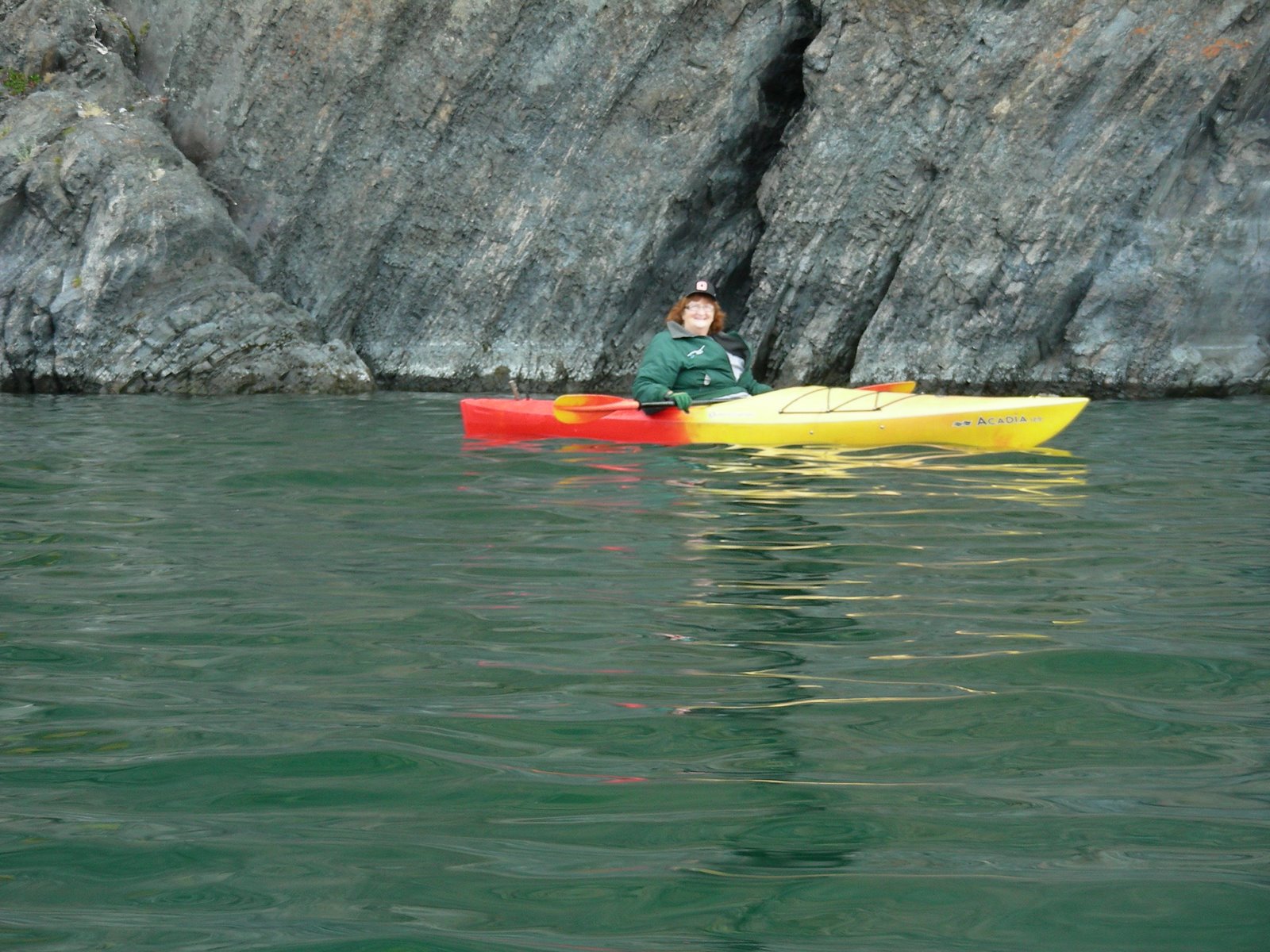
Kings Canyon

http://picasaweb.google.com/kyotesue/KingsCanyon#

Yes, I know the plans were to go to the Bristlecone Pine Forest on the eastern edge of California. One more time, Mother Nature had other plans. There were rumors in the air of bad weather, and sure enough on our expected travel day, we woke to snow falling in the High Sierra and closed passes. Even if we could have made it across HWY 50, the only pass open across the mountains, we would have run into more than 100 miles of 3 inch snow depths on HWY 395 traveling through the Mammoth area. No wayaround it, we had to come up with some other plans for our last trip out this year.

Before we left, the only requirement I had was that we not travel again across the wide, flat, and very boring Central Valley. We decided on a destination that was quite a way down on our to-do list, but was at least accessible, even if cold weather was predicted. With the days of tent camping behind us, cold was do-able. So we headed for the west side of the Sierras instead of the east side as originally planned, and set our sights on Sequoia National Park.

No matter where you travel in this state, however, it’s impossible to avoid the central valley, and we found ourselves headed south on HWY99 one more time into the smog and flatness of Fresno. Once out of town, east on HWY180, we again approached the Sierra Nevada. Only here, very different from my home near Jamestown, the mountains rise very abruptly from the valley floor. HWY 180 is a long steep road climbing 1000 feet every couple of miles until you reach the Kings Canyon National Park entrance at nearly 7000 feet. We were glad we had decided against towing the baby car, also glad that our 26 feet wasn’t any more than that. In fact, at 26 feet, we were too long for several of the national park roads that have a 22 foot limit.

The brochure for these two parks suggests that if you are towing a car with your rig, you should leave the rig and explore by car. The only problem with this plan is that most of the park is only accessible on foot, and what you can see by car isn’t exactly spectacular. The exception to this is the long downhill winding road into Kings Canyon. I would hate to have to drive down that road, and then turn around and drive back out the same day because I didn’t have my home with me. I was also very glad again for the tow-haul on the MoHo that helped with the constant downshifting as we traveled into this wild deep canyon that John Muir compared in all respects to Yosemite.

At the upper limit of the park boundary, however, is a section in the sequoia belt that had some groves of the huge trees, and the General Grant Tree. We stopped to hike the interpretive trails and wonder at these amazing living things before we continued on to our explorations of the park. The ranger was helpful, assuring us that our rig could handle the downhill road into the campgrounds on the Kings River, but also assuring us that we definitely should NOT attempt to go travel on the southern route out of Sequoia to Three Rivers on HWY 198. The maps said, “over 22 feet not advised” not prohibited, but that was a decision for another day.

The trip down the Kings Canyon was a bit obscured that first day by all the clouds in the mountains, and rain and snow falling at varying elevations. The temperature at the top was 37 degrees, and when we reached our campground at 4500 feet or so, it was still in the low 40’s. The night only dropped to 28 degrees at that campground, so again we were happy that we had decided to camp in Kings rather than in Sequoia at a higher elevation where the temperatures dropped to 12 degrees. F. Ahh, camping in October.

Our campground was one of two open on the Kings River, the Sentinal Campground, and when we arrived in mid afternoon was very nearly empty. A couple of people trickled in throughout the evening, and a surprising number of campers were in tents. I didn’t envy them as I watched them curled up in sleeping bags and woolen hats trying to enjoy their campfire, and sometimes there was a funny image of a person huddled over a sterno stove with their partner huddled in the passenger seat of their truck trying to read a book. Cold camping. ugh. We didn’t even opt for a campfire, and instead cooked warm soup and enjoyed the view from our warm cozy home.
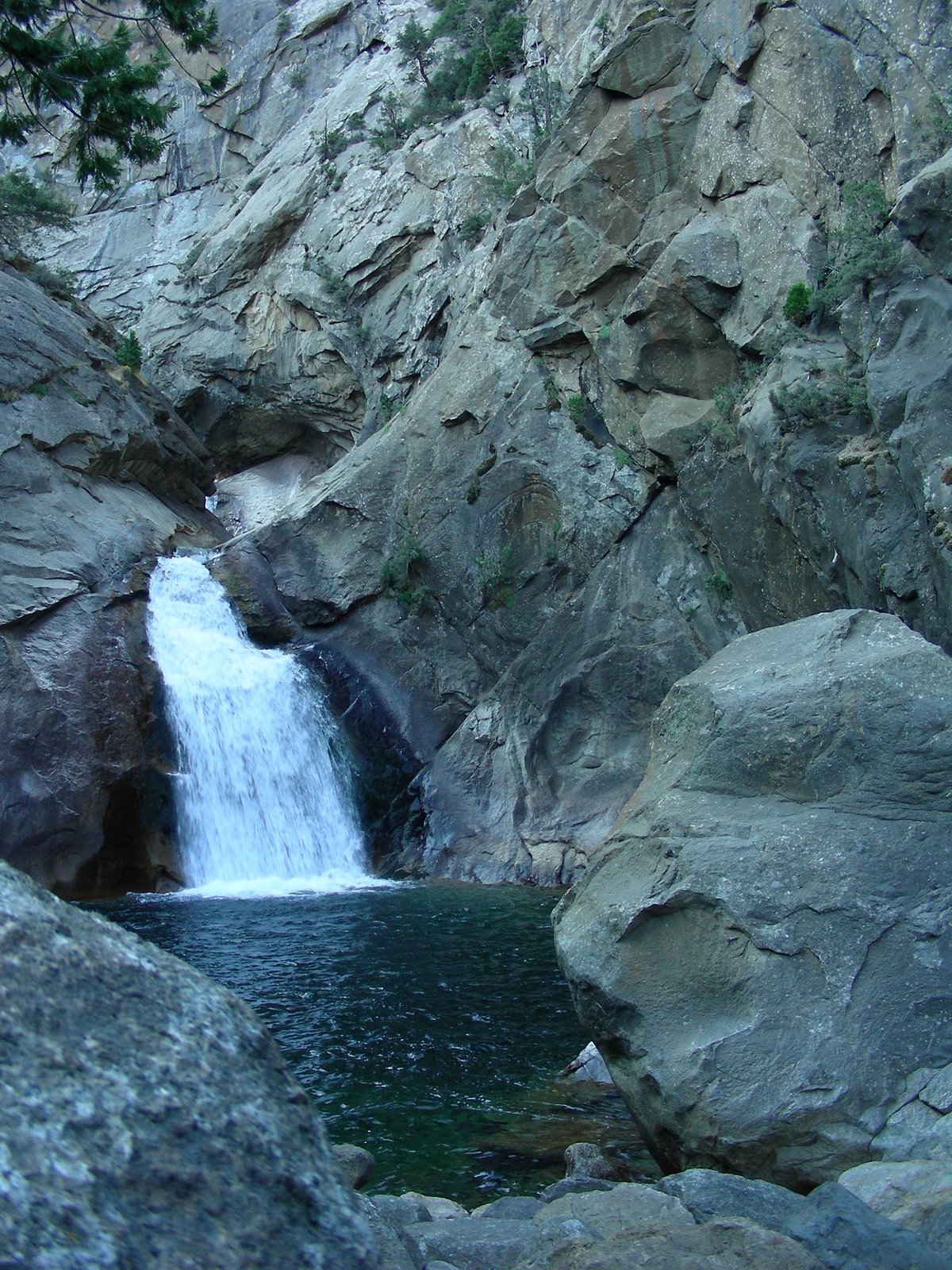
The next morning dawned bright and sunny once the sun actually made it over the high mountains, and we traveled further into the park to road’s end and a short hike to the Roaring River Falls before we traveled up that long pull out of the canyon on the way to the next day’s adventures in Sequoia.

We were happy in a way to have been thwarted on our east side Sierra trip, because both of us knew that we might not ever come back in this particular direction and so might not make the effort to see these parks. We also both know that no matter where we live, the eastern Sierra is always calling us, and sooner or later we will find Laurie and Odel’s boondock paradise in the Alabama Hills, and see the Bristlecone Pine Forest. But probably not in October!

East Lake in the Newberry Caldera

I was really excited about finally getting to Waldo Lake this year but it wasn’t to be. Mo and I were there in 2004 and the lake has called to me since then. Oregon was catching up with California this weekend and lightning strikes caused fires in the Cascades that closed almost every highway crossing the mountains last weekend, including our route to Waldo Lake.

When Mo and I left Rocky Point on Thursday morning, we already knew that HWY 58 was closed so we decided to go up to the Newberry Caldera just east of LaPine.
The area is a fascinating view into recent geologic events on the east side of the Cascades with two lovely lakes and some nice campgrounds. Here is the link to the Cascades Volcano Observatory USGS website for the Newberry Caldera.
http://vulcan.wr.usgs.gov/Volcanoes/Newberry/Locale/framework.html

This change in plans worked just fine for Mo’s brother Roger and his wife Nancy, who planned to visit us for some kayaking and campfire time, since they live on the east side of the mountains anyway. Didn’t work so well for my daughter Deb from Portland who had planned to meet us Saturday night at Waldo. Ah well, maybe next time.

When we first left Rocky Point, the smoke was visible over the mountains, covering what we knew to be the Crater Lake caldera rim and billowing high and white like big cumulus clouds very much too close to home for comfort. By the time we reached East Lake, however, the skies were clear and lovely. The campground is first come first serve, and there are about 7 sites right on the water. Lucky for us, number 14 at the end of the front row had been recently vacated so we managed to get on the water even though the other sites were full. Site 14 is what they call a “premium” site and with our Golden Age Pass was only $7 per night, (half the regular 14. fee).

This particular site was actually used as a full hookup site for the camp host during the season, and we still had fresh water piped right to the site, although the power connections were locked up. We also actually had a solid asphalt pad. Not bad for a forest service campground in the mountains! Once camp was ready, I took off for a twilight glide across the lake. The water was reflective, glassy, and totally still except for the jumping trout. I have never experienced this kind of jumping fish all around me. I actually thought that I would eventually get some fish in my boat, and had more than a few jump into the air within arm’s distance. Amazing. Later we learned that the fishermen were having good luck that night with 16 inch trout jumping onto hooks using super bait. The next day wasn’t quite so good for the fishermen, but we still watched nice sized eating trout being caught both from boats and from chairs along the shore.

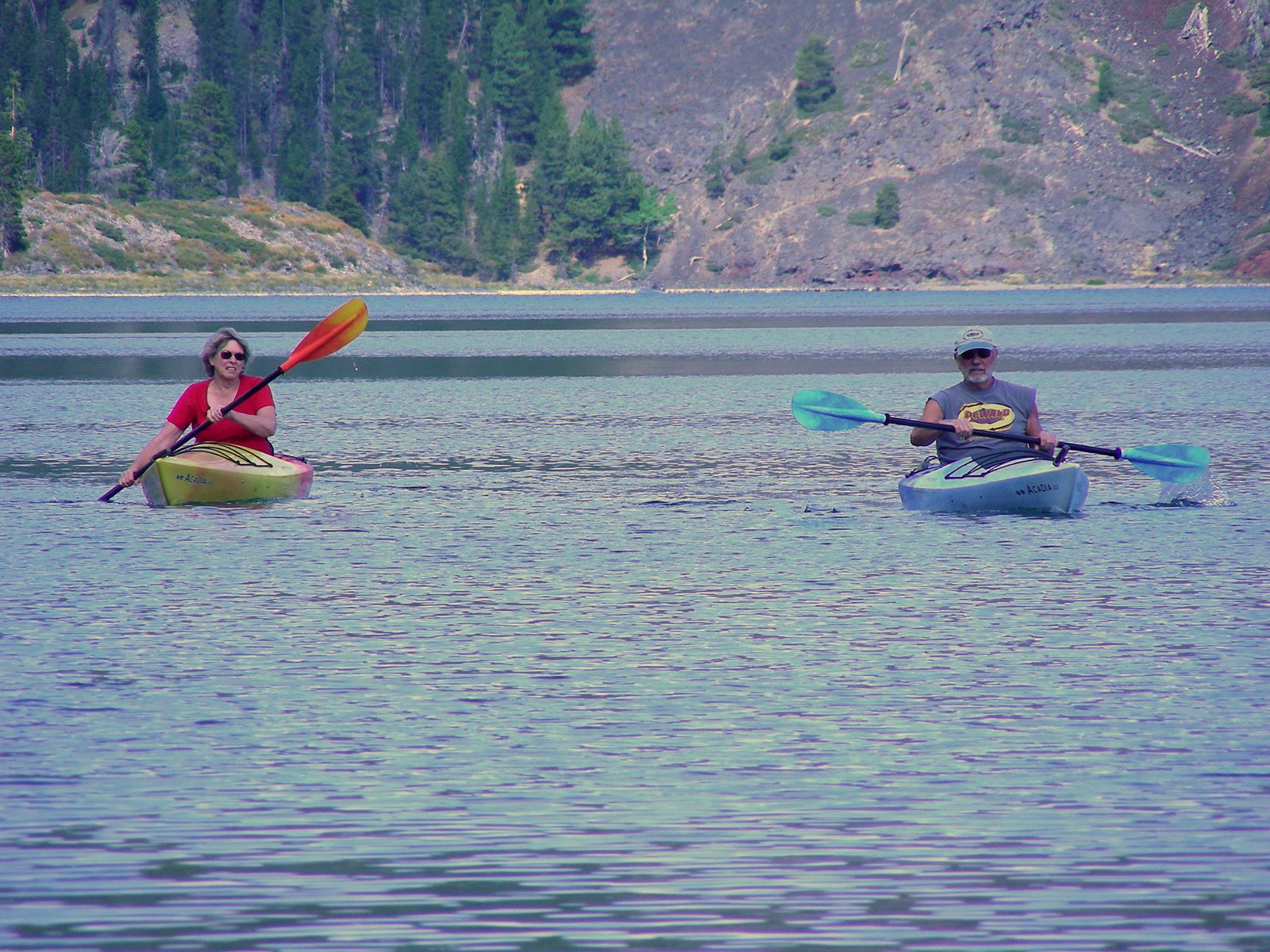
Friday morning I went for another paddle while Mo waited for her brother to show up and when they arrived, we sent them off with the kayaks while we watched the dogs. It was Nancy’s first time in a kayak, and like most people, she discovered that it wasn’t the least bit intimidating. Our boats are really stable and have a nice wide cockpit, which still doesn’t let anyone look particularly graceful trying to get in and out, but once you are in, it’s a piece of cake!

The weather cooperated, and after a nice ride, we all settled in for some hiking along the beach collecting pumice cobbles, and then a campfire and a planked salmon supper cooked on the grill. yum! It was nice spending some camping time with family, and nice that they only had less than an hour to get back home. It was also encouraging to hear that they had driven through thick smoke almost the entire trip up the hill and we were just out of it. I had an entire weekend with no smoke and no heat. A good thing!!

Saturday was cool, foggy and rainy most of the day, so after a good bacon and potato breakfast we spent most of the day relaxing and reading in the MoHo. I say “bacon and potato” because neither of us remembered to bring the eggs! I also created some entertainment for the two of us by trying to wind a large skein of ribbon yarn that kept us occupied for more than an hour at least. Good thing Mo is more patient than I am at that kind of thing. Finally, later in the afternoon, the weather cooperated a bit and we had time to hike the trail to the hot springs. Of course, at the time, I didn’t know the springs were there, and kept wondering where the strange poopy smell was coming from! When we did finally find them, they were a bit of a anti-climax, since the actual spring was only a few feet across and less than a foot deep of somewhat murky, barely lukewarm water. I was cold from the windy hike, and had been having visions of dropping my feet into a hot pool. Not this one. We even skipped our fancy supper, opting instead for some warm chicken soup and a half tuna sandwich by the damp fire. I had planned to relax on this trip, but maybe not quite this much.

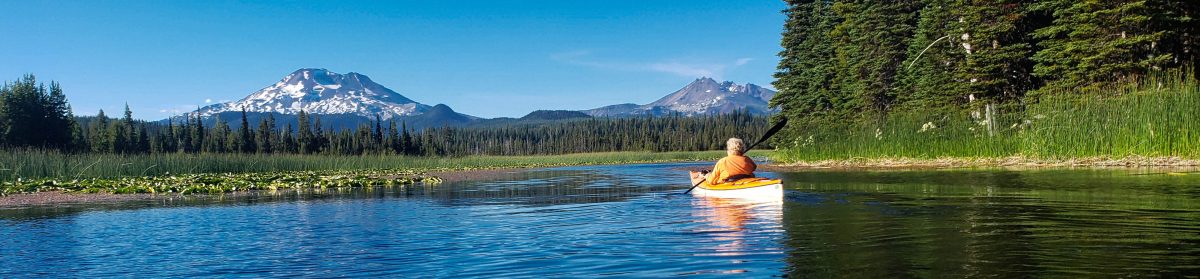
Sunday morning opened to a cold foggy morning, but we decided to go out on the lake anyway since it looked so still and lovely, and the previous day the winds had come up before noon. It was a good plan, since by Saturday afternoon the rains started. We circled the entire lake, checking out the springs from the water side, and enjoying the views during the few moments when the clouds cleared a bit and we could see Paulina Peak above the caldera. I made potato salad and Mo grilled burgers for us for a great evening supper watching the rain come on the lake and being very grateful for our warm MoHo.

Sunday night was cold, with the temperature dropping to just a hair above the freezing level. We were also grateful for propane and a furnace that night, and slept all warm and cozy. Our optimism regarding the dawning of a sunny day wasn’t rewarded, though, and after a quick breakfast, and a look at the very low propane levels, we though we might as well head home. Four days without hookups is easy, except the propane hadn’t been completely filled for a few trips, and with the temperatures in the high 30’s we really didn’t want to hang around. Geez, you couldn’t even warm a cup of tea if the propane ran out!

By the time we got back down the hill to LaPine, the clouds were clearing and by the time we reached the HWY 138 intersection with HWY 97 the skies were completely clear and off came the heavy sweatshirts. Heavy smoke from the Lonesome Complex fire filled the upper ends of the Wood River Valley, and was especially thick along HWY 97 north of Chiloquin. Even though the fire is very close to the Wood River Valley on the crest of the Cascades, the smoke stayed north and wasn’t too bad right around Rocky Point, even though you could see it all across the valley down to Klamath. A very smoky summer indeed, first California and then Oregon. As I drove back home, through more leftover smoke from the months long fires in the Klamath Forest of northern California, I sighed and wished for winter rains to come here as well. By the time I got back to Jamestown, the car temperature reading was in the low 90’s. Still. But I had a break, a cool, damp, fresh, clear break from it all and am ready now to “dig in” (yeah, it’s soils stuff) for another couple of weeks before the next camping trip into some clear cold mountains on the east side of the Sierras.
Here is a link to the rest of the photos.
http://picasaweb.google.com/kyotesue/CampingAtEastLake#

Traveling through Idaho

Here is the Picasa web link for photos for today:
http://picasaweb.google.com/kyotesue/TravelingIdahoToOregon

Mo and I are watching the morning news, which of course is focused on the summer Olympics in Bejing. The brilliant morning sun is flowing in through the open screen door facing east. We are in the Hellsgate State Park on the Snake River on the western edge of Lewiston, Idaho. I used to camp at this park often when I was working in this area 30 years ago, and when I did craft shows here, the lovely Dogwood Festival, held every April. Sometimes the dogwoods were in full bloom, and other times it would snow, but this area is usually much warmer than the surrounding parts of Washington and Idaho, and Lewiston is known as the “Banana Belt”. We are just south of the confluence of the Clearwater and Snake Rivers, and the Clearwater is an amazing river coming from the Bitterroot Mountains, and much of this area is part of the Lewis and Clark Trail. Here at the park, there is a lovely Discovery Center that highlights the story of the famous pair as they traveled through this country. We will be heading east and south along HWY 95, traveling through Nez Perce country, passing the Nez Perce visitor center and perhaps a casino or two that wasn’t here in the days when I did the soil survey for these areas. The Nez Perce National Historic Park has several sites in this vicinity, and it is a great history lesson to view these areas with the stories that go with them.
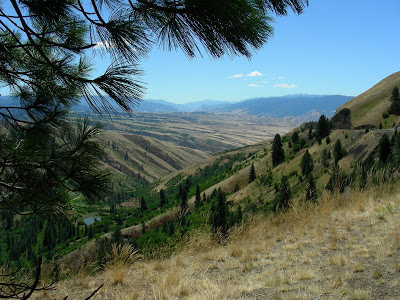
The photo is taken at the top of White Bird Hill, site of a famous battle involving the Nez Perce and Chief Joseph. http://www.nps.gov/nepe/
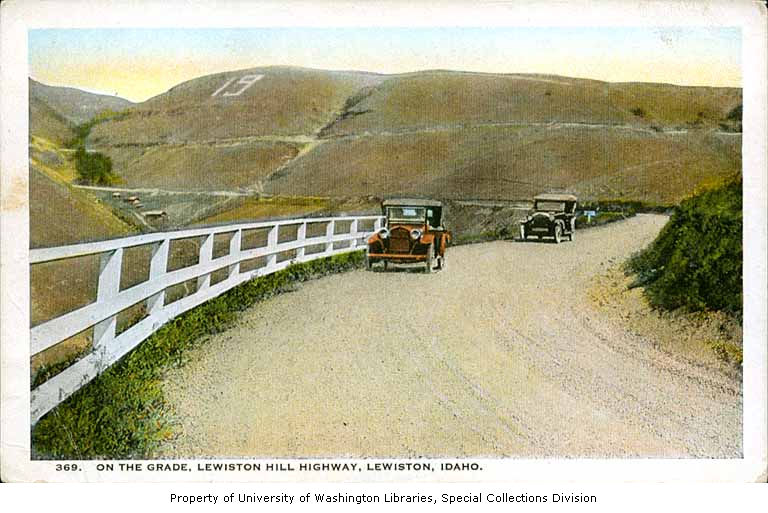
Its fun being here, recognizing all the landscapes and landforms, knowing the plants, the geology, the natural history. Sometimes when I am working in California I miss that intimate knowledge of an area that I developed over so many years working in the Idaho Panhandle. Technically we are out of the panhandle now that we came down the Lewiston Hill, once a winding steep road with many switchbacks, now a very long down grade of 7 percent that makes me very happy with the MoHo’s tow-haul feature that downshifts with just a slight touch of the brake. I lived here when the hill opened and the first weekend a semi hit one of the runaway truck ramps, and because it was unexpectedly frozen, the trucker was launched out over the 1000 foot hill to an unhappy end. Here is a great photo from the 1920’s of the original road which had 64 turns in less than 10 miles. http://www.idptv.state.id.us/buildingbig/hiways/lewistonhill.html

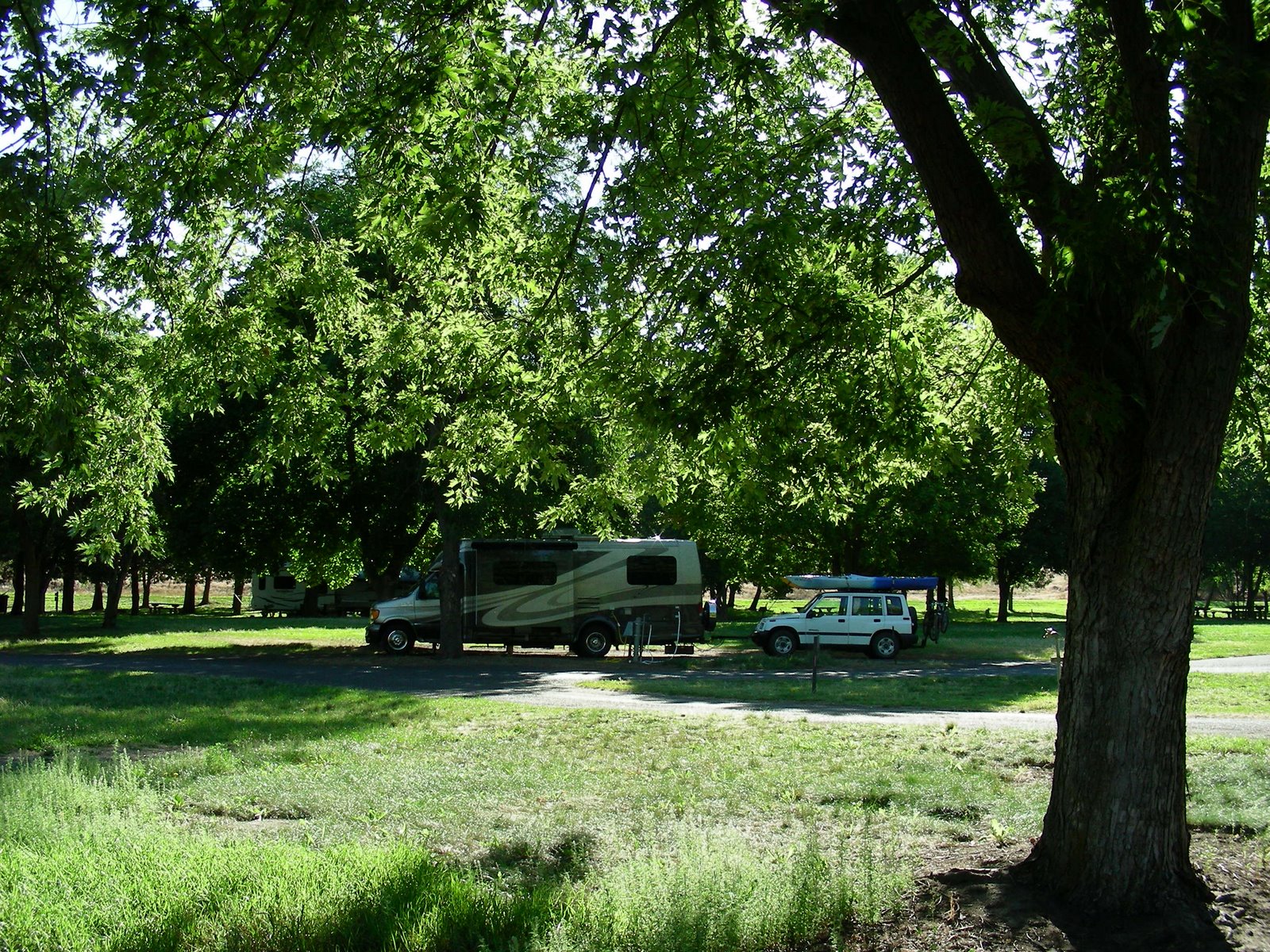
Our goal was this lovely park, full of big old maples that have been planted long enough ago to provide lovely shade, the Snake River out our window, electric and water, with a dump station and television reception with an antenna from Spokane. This is a place worth returning to, with so much around the area to explore, including a long lovely river walkway that goes for several miles along the Snake and the Clearwater. In a little while we will head south and plan to go through John Day in Oregon and then on to somewhere unknown for the night tonight before we head home tomorrow via Mo’s brother’s home in La Pine. We couldn’t ask for a better day to travel through this part of Idaho.

Quiet Friday

Photo link for today:
http://picasaweb.google.com/kyotesue/RiversideStatePark

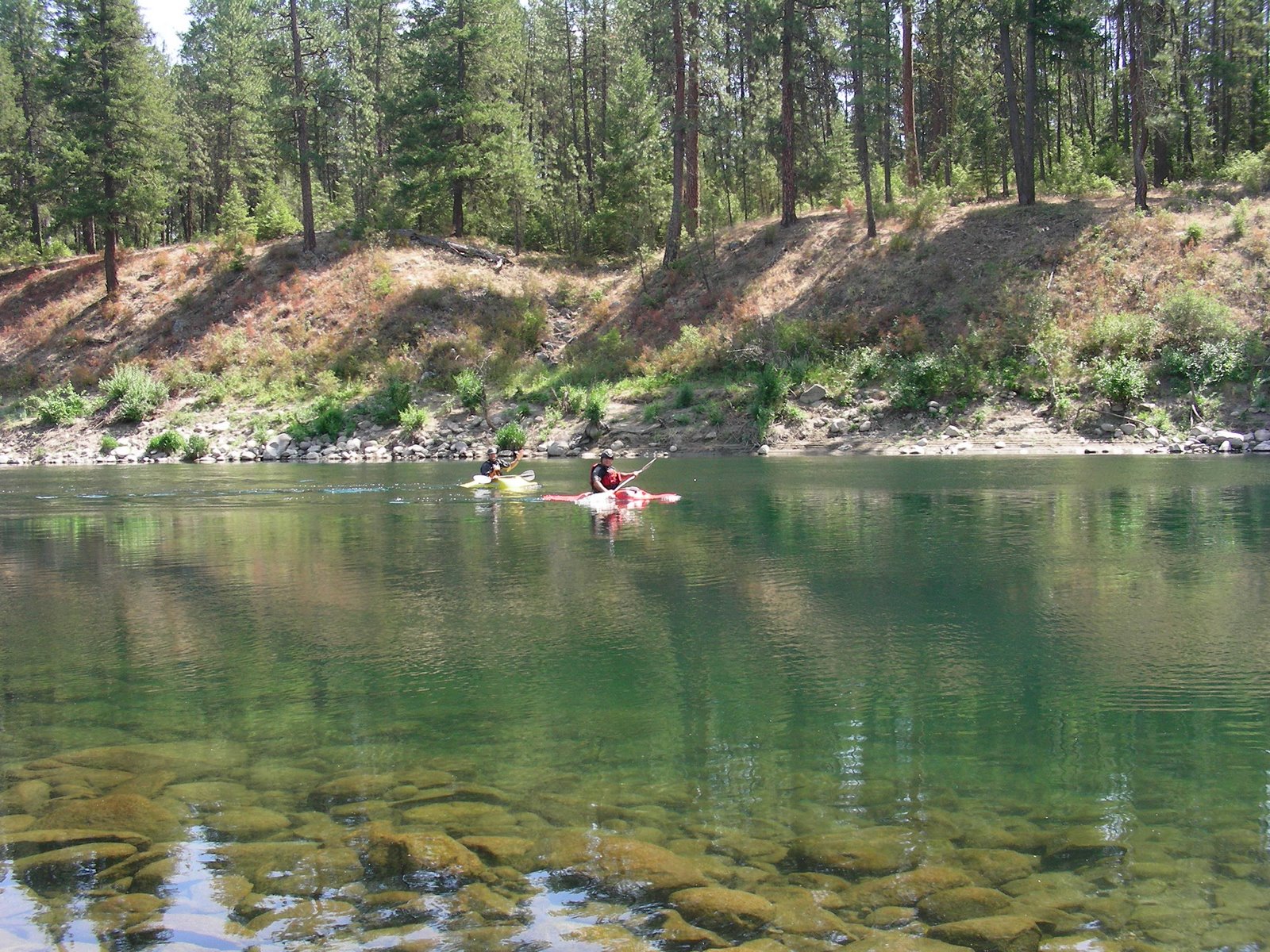
Mo and I are sitting in the shade of our awning under the pines at Riverside State Park. We are camped with other family in 3 spaces right along the river. The sun is warm and it’s hot and a bit humid for the west, maybe mid-90’s, but I remember summers like this in Spokane. Lake days. The Spokane River is just below us a few hundred yards, flowing silently but with a steady current. The river is deep here, with slippery rocks dropping quickly to a clear green abyss. It looks incredibly inviting, but I am still squirrelly about swimming in strange water with things I can’t see down there. I’m a sandy beach swimmer rather than a river swimmer.

Mo is sitting here quietly in the shade at the edge of the warm sun. We went for a walk down to the Bowl and Pitcher earlier, but the walk was a bit difficult for her and we came back to rest, make sure she had some Advil and let her sit quietly.

http://www.riversidestatepark.org/ Riverside State Park is a jewel right in the city in Spokane. It’s in ponderosa pines with some light shrubs and grasslands. On one side of the river it’s dry and piney, on the opposite side is Douglas-fir with snowberry and huge outcrops of basalt from the cliffs above. The Bowl and Pitcher is actually a narrow part of the river with rapids formed by all the basalt that has caved from the flows that form the cliffs above the park on the west side. There are really great old CCC buildings all around, including a group shelter and some other buildings crafted from the basalt by men trying to escape the depression of the Depression. Bless you, FDR. There is a similar building at the top of Mt Spokane that is equally as perfect in its stone craftsmanship. It’s a bit of a mess trying to get to the park if you don’t know the area, and it was even hard for me knowing the area, because of the construction and bridge repairs that are ongoing in this city. The Spokane River dominates this town, and no matter where you are going you have to get across the river one way or another. Many things to love about Spokane, and sometimes I really miss it, especially the South Hill and all the old craftsman homes that were built in the early 1900’s when Spokane was a rich exciting city built on mining and railroad fortunes.

Traveling to Spokane

Picasa photo link for today:
http://picasaweb.google.com/kyotesue/TravelingToSpokane


Wednesday morning
Finally, finally, a MoHo trip. Reading about all those folks who are full-timing out there is so much fun, but for us for the time being, we have to take what we can when we can. I left Jamestown at 3am in order to get to Mo’s early enough in the day for us to have a nice evening on the Columbia River on our way to Spokane. Our route from Klamath took us north on HWY 97, through Bend and Redmond to Madras and on north to the Biggs Junction on Interstate 84. Even though we were in Madras just a little more than a year ago, it was incredible seeing the growth and development that is occurring along that corridor. Redmond is now boasting big houses and brand new huge shopping centers that may eventually rival all the growth in Bend. The traffic was bad as well, with everyone in a hurry and aggressive. I kept wondering if really was a Tuesday afternoon and not a busy weekend. I also wonder what kind of recession we are really in, because even at more than 4 bucks a gallon there are a lot of big rigs, big trucks, rv’s, boats and toys being hauled around on the highways. Someone still has the money to play, as we do I guess. I know some people are really feeling all this, and I wonder how long it will take to hit the rest of us out here traveling the highways. So far we have managed to keep on doing whatever it is that we would be doing if gas were cheaper. We still drive 60mph to try to keep our mileage better, still buy discount gas at safeway and Costco whenever we can, but we still go where we want to go.

We are back on I-84 following Dan to Spokane after a really nice stop at theriver for a relaxing overnight. We originally planned to stay at the Maryhill State Park on the Washington side of the river at Biggs Junction, but the price was a bit steep at 38. We found the much less expensive LePage Park at the John Day Lock and Dam. Our national pass saved us half the hook up price which is a deal at $17. anyway, with electric 30 amp and water. The park itself is small and pleasant, with decent 2 bar telephone service. I let our air card go since I really didn’t want to keep paying 60 a month for that service when we aren’t traveling full time. I hope I don’t miss it too much. I suppose I can hang out at rest areas if I really need to get on the internet now and then. It all balances out eventually.

We are caravanning to Spokane from the park with Mo’s brother Dan. Being a bit independent, this is the first time that we have done this with someone and it’s a bit different, but should be fun. Dan and Chere, Mo’s brother and sister in law are in a nice Class A rig pulling a jeep. Her other brother Roger, who also has a Class A couldn’t make the trip this time, so we are the only two in the caravan. Does that qualify as a caravan?

We had a truly lovely relaxing morning today, after finally falling asleep during a very hot night. It was sunny and 104 degrees yesterday when we arrived at the park at 6pm. Hot, with a dry wind that made it feel like a real desert. We set up, and appreciated how easy this is getting for us now that we understand all the little details, but of course we still don’t have to do the satellite dish thing, and at this park we didn’t even have sewer, so it was all pretty quick. Steps worked, levelers worked, slide worked. I love it when things work. Funny side story however, this morning we ran out of water pressure as our fresh water tank emptied. Couldn’t figure out why, since we were supposed to be hooked up to shore water, and Mo finally found a little plug in the faucet that she had put there to keep bugs out while we were traveling. Oops, I didn’t take it out when I hooked up the water, and of course, we were just running off our water tank instead of shore water. Little things.

Dinner was about as good as you get, and fast as well. The little gas bbq that I got from Wal-Mart is still a hit, heats up fast and we had magnificent bbq’d pork chops in about 10 minutes, while I put some cole slaw together and microwaved a sweet potato. A glass of good red wine and things couldn’t be better. After dinner we took Abby swimming and discovered that the John Day River in this area is dammed up by the John Day dam enough that even though it’s deep, there isn’t enough current to worry about the dog getting carried away, so she had a great time swimming in the deep water, and then later when we took her over to the swimming beach where she kept trying to find water deep enough to swim in. The park itself is a really nice place, and we added it to the list of places where we might return and spend a few days hiking and definitely kayaking up the John Day River. Even though the park is in close proximity to the interstate, we couldn’t hear it at all down in the park, and even though the spaces are close together, they are all pointed toward the river in such a way that when you are sitting at your table, it’s still private enough that it isn’t too bad. We had a young couple with kids right next to us in a tent, and the only bad part was waking up at 530 am in a funny mood and worrying that our silly laughter might wake the neighbors.

We were waiting for Dan and Chere to arrive after 10 or so, so we had plenty of time to go for a nice hike up along a service road that paralleled the river along the middle slope of the basalt. High enough to see the rivers and trains and such, but not so high and steep that it was a difficult hike. We were entertained by flocks of chukkars running straight up the cliffs, lots of deer tracks and coyote tracks, and then Abby found a rattlesnake who obligingly gave us a great warning as we approached. Mo tried to get a photo, but I won’t know if it came out till I upload the photos.

Basalt on the Columbia Plateau and in this canyon is part of what is one of the largest continuous basalt plateaus in the world. I think the only large one is in India somewhere. The basalt has several different members with different characteristics, and different flows within individual members that have differential rates of cooling that makes them look like pillars and pillows, and little square chunks called entablature. http://www.cwnp.org/naturalist/basalt.html Then there are in between layers of pillow basalts that cooled under water, and conglomerates that were picked up from old river beds by the hot lava and all sorts of other interesting things. Of course, this area was also flooded 13,000 years ago by the catastrophic Missoula Floods, another fascinating story, so some of the very old rounded alluvial gravels that we found may have come from ancient Lake Missoula which covered a very large part of the state of Montana before the ice dam broke and created the floods. http://en.wikipedia.org/wiki/Missoula_Floods

Regardless of the origins, the basalts are fascinating and lovely to look at while hiking along the canyons along the rivers.