Day 9 Pamukkale and Heiropolis and the Spa

http://picasaweb.google.com/kyotesue/Day9PamukkaleAndHeiropolis#
Relaxing in Pamukkale with an afternoon appointment for a Turkish Bath and an Auruvedic Massage. Yes!

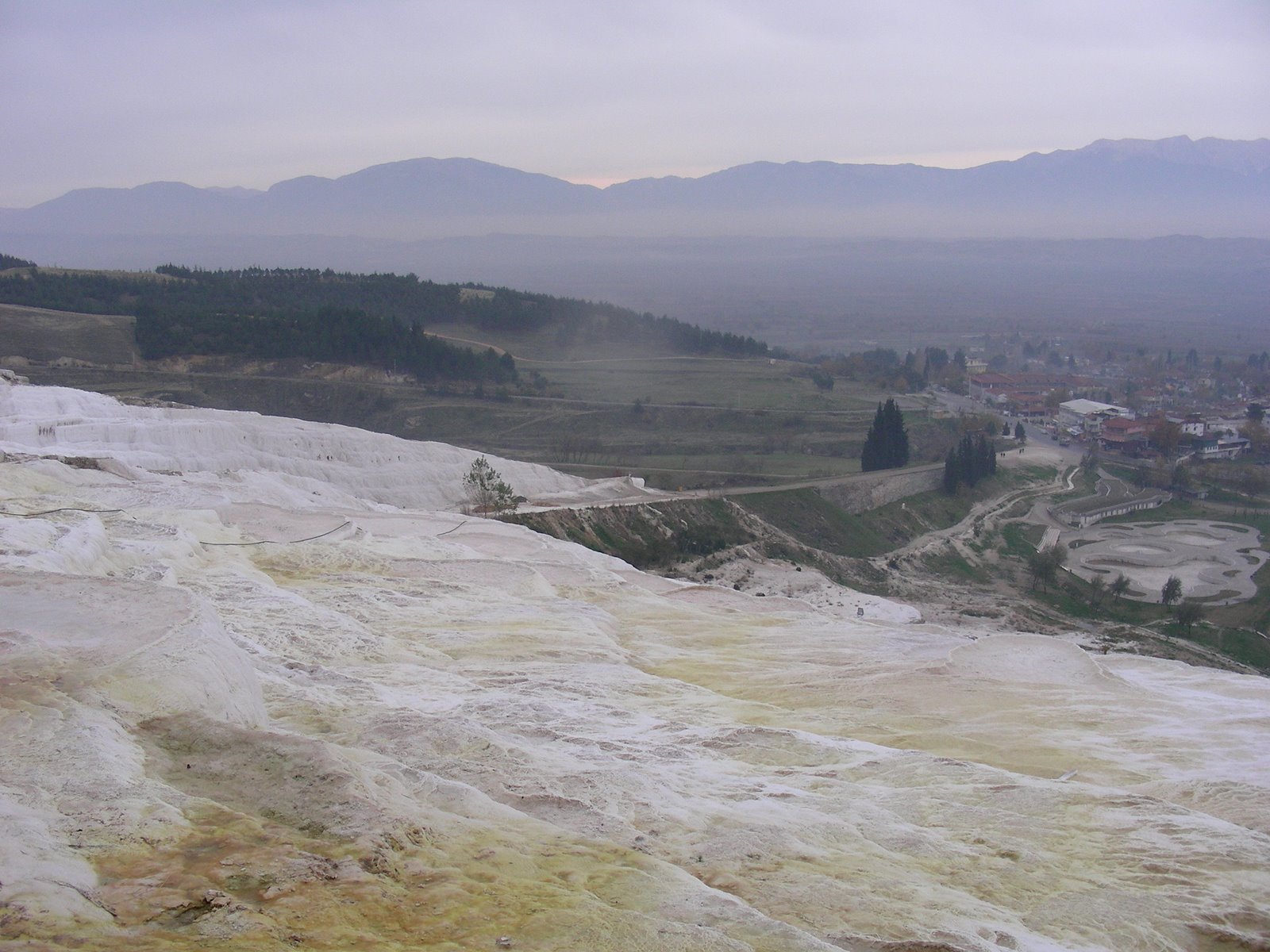
The travertine pools at Pamukkale have been a site for healing for a few thousand years or so. The geology of travertine wasn’t something I fully understood, so I had to go look it up.

Travertine is a kind of limestone deposited by springs. Groundwater traveling through limestone beds dissolves calcium carbonate, an environmentally sensitive process that depends on a delicate balance between temperature, water chemistry and carbon dioxide levels in the air. As the mineral-saturated water encounters surface conditions, this dissolved matter precipitates in thin layers of calcite or aragonite, two crystallographically different forms of calcium carbonate (CaCO3). With time, the minerals build up into deposits of travertine. It is an odd geological resource that can be harvested and renewed.

The region around Rome produces large travertine deposits that have been exploited for thousands of years. The stone is generally solid but has pore spaces and fossils that give the stone character. The name travertine comes from the ancient deposits on the Tibur River, hence lapis tiburtino.

Today we are at the Lycos River Hotel in Pamukkale. It’s the first fairly quiet day we have had since we left on this tour. Pamukkale is in a very rural part of Turkey near the city of Denizli, but the hotels are not even in Pamukkale. The hotels are associated with the springs and there are many here, of varying qualities and amenities, and all a mile or so from the village where most businesses are closed since the normal travel season ended back in October. I can see why as I viewed the snow on the mountains around the Meander River Valley were we are traveling. As has been the case all along on the trip, our hotel is adequate but certainly not luxurious. This morning was a bit dicey when I couldn’t get any hot water for about half an hour. Funny, since there are hot springs all around with water at 117 degrees F. Finally managed a lukewarm shower and out in a cold foggy morning for our visit to the famous travertine pools and hot springs, and the ruins of the city of Heiropolis.

In Hellenistic times, between 200 and 300 BCE or so, the thermal springs at Heiropolis made the city a popular spa area. Later on the Romans developed the city even more into a spa retreat, with huge baths and pools, libraries, and temples. There is a pool there now that is littered with marble columns where you can swim and dive, but on this day it was too cold to think of such a thing. The ruins are extensive here as well, and the artist rendition of what the city looked like in Roman times is amazing. The city is perched above the travertine terraces shaped like a semicircle, with another huge stadium on the hill, and a Necropolis outside the city that has the highest number of existing sarcophagus from ancient Anatolia. It has been quite a revelation to be in Turkey seeing so many ruins of ancient cities of Greek and Roman culture. Another interesting cultural note is that Suleyman insists that we refer specifically to Hellenistic culture aka 300 BCE, rather than “greek” culture. I think the Turks and the Greeks are not so friendly. Some of Suleyman’s wisecracking little remarks have been directed towards Greeks.

The skies were very gray and boring, and the wind was cold and the rain started while we were walking the ruins, so the photos are a bit dull. But even the dull skies couldn’t really detract from the physical geologic wonder of the travertines. Although I did buy postcards that show how gorgeous they are in the brilliant sunlight, all white against brilliant blue skies. No blue skies today, however, so we were glad to return to the hotel and our room, turn up the heat and do a bit a relaxing for a change. Tomorrow is another long day of travel back south to the Mediterranean coast and Antalya.
Day 8 Miletus and Didyma

http://picasaweb.google.com/kyotesue/28NovMiletusAndDidyma#

For some reason this day slipped by without leaving a lasting impression. Another day of ruins and blue skies and riding in the bus. The morning started again with bags outside the door at 630, breakfast at 7, on the bus by 8 and off we go again. This group is much too large, actually, with 43 people traveling together. It’s interesting to watch the interactions and the patience shortening, including mine. I’m still not impressed with this tour company, although Suleyman our guide is pretty impressive.

First thing on the road and we stopped at a leather factory. Once more an opportunity for the tour company to get their cut off what the tourists are willing to buy. Again, though, the show was fun, with all of us lined up along the runway while they played very loud rock music and flashed the lights and the models so we felt like we were at a real fashion show. The leather was beautiful as well, great craftsmanship, and of course, very expensive. Most touchable was the “silk” leather, as thin as a shirt, soft and buttery, and still strong and guaranteed waterproof. Several people bought nice coats and jackets, but in spite of how delightful it felt to try on the silk leather coat, I didn’t succumb to 700 American dollars for a jacket. Give me a break! It is fun watching the group buy things though, and everyone cheers when we get back in the bus and show our “stuff”.

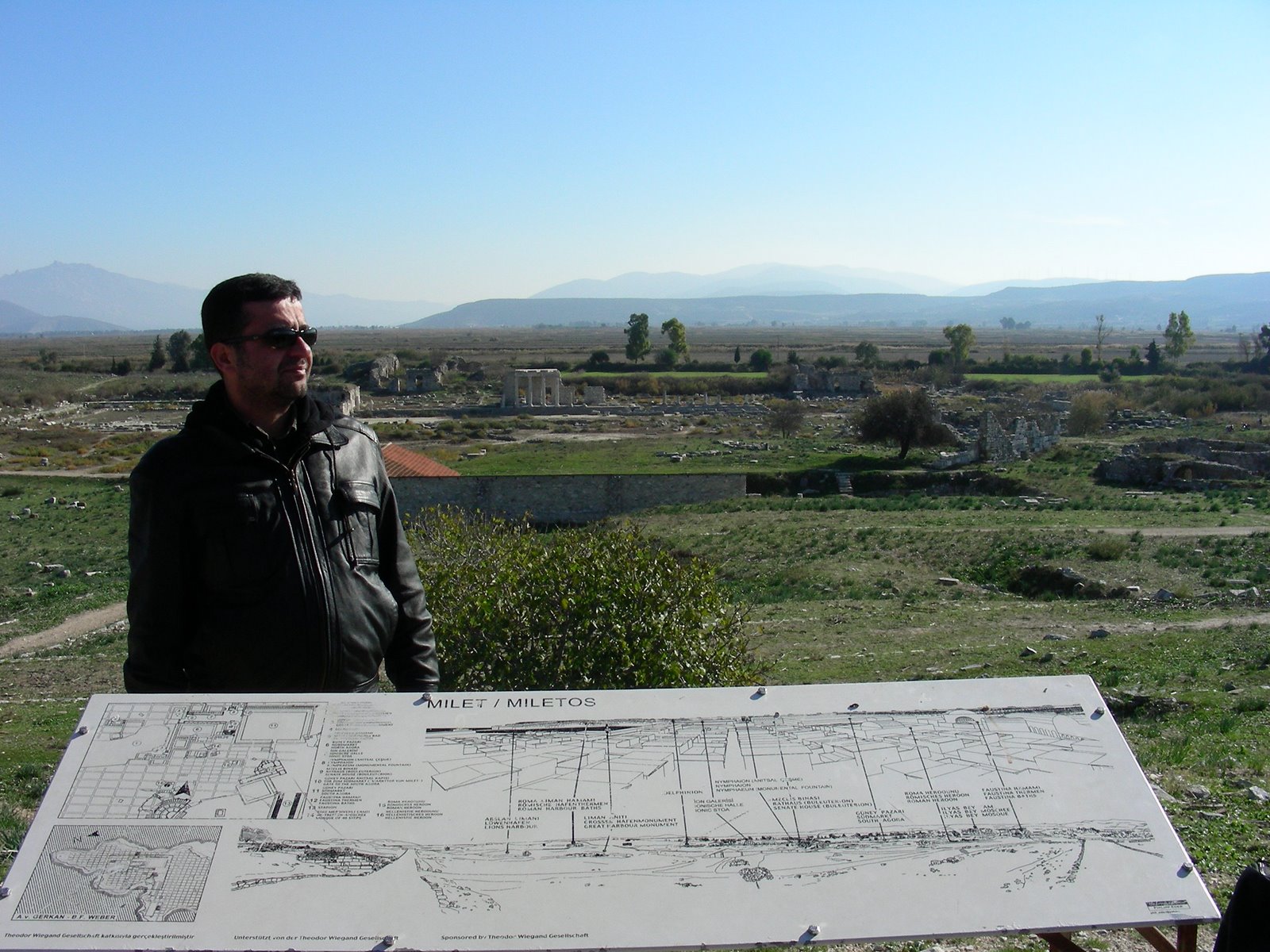
We rode along the coast to the Hellenistic ruin at Melitus, most interesting for the view of the valley that was a bay at the time the city was built, but has since silted in to become a fertile agricultural landscape, much like the valley around Troy. The theater was again Hellenistic in style, built into the natural contours of the landscape.

We then traveled to Didyma, a small village, noticing how simple and small most of the houses in Turkish villages are. Right in the village, behind a fence, is what is left of the Temple of Apollo at Didyma. Standing outside looking in doesn’t quite prepare you for how it feels inside this temple. The columns are huge, and the artwork is dramatic, including a gorgeous sculpture of the face of the Medussa that is beautiful. This temple was used to honor the god of prophecy and oracles and is thought to have been associated with the temple at Delphi, with priestesses dreaming and prophesying. After the prophesies, they would be written down and the books were stored here as well. The temple is constructed entirely of marble quarried from the nearby Lake Bafa area. The temple was built in the 7th century BC, and was one of the leading oracle shrines in the world. The temple was destroyed by the Pesians in the mid 6th century BC but was restored by Alexander the Great in 350 BC. With the coming if Christianity, the temple was converted to a church and was destroyed in 1493 by an earthquake. It is interesting that in Turkey, much of the history of these ruins and cities includes some kind of a statement, “destroyed by an earthquake in etc”.

As I have been traveling through this country I have been feeling often as though I was back in California. Today, searching the internet, I found that the San Andreas and the Anatolian fault are so similar that the USGS is studying the Anatolian Fault and sharing information hoping to understand both faults. Here in Turkey we have traveled through serpentines and metamorphic and metavolcanic rocks that are the identical twins of what I am working with in the foothill metamorphic belt back home in Sonora. Even the accreted terranes are every bit as complex as anything I am dealing with at home in my current soil survey. An accreted terrane is basically a little continent traveling and slamming up against another continent, and terranes are the main building blocks along the foothills of California and right here where I am in Turkey. It’s fascinating and fun for me, especially.

We had lunch at a small restaurant with another buffet and a Turkish “Efes” beer, (very good!) and more driving up the Meander River Valley to arrive at the Lycos River Hotel in Pamukkale after dark once more. I hate arriving anywhere after dark, with stacks of luggage and people milling about. Ugh. Did I mention the patience thing?

Day 7 Ephesus and Turkish Carpets

http://picasaweb.google.com/kyotesue/Day7EphesusAndTurkishCarpets#

Every year when we gather for
Thanksgiving, I ask my family to go through the ritual of saying what we are most thankful for that has passed in the previous year. I am sitting at the moment in a generic looking lobby of a resort hotel in Kusadasi, Turkey, thinking of my daughter in Klamath with the turkey in the oven and safe in a warm house. I am thankful that my family, each of them, has a safe warm home to live in, and good food to eat, and that I have a family. Truly thankful.
I am much less tired this evening than I was when we arrived here in Kusadasi. It’s nice to spend more than one night in a row in a place. Today Mo and I decided to skip out on one of the optional tours and just walk around town and check things out on our own. Nice. Kusadasi is a very popular beach resort town during the summertime, but at this time of year, things have quieted down a bit and it’s really quite lovely.
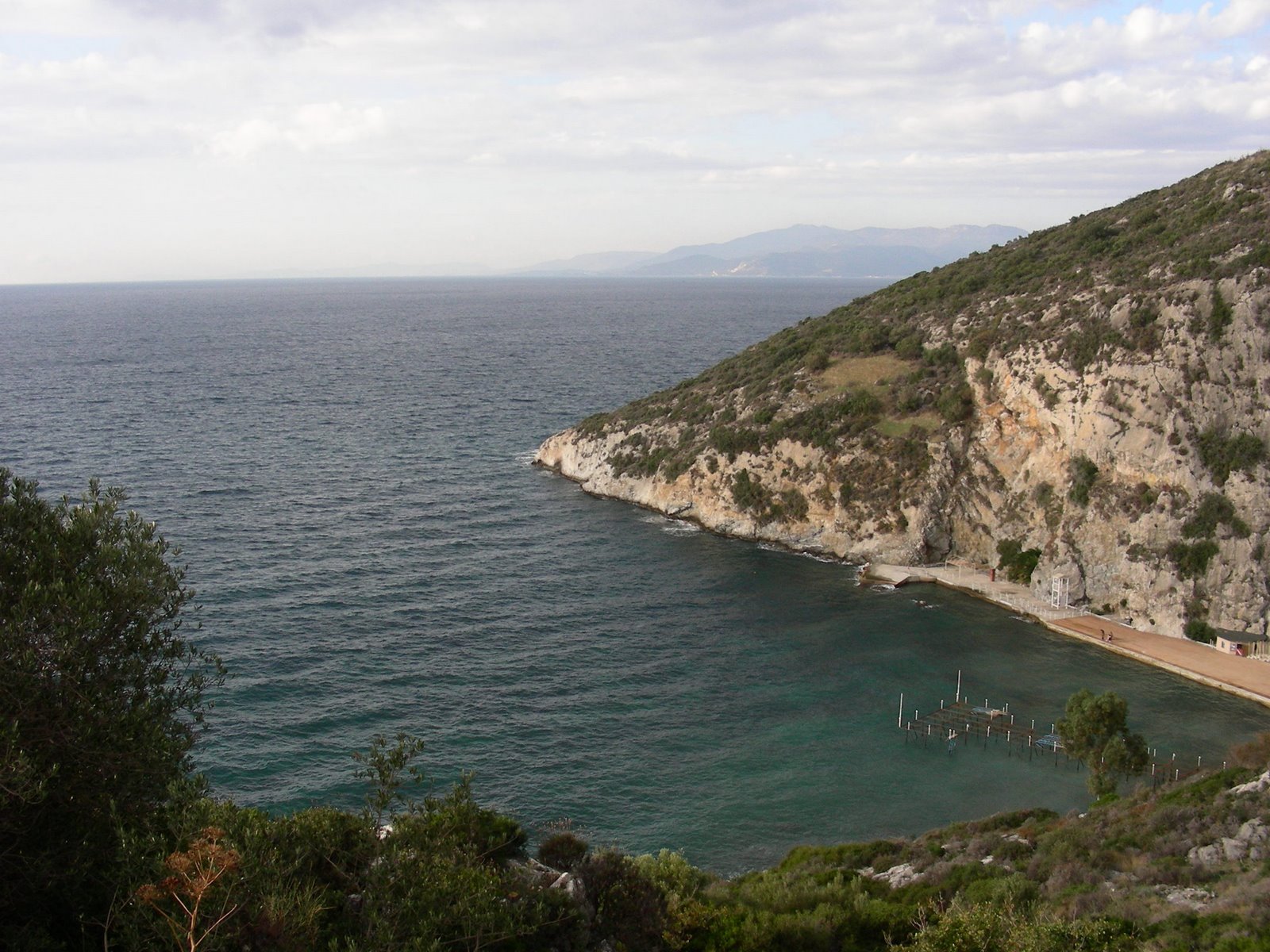
After breakfast today we all loaded up for the trip to Ephesus. In addition to the ruins, we saw the final home of Mary, Mother of Jesus, at least according to local legend and tradition. This is supposedly the place the John the Disciple brought the mother of Jesus to keep her safe and cared for until she died peacefully many years later. True or not, the shrine was lovely, beautiful and peaceful. Again, it was perched on top of the highest mountain around, with amazing views of the countryside and the distant Aegean Sea. From the road the ruins of Ephesus are visible, as a city much larger than what has been excavated so far.
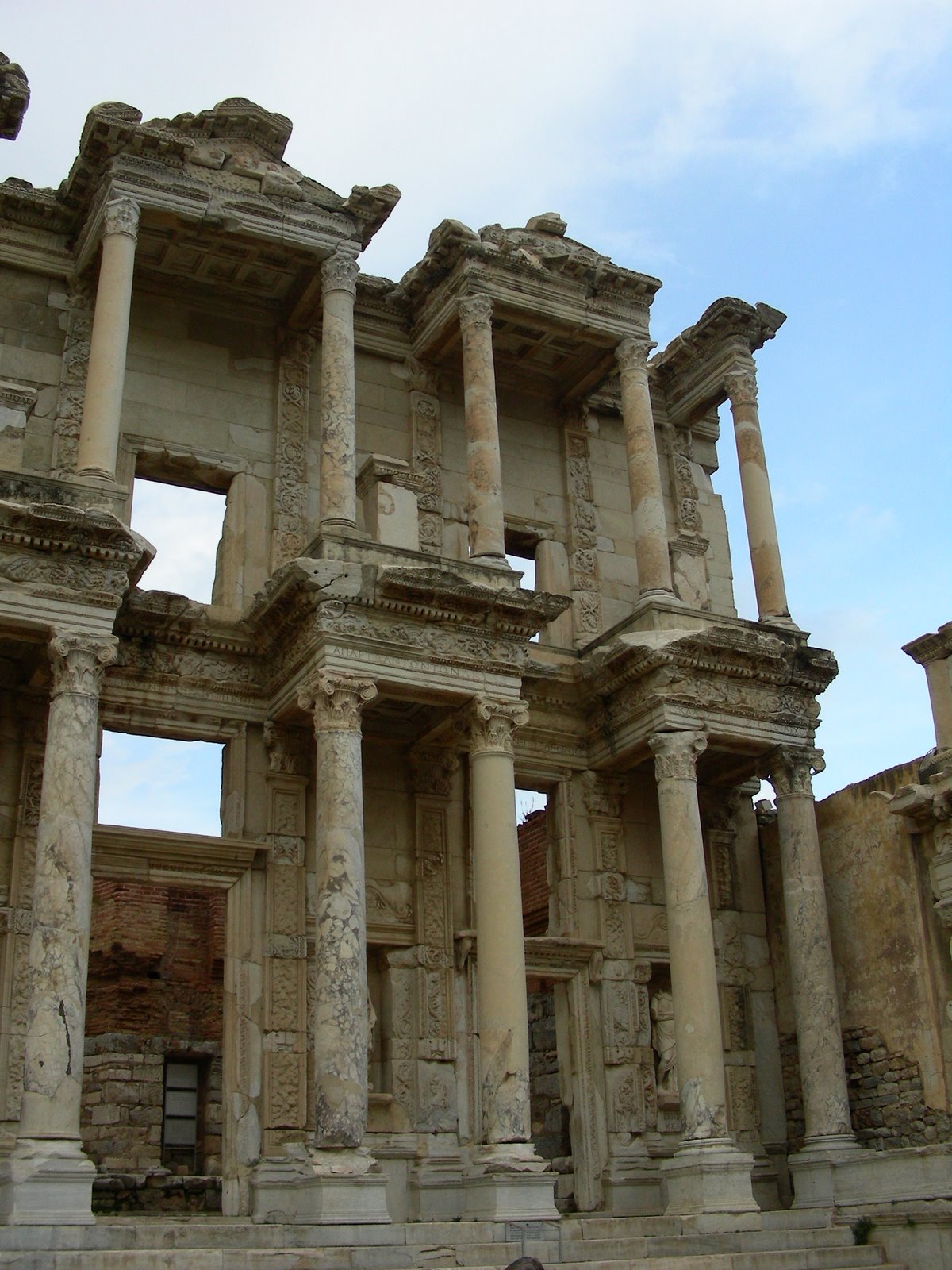
I had no idea what to expect from Ephesus. I knew it was a cultural center during Hellenistic times, that it mentioned in the bible, that Paul wrote letters to the Ephesians, which I read several times as a teenager, but to be in the city of Ephesus was a surprise. At first, it was a bit of a disappointment. It would take a lot to outdo the magnificence of those huge white columns we saw yesterday at Pergamon, and from the upper road, Ephesus isn’t very impressive. But as we continued to walk the old roads, deeper and deeper into the city, it was more and more obvious what a large, impressive, and civilized city this once was. We saw the baths, the latrines were good for a laugh, with our tour guide demonstrating how they were used as gathering places for the men. The library at Ephesus is truly impressive, magnificent, although much smaller than the one at Pergamon, where there were 200,000 volumes. Here at Ephesus, there were merely 20,000 books, but the edifice is incredibly beautiful. It amazed me to see how the archaeologists manage to piece the puzzle together as they reconstruct this city from the rubble and tumbled pieces of marble and stone.

The theater at Ephesus seated 22,000 people, and was built again in the Hellenistic style that fits the contours of the landscape. For my daughter, Melody, and for her friends in the theater, I took pictures of the backstage area at the theater in Ephesus, the place where there were only comedies and tragedies. Only later with the Romans were the lions and the gladiators brought in. The Greeks were so civilized. The pillars supporting the stage were still there, but after the Romans came, the lower seats were converted to a wall so that the wild animals wouldn’t harm the people in the stadium. You could see the doors where the lions entered the arena. It was interesting seeing the evolution of this magnificent city from a place of learning and culture to a place of Roman sports and indulgence. Ephesus was a surprising wonder.
After our tour of the ruined city, we went to a carpet dealer. I know it might be fun to sit in a little shop in Istanbul and buy a carpet, but I’m still not so sophisticated that I didn’t appreciate a little help. Of course the tour company gets a cut of whatever we buy, it’s like that no matter where we travel, but it still was a lot of fun and a great show. They had carpet weavers making several different kinds of carpets and explained the details of those differences, including the number of knots, the fibers and dyes used, and where the different styles originate. Then while we had a great lunch of Turkish pizza, cheese rolls and beer, we were wooed with a display of Turkish carpets that took my breath away. The emcee started simply, with a discussion of the simplest killims, and went on to talk about silk carpets that have hundreds of knots per inch and the skill needed to make these kinds of carpets. Then the show began. Men came out in groups with carpets, throwing them out on the floor with a flourish, one after the other, more and more, all on top of each other. The colors were thrilling, and then he said, take of your shoes and walk on them, so of course, sensory me again, was walking barefoot over thick silk carpets that went for 32,000 US dollars. What fun! I came on this trip, knowing down inside me somewhere that I would buy a carpet, and sure enough the silk ones caught my heart. Also they caught my breath when the one I truly loved was priced at 4400 US. Maybe not. So then the tiniest one, a lovely piece of silk artistry that I could hang on the wall, maybe a foot by two feet, was 1100 US. Maybe not. Ahh well, they were lovely to look at and wonderful to feel beneath my feet. And yes, I did buy a carpet, a keepsake for a lifetime from this delightful country. Only my carpet is wool on wool with only a couple hundred knots per inch, but it isn’t even dyed, it is made from the natural colored wools of the sheep. I am tickled. Included in the price is the customs, the taxes, the shipping, and in a couple of months my carpet will be delivered to my door fedex. Another nice thing about settling for the tourist carpet thing. It was surprising to see how many people in our group bought carpets, some more than one, and my fellow soil scientist bought one that was 10×12 for their lovely hardwood floors back in North Dakota. Glad I don’t have to pay that bill!!

After the carpet venture, we sipped on Turkish coffee and waited for our van. The van driver’s name was Abdul, and he turned out to be our very own scenery man, a much better trip than the bus to the “village” would have been. He took the 6 of us around the hills to high points over the sea and we got some gorgeous photos of the Aegean we wouldn’t have seen any other way. Home to our hotel, we unloaded our bags, and headed back out to walk the promenade, find a supermarket and a pharmacy, and enjoy the feel of the city, and the gorgeous views along the beach. It was a wonderful way to end the day, with the long walk, and back to the hotel room for a rest before dinner.
This hotel room is way too big, with two rooms, a suite actually, a huge hall, and still you can’t get two people in the bathroom at once. Very funny. But we have big windows that we can open, fresh air, and a view of the sea from the balcony if not from the room itself. Tomorrow we continue on to Pamukkale, although what else is on the menu is completely gone from my memory. Guess we will just get up, put the bags outside the door, and see what the day has to offer.

Day 6 Troy and Pergamon

http://picasaweb.google.com/kyotesue/26NovDay6TroyAndPergamon#

This morning started with the call to prayer once again, only this time it was still dark and there was no wind to interfere with the haunting sounds. I recorded it again, and then we managed to get our tired bodies rolling around in time to have the bags out the door by 6:30. Our stay on this one short night was in the Hotel Akol. I read several reviews and expected things to be dicey, but the beds were comfortable, the bath was clean, and there was even a door that we could open to smell the fresh air of the Dardanelles, even in the dark, you can tell you are near the sea.

We went down for another typical Turkish buffet breakfast of cheeses, breads, hard boiled eggs, and yogurt with many kinds of honeyed fruits. The coffee always is good and strong without being bitter, but I have yet to actually drink the official Turkish coffee, according to Suleyman, it’s ground to a very fine silky powder, boiled slowly in a Turkish copper pot and sipped carefully so you don’t stir up the sludge in the bottom of the cup. I’ll have to find some soon.

The first leg of the day was a short bus ride to Troy, Truja it is called here in Turkey. Suleyman is again very good at telling us the history and myths of the area where we are traveling. I have my trusty guidebook, “Eyewitness Guide to Turkey”, but I still enjoy his stories and his perspective. Traveling with 43 people is interesting, some quite nice, others a true pain in the neck, but so far we have managed to keep to ourselves most of the time, with nice pleasantries but nothing too memorable, good or bad.

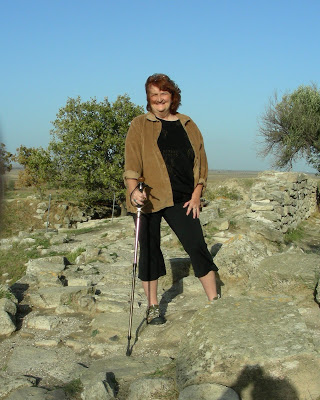
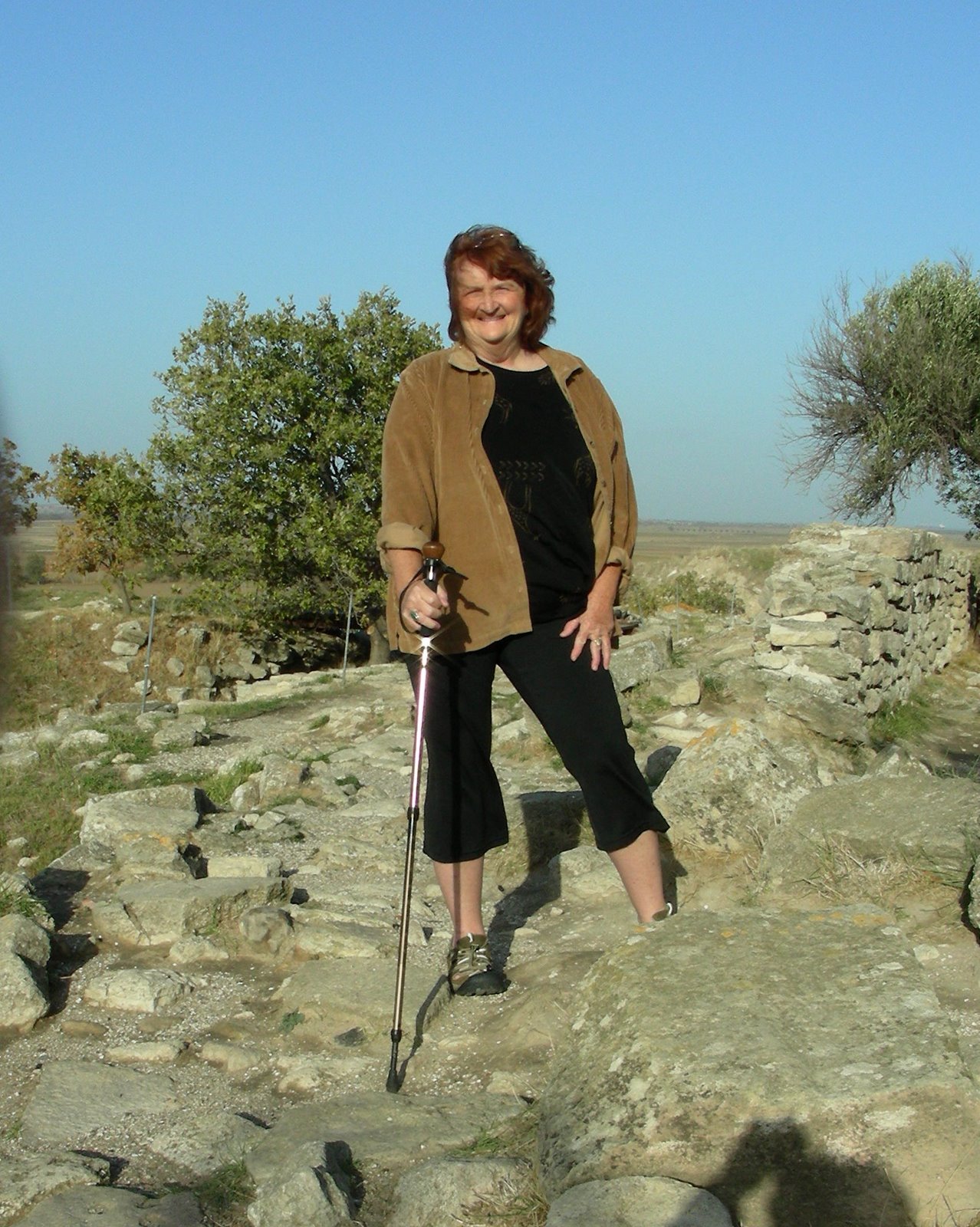
Troy has been inhabited for several thousand years, for many reasons, no doubt, but probably most importantly for its strategic location on the Dardanelles, guarding this gateway into the inner reaches of Asia Minor, and the Black Sea. What was most interesting was the fact that Homer’s Troy was the 6th level of 9 different levels of civilization that have existed there. When the site was first discovered in the late 19th century, there were no protections in place and much of the wonders were looted, moved, sold, and lost, with some of the finest treasures lost to Germany, then to Russia during WWII. We walked around the ruins, listening to the history and the stories, and I looked out across the beautiful agrarian landscape thinking of what it must have been like to live here. Suleyman discussed the theory again that the cultures of this land existed for millennia without actually having any sign of war, with trade and communications between various people going on for a long time peacefully. But people were beginning to discover power, and war actually became a real concept right here in Troy, and even though much of Homer’s story might be mythological, the strategic location of Troy is undisputed.

As Mo and I left, she said that it wasn’t very impressive, and didn’t feel anywhere near as magical as the temples in Malta felt. I suggested that might be due to the “energy” of the place, the fact that Malta was probably a sacred retreat for spiritual uplifting purposes, and Troy was a city most often functioning as a defense against aggression and war. Maybe, maybe not, but while it was fascinating, it didn’t particularly move either of us.

Back into the bus again for a long drive across the countryside of Turkey, which is amazingly beautiful. We drove up through the mountains, past Mt Ida, mentioned in the Illiad and in the Bible, and winding narrow very high roads gave us our first view of the Aegean Sea. The fall colors have started to turn, and especially in the mountains there are oaks and what looks a bit like birch or aspen that are golden and yellow. The highway dropped down along the coast, through myriad small coastal towns that looked a bit drab until we started getting into areas that still had a bit of Greek influence from the time prior to 1923. It seems that there was some sort of trade made when Attaturk created the present country of Turkey, and a million and a half people had to be relocated as a result. Greek Orthodox people living in Turkey were relocated to Greece, and Islamic Turkish people living in Greece were uprooted and forcibly moved to this part of Turkey.

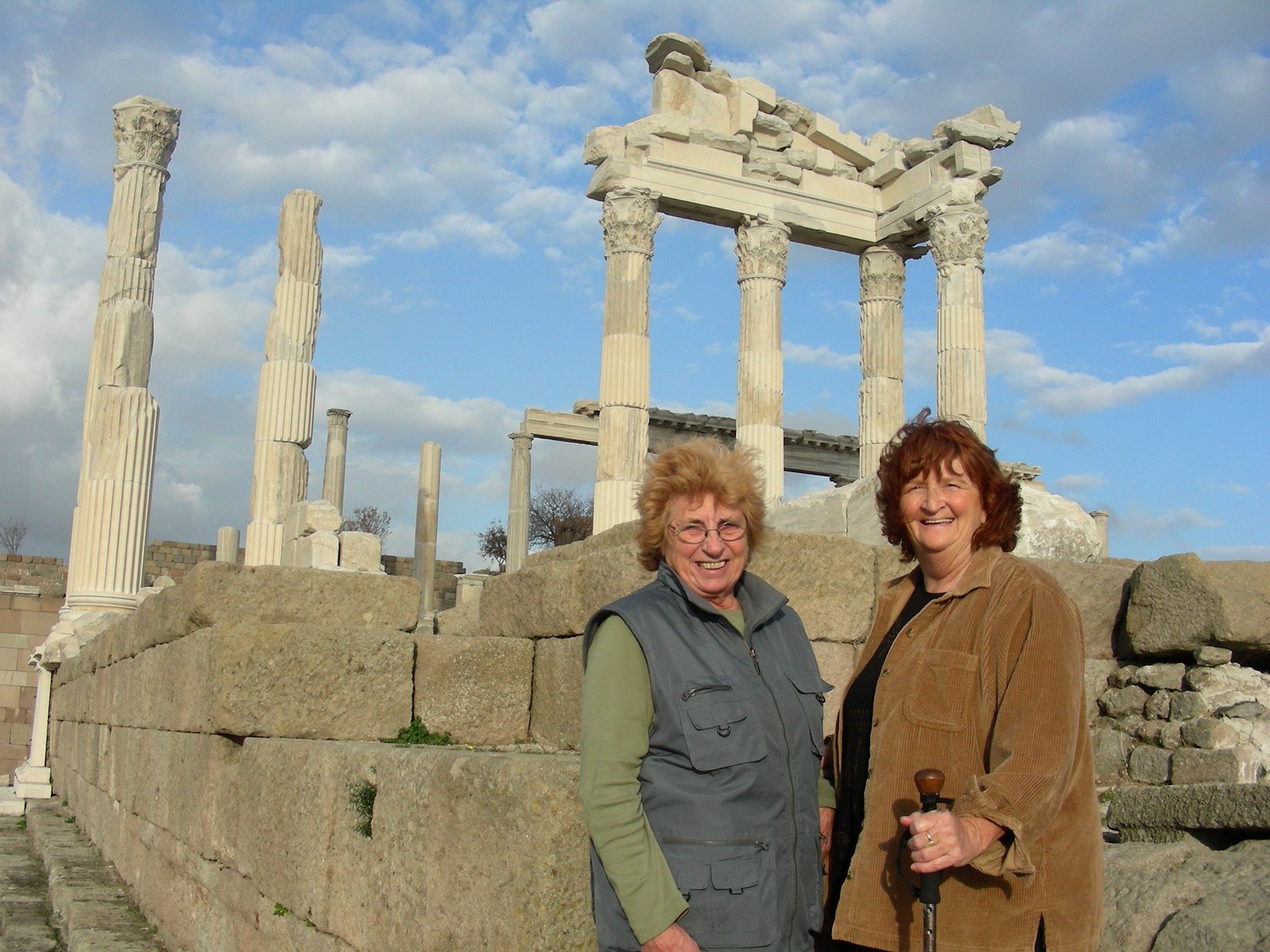
We had lunch in a hotel restaurant that can handle 43 people and continued on to our afternoon visit to Pergamon. I need the time to sit with a thesaurus so I can come up with words other than wondrous, gorgeous, magical, lovely, fascinating, dramatic, magnificent. These words don’t begin to do justice to what it feels like to climb up the narrow winding road to this temple remains overlooking Bergamon and the Aegean Sea. The history of this place is complex, with mythology and actualities mixed together into a plethora of images, but the hard reality of huge marble columns and quarried andesite walls is right there to feel and to see. The wind was blowing hard, with clouds coming from the west, but giving us breaks in the light that made it all the more delightful. Pergamon had one of the greatest libraries of all civilization, second only to Alexandria, and eventually all the books were moved to Alexandria. Pergamon was also the place where books were actually invented. Until this time, writing was on papyrus, but here they discovered how to use parchment. Since parchment was heavier and couldn’t be rolled, they had to cut it into squares and lay the squares on top of one another. Books. Here. In Pergamon. This was a place of worship and of culture, with a magnificent amphitheater built in the Hellenistic style that used the actual relief of the landscape as part of the structure. It was more than incredible. I need to work on my writing skills for this trip, I am sure, but these words will have to do for now. Thank goodness for photos.

We are on the bus again, and it is dark, after a lovely sunset over the Isle of Lesbos, which is visible here along the coast. Our destination is Kusadasi, where we will actually get to stay for two nights in a row. Ahhh. Dinner will again be some kind of buffet, but if we don’t get there till 830 or so, I guess we will be eating European style at some ungodly hour. Mo is doing better today, with her cold beginning to recede. Hopefully by tomorrow she will be back up to par all the way, and knock on wood, hopefully her cold will remain hers. No sharing needed!

Day 5 Traveling to Bursa

http://picasaweb.google.com/kyotesue/Nov24Day5IstanbulToCannakkaleViaBursa#

GoAhead Tours seems to be of the mind that we want to see as much as possible of Turkey, even if a lot of it is at 55mph! We knew that when we signed up for the tour, we knew it was ambitious, however tonight at 6 when we arrived in Cannakkale in the dark after being on the bus all day it seemed like a much less acceptable way of traveling. Ah well. It’s a tour, and I am at the stage in life where I don’t want to be schlepping my luggage around train stations with languages I can’t read sending me off to somewhere weird.

We left Istanbul this morning at 730, after an early wakeup call and bags out the door by 630. The ride out of town was lovely actually, watching all the traffic coming in from the Asia side of the city made us all very happy we were traveling east instead of west. Just a short distance out of town, we took a ferry to cross Sea of Marmara to the town of Yalova. Nice little stop at a very modern grocery store with real flush toilets, and then on to the mountain town of Bursa.

The town of Bursa is really a very large industrial city famous for its textile manufacturing, but the part we were to see was on the mountain at the base of Uludag National Park, where we could see snow and the ski lifts. We visited the Green Mosque, named for it’s green tiles (aka the Blue Mosque and it’s blue tiles), then had lunch at a nice little restaurant with a view of the city. View of the city also means view of the air pollution, the price paid for all that textile work, I guess. Suleyman told us this restaurant had the very best most classic special kabob of all, and so once more I tried it, and once more the sheepy taste got to me and I couldn’t eat it. Now I think I like lamb, but maybe I need something done to it, like bbq, or that great morrocan honey coating I ate with the lamb I had back in Spokane one time. Memories of those Morrocan lamb kabobs are what I thought I was going to find here in turkey, but not so far.

After lunch, the part of Bursa we visited was charming, and quaint, with old and not so old men playing some kind of gambling game on the side streets and a very sweet, very little old lady collecting money for her little packets of tissues. I had an ulterior motive when I pulled out some Lira, she was just so cute and I wanted her photo. She smiled with me and then insisted on a cheek kiss, both sides, and one of our tour buddies, Gong, who used to be from China and now lives in Austin, took my photo with her. Gong is great, and has a killer camera with a lens that needs a man his size to carry. He introduces himself as “gong, you know, like the gong show”. He’s very nice. The scary part of all this, is that when you look at the photo, we match, the little old lady from Turkey has the same chin and nose that I do. She could have been my ancestor from somewhere, except for the fact that she was literally half my size. Still, it makes for a delightfully fun photo at least.
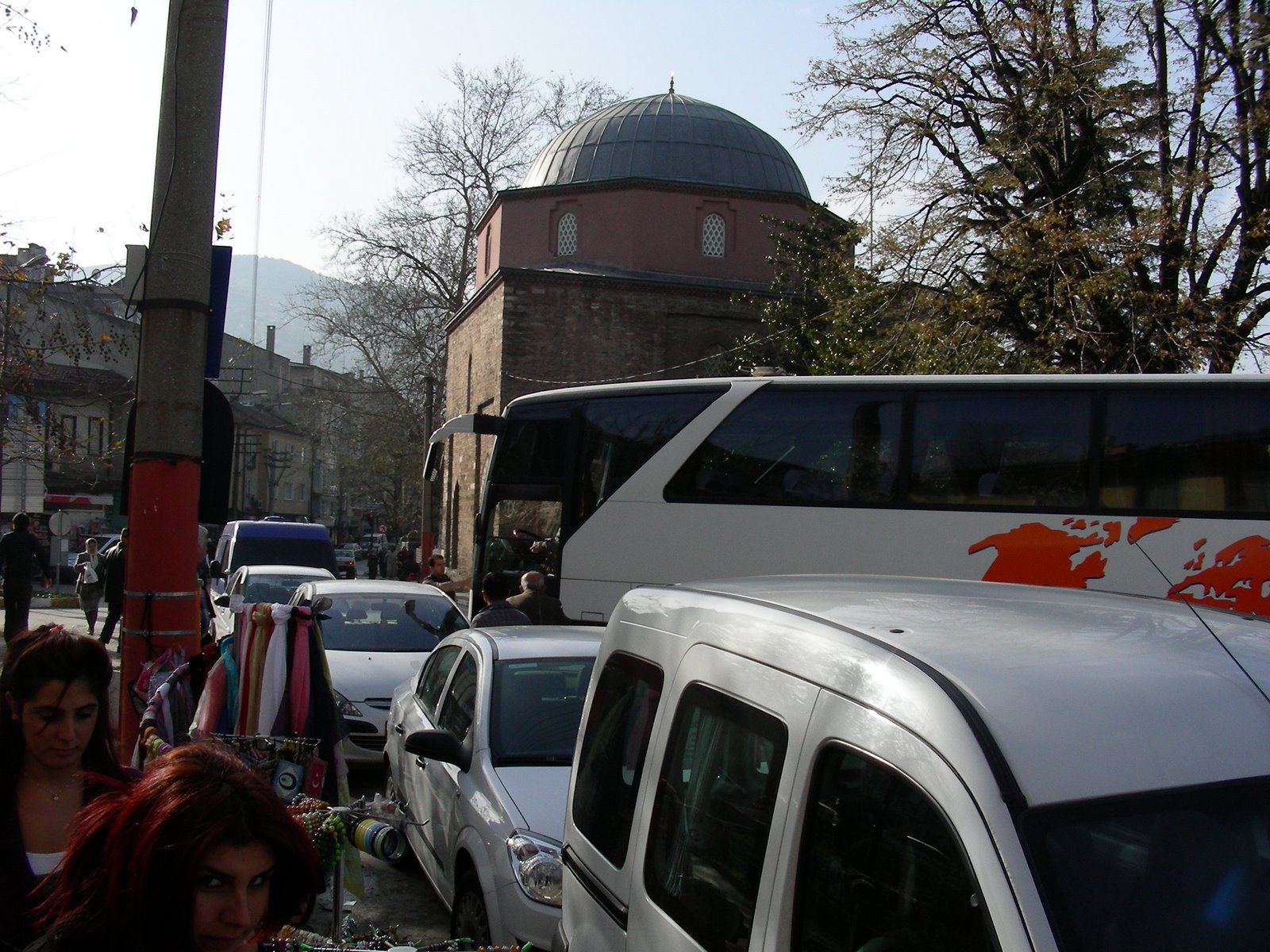
We then shopped at the Silk Market, since silks have been produced here for centuries and the shop was accessible at least. I found a great pillow cover in silk with images of Turkish horses and sultans that I love. However the big tourist bus got into a pickle trying to turn around on the streets, so we all gawked, while the locals looked entertained, and finally our tour driver Zach managed to get the monster turned around. Talk about being a tourist! Geez.

We all climbed back into the bus for the 4.5 hour drive to Cannakkale on the Aegean coast. The drive was boring for a time, but as the countryside opened up it was really lovely, much like northern California coastal landscape with rolling hills of very deep very dark soils and many assorted agricultural fields that were mostly harvested and barren. Views of the Dardanelles opened up to the north, the straits between the Aegean Sea and the Sea of Marmara, and the place where history has been made over and over throughout civilization. Tomorrow we will get more history lessons as we visit Troy.

Today however, Suleyman was focused on giving us a good picture of Islam as he knows it, and Islam as it is practiced in Turkey. Most Turkish people are Sunni’s, meaning that they do not have a hierarchy or a clergy. He explained the 5 pillars of Islam, and that all it takes to become a Muslim is to say basically ‘There is no God but Allah, and Muhammad is his prophet’. Although he explained that the translation is somewhat distorted and said that the Arabic words mean more closely, “There is no deity but God and Muhammad is his messenger”. He tried to answer questions, but became a bit uncomfortable when I asked where the word “infidel” came from. Suleyman has explained to us how many Muslims pray 5 times a day, and that there are very specific, ritualized ablutions required before prayer, with the men all washing properly at the open faucets lining the exterior of the mosques. The women perform their ablutions in private however. He also said that he only prays once a day, and that many Muslims are reformed in this way, and don’t practice so intensely, yet still consider themselves devout.

Also, we have a large group of Methodist church members traveling together, and they are mumbling, “When are we going to get to some of the Christian history”. Tomorrow, I said, tomorrow. On this next day we will be seeing many of the Christian sites talked about in this part of Turkey, including the final resting place of the Blessed Virgin. It is really interesting having tour guides with different perspectives. In Malta, a Catholic country, we learned a lot about Catholic Christian history, in Thailand, we learned a lot about Buddhism, and here we have a chance to learn about Islam from a person who practices Islam in a sectarian country, without the scary connotations that we have in the US at the moment regarding Islam. It’s one of the great things about traveling, I think. That and the food. Ha!

We landed this evening in the dark in Cannakkale, close to Troy, with the smell of the sea and the sound of the call to prayer echoing all around the hills. Mo is fighting a nasty cold, and we were glad when dinner at the hotel had come and gone so we could go back to our room and rest for the next day of wild GoAhead style travel. I think after tomorrow, though, we will have a couple of days in one place to regroup a bit and relax. Suleyman warned us in the beginning that this was a teaching trip, not a relaxing trip. He meant it. Best part for me is plenty of knitting time on the big bus that manages a fairly smooth ride even on these narrow country roads. My sweater is coming along and who knows, I might get close to finishing it before this trip is over.