07-31-2025 July Journeys: Fire, Water, Wine, and Wheels

I took far too many photos during July. After sorting through pictures and writing about our Fourth of July weekend, my visit with Melody in Brownsville, and our quick trip to Klamath Falls for the Air Show, I still had a mountain of images left and plenty more memories to track. 

That’s when I realized just how busy we had been. Even my trusty Google Calendar wasn’t much help, since a few things were missing entirely. In the end, the only way I could piece it all together was by laying out the photos in order and filling in the blanks. Sheesh!

After our delightful July Fourth, we returned home to a less-than-happy scenario. My sweet little Dakota pickup, purchased brand new in 2002, refused to start. This wasn’t the first time. With a truck of this vintage, a hiccup here and there was expected. A battery replacement, an alternator, even a new transmission back in 2017, and she still ran great until now.

My grandson Matthew came over to take a look and finally asked if he could roll it across the street to his place to tinker with it. After a few days, he reported, “Grandma, I can get it to start sometimes, but it won’t stay running, and sometimes it won’t start at all.” He was stumped. Reluctantly, I called for a tow to the Dodge dealer here in town, never dreaming her days might be numbered.

A couple of weeks later, the diagnosis came with a jaw-dropping estimate: eleven thousand dollars. The culprit was rodents that had made nests under the hood and chewed up a mess of wiring. I knew enough to understand that electrical problems of that kind are a nightmare to fix, and I had no clue where else to turn. My only option was putting her up for sale as is and beginning the search for another pickup.

We already have two cars and the motorhome, but with an acre of land to maintain, a truck is still a necessity, especially when it comes to hauling away debris during leaf season. Thankfully, a buyer showed up almost immediately. He offered me two hundred more than even the tow truck driver thought I could get. When he asked if his price was acceptable, I accepted instantly. He handed over a stack of $100 bills, looking almost surprised at my quick yes.

The sale more than covered the towing bill and the failed diagnostic charges. Still, letting go of that little truck was bittersweet. She had been good to me all these years, and I was more attached than I realized. But there’s more to that story still to come.


For a couple of weeks, things at home were reasonably quiet. We enjoyed Sunday brunches with Deborah and did a bit of puzzling when the temperatures got too hot for outdoor activities. 

The roses bloomed beautifully early in the month, and the front lawn had not yet succumbed to the drying July heat. We even had a couple of gorgeous sunsets with clouds, though there was no rain to bring much relief. I always think July is a tough month, but this year it did not seem too bad. The temperature reached triple digits for several days in a row, and we had a constant battle keeping enough water in the well. Still, it was not as bad as it has been in past years. One hundred and ten degrees feels much better than one hundred and sixteen, believe it or not.

During the last three weeks of July, our well would run low, and we needed to buy a truckload of water every week. For a mere $120, we can get 2,000 gallons of good water delivered to our cisterns. We have two of them underground to help manage our low-producing well. We talked about drilling another well, but there is no guarantee that we would find water, or that it would be fresh rather than salty, as many wells in this area are. A few quick calculations showed that we could buy delivered water for years before reaching the cost of a new well.

I spent much of July hand watering, checking the well levels, and sometimes getting a bit of free water from neighbors who have a good well and are very generous. I try not to take advantage of their kindness. 

July is also trimming season, when all the lush spring growth turns into wild summer overgrowth. When I was not dragging hoses or measuring the water depth in the cisterns, I was busy cutting back plants.

With our reverse osmosis unit producing less and less water, we knew it was time to replace the membranes. Our water guy from the local well company is excellent and will come whenever we need him. Of course, his visits are not free. Installing the new $700 membranes takes a couple of hours, and it always seems that July and August bring expensive household projects. That made it all the more refreshing to take a break, let Mo worry about the water while I was gone, and enjoy my visit with Melody, which I already wrote about.

Mo does most of the outside maintenance jobs:  this is the front gate

Just a few days after I returned, we were suddenly reminded of the realities of living in Oregon during fire season. Several emergency notifications arrived on my phone announcing a fire in a nearby area. We skipped right past the “Ready” stage and went into stage two: “Get Set.”

When I stepped outside and looked southeast, I could see smoke billowing into the sky over the mountain behind us. It was a scary sight. We both felt extremely lucky that there were no strong winds to spread the fire. What wind there was blew away from us toward the southeast.

This was the start of what became known as the Board Shanty Fire. It began on the evening of July 17 as a small 5-acre blaze but quickly surged to 80 acres by nightfall. The terrain made firefighting difficult, and crews had to battle spot fires that broke out along nearby Green Creek Road.

Within two days, the fire had grown to 469 acres, and evacuation notices went out for several zones in both Josephine and Jackson Counties. Residents closest to the fire were told to “Be Set,” while others nearby were put on “Be Ready” status. Thankfully, no major winds developed to push the fire further into residential areas.

By July 20, firefighters had managed to line the entire perimeter, though containment was still listed at only 9 percent. Aircraft made repeated drops while ground crews cooled hotspots and strengthened firelines. Over the following days, progress was steady. Containment rose to 20 percent by July 22 and 45 percent by July 25.

Seeing that smoke from our place was sobering, a reminder of how quickly fire can change everything. We felt grateful for the crews working in the heat to keep it from spreading, and more than a little relieved that the wind carried it away from us.

It was an interesting experience, to say the least. Mo and I have always considered the MoHo to be our version of an evacuation “bug-out” bag. I try to keep her fueled, with copies of important papers and documents tucked safely inside. We also store necessary medications, animal food, a minimum supply of clothing, jackets, shoes, and a bit of cash. With all that in place, the Level 1 “Ready” stage of evacuation is simple.

Level 2, “Be Set,” was another matter. That was when we had to really think about what else mattered enough to pack if the fire escalated and we had to leave in a Level 3 “Go Now” situation. It was much harder than I expected to make those choices. While keeping an eye on the smoke billowing over the mountain, I spent time walking through the house and outbuildings, taking videos of everything we owned in case we ever needed to file an insurance claim.

Our house is at the blue dot in the screenshot aboveWhat do you truly care about enough to grab in a hurry? For us, it started with the essentials: the dog and her needs, our medications, computers, phones, chargers, and backup devices. Photos and important documents have all been digitized, so we did not have to worry about paper files. What weighed on me most were the irreplaceables—original art and the quilts I have made over the years. We experienced an interesting moment as we looked down the side street on our east side.  Everyone on the street had their RVs parked at the edge of their driveway, ready to go.  We decided that maybe it was time to bring the MoHo out of the shed and park her facing out of the driveway as well.

Even though the fire never came close enough to feel like a direct threat, the experience required us to think carefully about what matters most. Both of us were extremely relieved when the evacuation notice was finally lifted. Life felt normal again. Almost.

After the fire threat eased, Mo and I agreed that an afternoon of music and good wine was exactly what we needed. I sent Deb a note asking if she’d like to join us at our favorite spot in the Applegate Valley—Red Lily Vineyard. I had resisted joining any local wine clubs for a long time because I didn’t want my choices limited. But Red Lily’s signature Tempranillo reds kept winning my heart and awards. Eventually, I decided to become a member, and sharing the wine club with Deborah gives us a great discount on our purchases.

Red Lily Vineyards is a boutique, terroir-driven winery in Southern Oregon. Its philosophy focuses on crafting wines that truly reflect their place of origin, and that sense of place comes through in every sip. The winery is nestled along the Applegate River in the Applegate Valley AVA, a sunny, warm region perfect for Spanish-style varietals like Tempranillo. Its name honors both the rare Bolander’s Lily found in the Siskiyou Mountains and the winemaker’s daughter, Lily. Everyone finds a welcoming space with a tasting room, picnic tables, and riverside seating. It’s a great family spot.

It was a wonderful afternoon, sitting by the river, sharing wine and music together.

The month of July ended on a high note with the purchase of a great little truck to replace the forever-broken Dakota. I began searching CarFax for used compact pickups, thinking perhaps a Toyota Tacoma might be the right choice. It was surprising to see how expensive even older models were, and how many miles most of them had logged.

Mo joined in the search, and between the two of us, we found a beautiful 2016 Chevrolet Colorado with only 56,000 miles. The photos looked almost too good to be true, and as we drove north to Portland to buy it, I was more than a little apprehensive. Surely it couldn’t be as perfect as it looked online. To my delight, it was. The color is a soft bronze, and inside and out the truck looks nearly new.

After completing the purchase, we celebrated by meeting Mo’s brother Dan and his wife Chere for lunch at the big food court on 82nd Street in Portland. Mo drove the car while I took the new pickup, which made for a nerve-wracking first drive on a crowded, narrow city street. It was a challenging introduction, but also a lot of fun getting used to the digital screens and all the bells and whistles we have lived without for so many years. I am still discovering new buttons and features.

Rather than making the long drive back to Grants Pass late in the day, we stopped in Brownsville, where Melody graciously welcomed us for the night. 

Melody works from home but she made time for us to visit

The next morning, I had three hours of interstate driving to get better acquainted with the truck. My favorite feature so far? The Bluetooth system for hands-free phone calls, a luxury I have long coveted.

It was a wonderful way to close out a month that had been filled with both ups and downs.

another lovely midsummer sunset at Sunset House

07-20-2025 The Amazing Air Show at Kingsley Field

The mountains surrounding Kingsley Field made a perfect backdrop as we found our spot along the flight line.

Mo and I lived in Klamath Falls for many years, but during that time, we never saw an air show featuring either the Thunderbirds or the Blue Angels. I lived in town and loved the sound of the Tuesday morning practice of the F-15s, as the fighter pilots trained from Kingsley Field, the local Air Force base. The roar of those planes flying low over my house never failed to thrill me.

So when I learned that the Wings and Eagles Air Show at Kingsley Field was happening on a weekend in July, I told Mo, “We can’t miss this one. The Thunderbirds will be there — and so will our beloved F-15s and other fighter jets!”

The wide open skies of the Basin — a familiar landscape from our years in Klamath Falls.”

It was a sunny Sunday morning when we left Grants Pass to drive over the pass once again to visit the Klamath Basin. I don’t really miss living there, but I do love to return. I love seeing the open space of the Basin, driving along Klamath Lake, and remembering the years when Mo and I explored the refuges, full of migrating birds.

The day was forecast to be hot. The sun on the east side of the Cascades is stronger and brighter than where we now live on the west side, so we brought sunglasses and visors to enjoy the show. What we forgot was sunscreen. I paid for that later, and I’m sure my dermatologist would be aghast if she knew!

Kingsley Field Air National Guard Base, located on the south side of Klamath Falls, has been an important part of the U.S. Air Force since the 1940s. Originally established as a training base during World War II, it has hosted a variety of aircraft over the decades, from P-38 Lightnings to F-4 Phantoms. Since the 1990s, Kingsley Field has been home to the 173rd Fighter Wing of the Oregon Air National Guard, with a primary mission of training F-15C Eagle pilots.

The Thunderbirds were the highlight of the show, but before that finale, we were treated to some amazing displays of U.S. Air Force capabilities. First, though, we needed a place to sit. We had folding chairs, but all the shady spots under the huge wings of display aircraft were already taken by savvy spectators. Instead, we set up along the fence separating the crowd from the flight line — a hot spot in the sun, but a perfect view of the runway.

The first demonstration came from the F-35 Demo Team, currently based at Hill AFB in Utah. Their maneuvers included the minimum-radius turn, a high-alpha loop, and an especially breathtaking slow-speed to power climb. Ironically, going slow in a fighter jet takes more skill than going fast.

We also learned that the F-35A Lightning II is replacing the F-15 training at Kingsley. The base is scheduled to receive 20 F-35As to replace its current 27 F-15Cs.

The F-15 Eagle demonstration was particularly thrilling — not only because of their speed and power, but also because these aircraft are nearing retirement at Kingsley. For decades, the base’s mission has centered on F-15 training.

We also saw the massive KC-135 Stratotanker demonstrating aerial refueling maneuvers. Capable of carrying up to 83,000 pounds of cargo, it was impressive to see such a large aircraft move so gracefully. 

Between the military demonstrations, several civilian acts entertained the crowd — including the Smoke and Thunder Jet Show, Wingwalker Sam, the Mini-Jet Airshows, and Undaunted Air Shows. While entertaining, none quite matched the sheer thunder and spectacle of the Air Force jets.

Finally, the Thunderbirds rolled out onto the runway. Watching their precision formation take flight was beautiful, though honestly, I found the raw power of the F-35 and F-15 more exciting. One frustration was the long delay before they took off — half an hour of loud music and announcements before anything happened. Still, this was my first time seeing the Thunderbirds, and I was grateful for the experience.

By the time we drove back over the Cascades to Grants Pass, we were tired, sunburned, and thoroughly happy to have experienced such a spectacular air show at Kingsley Field.

And yes, I DID get a pretty good sunburn

06-21-2025 June Trip to East Lake Oregon

Before I begin writing on this very warm late June afternoon about our recent camping trip, I want to share a few things that make me happy.  Sometimes it is easy to slip into negativity about this or that, about the state of the world or the state of my health, or simply the fact that I will be 80 in a very short time.  But then, even without trying, “grateful” will kick in.  

Can you find the kitty? I’m grateful for our neighbor’s kitty, who seems to like spending the night in our yard, ensuring our resident gophers don’t take over the pasture.

I decided to keep track of those grateful moments that come unbidden, another little thing for which I am truly grateful.  Does anyone remember the popularity of the old “Gratitude Journals,” which were part of the New Age Movement back in the 80’s?  I kept one for years, and found it recently in an old drawer of journals that escaped the fiery purge I did a few years ago when I decided my kids didn’t need to see all my neuroses from my youth.  The journal is wonderful and a delight to read.

I am grateful to the young woman who carefully dusts all the ceiling fans every two weeks

Incredibly grateful that the same young woman cleans the floors and the rest of the house so nicely, and that at this stage of my life, we can afford to buy a bit of help.

Speaking of floors, I am so grateful for the luscious silkiness of the finish on our oak floors every time I walk on them barefoot, which is often, because we are a shoeless home.

Sometimes, standing in the kitchen in the evening after supper and wiping the counters, I am so grateful for the cool smoothness of the granite (actually gneiss) counters that we chose so carefully more than 8 years ago. For the teapot from my sister, the knives I bought one by one for the new house, and the beautiful antique tiles that Mo packed around for years before they found a home in our kitchen.

Beyond grateful that there are the resources to build a new fence when we decided that the trees recently removed between our house and the neighbors left us just a little bit too open.

But now it is time to focus on the real reason for this blog.  Another trip in the MoHo to another favorite lake.

Mo and I have loved East Lake ever since we first camped there back in September of 2008.  At that time, Mo’s brother and wife Nancy lived in La Pine, Oregon, just down the hill from the Newberry Crater, where the lake is located at the bottom of the Newberry Caldera.

An especially sweet memory of our trip to East Lake in 2008 since Roger is no longer with us

Mo and I have returned to East Lake a few times since then, and every single time we have loved the campground and the lake. The lake is one of the twin lakes that occupy part of the Newberry Crater (caldera) in Central Oregon. It is located in the Deschutes National Forest east of the city of La Pine. The caldera was formed over 500,000 years ago from volcanic eruptions. East Lake’s water comes from snow melt, rainfall, and hot springs only. The average depth is 67 feet, 180 feet at the deepest point, and it covers about 1,044 acres. 

East Lake has two main camping grounds along the lake shore as well as East Lake Resort. The resort has cabins and boats for rent, in addition to a general store. Mo and I have explored Paulina Lake and the other campgrounds in the area and have decided that East Lake Campground is our favorite.

Trout were first stocked in the lake in 1912. The lake offers fishing for brown trout, rainbow trout., Kokanee, and Atlantic Salmon. East Lake is one of the finest and most traditional fisheries in Oregon, regularly producing brown trout over 10 pounds. The lake record for brown trout is 22.5 pounds.

Notes from my journal on the day we arrived:

 “We just arrived at East Lake about 20 minutes ago. It started snowing between the six-mile and the 12-mile snow park once we passed the unmanned entry gate. The snow was coming down rather in earnest, but it was still mixed with rain. And right now, as we look out over the fog-shrouded lake, it is either raining or snowing, I am not sure which.”

In spite of the weather, we were content.  We had charged batteries, plenty of food, our site was perfectly level, and the propane furnace was going strong, keeping us toasty.,

When we first pulled in, we didn’t unhook the baby car, and simply pulled right into our spot. As luck would have it, there was a sharp angle between the MoHo and the Tracker, and the little car didn’t want to come off the hitch.  Lucky for us, we were able to do some jockeying around with the motorhome,  got the Tracker a little bit straighter, and finally got the hitch unhooked. 

We decided that with the snow coming tonight to leave the slide closed so that we wouldn’t get any snow accumulation on the slide topper. 

Site 3 at East Lake Campground in the Newberry Caldera National Monument

We were settled in by 3:20 in the afternoon, watching the snow.  The previous night was the first of three we reserved, and we didn’t make it to the campground because of all the overnight snow on our route through the Cascades.  With only one night left after tonight, we hoped to get an additional night.  The campground looked fairly empty, but all the sites had reserved signs on them when we walked through the park to check for open spaces for Monday.

We arrived on a Saturday, and the weather for Sunday was predicted to be a bit better, and then by Monday, it was going to be clear and warm once again.  Things shift fairly quickly in the mountains. 

We enjoyed an indoor supper after 6, an easy dinner of leftover burger patties in a rich onion gravy with green beans and tiny little boiled yellow potatoes.  The rain dissipated a bit as the evening progressed, and the wind came up, so we debated some more about opening the slide.  Things are so much roomier when the slide is open, but with the inclement weather, we decided to leave it closed.

After supper, we took a walk with Mattie around the park, hoping to check in with the camp host and ask about Monday night. Even though there was a camp host sign, and the trailer in that spot looked inhabited, there was no sign of a human and no answer to the knock on the door.,

After some dominoes, we settled into our warm bed to enjoy the sound of the wind and the rain on the last day before summer solstice, the longest day of the year, and technically the beginning of summer.

The next day, June 22, was middle daughter Deanna’s birthday.  She was celebrating at home in eastern Washington with her husband and grandkids, and her sister Deborah, who traveled from Grants Pass to visit for a few days.  There was no way to wish her a Happy Birthday because at East Lake, there is no phone service, no internet, and no text messaging.  We were completely off-grid, something I had forgotten about camping here, and it does take a bit of getting used to.

We both slept fairly well that first night, waking up around five and staying in bed till 7:30. There was nothing particularly exciting to get up for. We couldn’t turn on the generator until 7, and that’s when we made our coffee. In the old days we used to make coffee in a French press with boiling water, but we got tired of the mess, and we got tired of the hassle. So, now we just wait for power to use my Keurig and Mo’s electric pot, and we have nice hot coffee by 7:30. 

Our plan was to go kayaking that morning, but we woke to a little bit of a breeze on the lake and snow just above us on the hills across from the lake. It wasn’t really conducive to jumping in the kayaks. We had breakfast, and then we unloaded the kayaks, in readiness for a shift in the weather.

On this trip, Mo brought enough wood for plenty of campfires, and we decided that a daytime fire would be great.  That was our plan for the morning after breakfast…sit by the campfire and enjoy the beautiful view of the water from our site. We brought enough wood for three nights, and we doubted there would be enough dry weather to use all the wood.

We unloaded the kayaks, locking them to a tree by our site, with hopes for a shift in the weather by afternoon.  We readied the BBQ for supper pork chops, and laid out the tablecloth for dinner. Sometimes the lovliest part of a camping trip is simply quiet time in front of a lake by a campfire.

By mid-afternoon the weather shifted, and the winds were calm enough that we launched the kayaks

There used to be a really nice spring along the shoreline of East Lake, but over the years it has shifted. When we first visited years ago, the springs were easily accessible by kayak on the east side of the lake.  The springs were also accessible via a trail along the bluff above the lake, but the shoreline trail was usually under water.  The water was hot and clear and about 2 feet deep.  

East Lake Hot Springs in July 2013

In 2013 Nancy and I kayaked over to the spring from the campground and Roger and Mo hiked the upper trail to look down on us from the bluff above.  At that time, the water felt great.

This year, however, the springs appeared lower along the shoreline, due to water level shifts, and only 6 inches of water bubbled a bit. Still, it was fun to kayak to the springs and remember when we could soak our feet in the hot sulphur water.

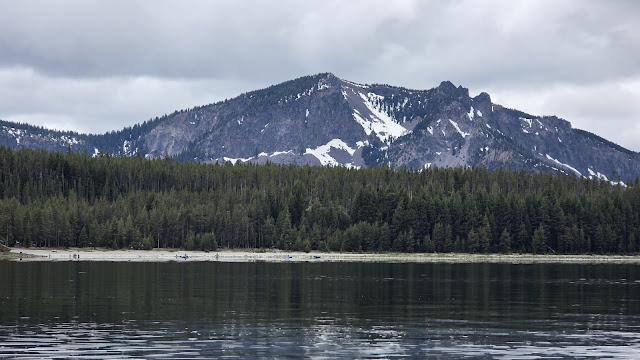
We stayed on the water for a couple of hours, enjoying the glassy surface, the birds, and the stormy skies with view of Paulina Peak to the south,

Still attempting to identify this bird.  There were dozens of them flying around us, almost landing on the boats

Paulina Peak, south of the campground 

If you look close, you can see the MoHo to the left of the boat launch and right of the white rig

Plenty of signal at the viewpoint looking toward the Cascades and the Sisters

After we returned that afternoon, we decided we were tired of having no communication with family and no internet, so we drove up the hill and then back down to the Twelve-Mile Sno Park where Gaelyn camped in 2023 and where we knew we could get a bit of internet.  It was important this time around, with things going on with family that we wanted to be sure we were aware of.  It didn’t take long, and it was a bit of a relief to discover that all was well, but it is surprising how difficult it can be to have no contact. Sometimes I like it when we are off-grid, but this wasn’t one of those times.

Our evening fire felt good, but not so good that I didn’t need my fuzzy sweater beneath my lined rain jacket and a warm wool hat to sit and enjoy it.

The next morning dawned clear and gorgeous, and before breakfast, I took Mattie for a nice walk along the shoreline toward the springs.

Look closely and you will see the icy frost along the trail where we walked

Mo and I didn’t kayak on that day because once again, I drove to a phone signal site and called the dermatologist about the surgery wound that didn’t seem to heal. She said “Can you be here tomorrow morning?”.  We decided it was best to simply pack up after just two nights on the lake and travel over the mountains toward home.

Before we left Mattie got to play with a very nice dog named Trish.  Such a calm sweetheart that dog was, even though Mattie intimidated her a bit.

By the time we returned to Grants Pass, the skies were clear, with no sign of the crazy weekend storm that covered most of Southern Oregon the previous weekend.  

I won’t include any photos of the dumb wound but will say that the doctor gave me a resounding approval and said it was healing well.  Mo and I were both relieved and glad that we managed to get back home for the last-minute appointment.

07-08-2025 The Fourth of July at Fish Lake

Setting up camp at Fish Lake 

The Fourth of July has always been a family holiday for us, a time to gather, share food, and make memories together. Of course, even the best-laid plans can sometimes be thwarted. This year, our plan was to meet up for a camping trip at Fish Lake in the Oregon Cascades. Mo and I were looking forward to time with daughter Deb, grandson Matthew, and his girlfriend Katy, and with daughter Melody and son-in-law Robert, who make the drive down from Brownsville. A cozy circle of family, gathered in one of our favorite mountain places—that was the dream.

But sometimes life has other plans. Robert was away on a work trip, so Melody stayed home in Brownsville to keep the cats company. Matthew and Katy, ever so responsible, couldn’t leave their elderly charge, Karen, alone overnight. And just like that, our big family Fourth of July celebration turned into a quieter gathering of three—Mo, Deb, and me.

Family at Lake of the Woods, 2016

It wasn’t the first time we’d celebrated the Fourth in the Cascades. In years past, our extended family spent long, sun-soaked days at Lake of the Woods, a beautiful mountain lake not far from Fish Lake. Camping there over the holiday is wildly popular—so popular that reservations vanish the very moment they open. This year, I tried but discovered that people had booked entire two-week stretches leading right up to the holiday. By the time I checked, there wasn’t a single site left.

That’s when the plan shifted. Fish Lake is just down the road, quieter and less competitive when it comes to reservations. We realized we could set up camp there, enjoy the peacefulness of the lake, and still make the short drive over on the evening of the Fourth to watch the annual fireworks burst above Lake of the Woods. A perfect compromise, and one that gave us both serenity and celebration.

We left early enough to arrive at Fish Lake by two o’clock, plenty of time to secure our site. Deb followed along and pulled in not long after us. The weather couldn’t have been better—blue skies, just a ripple or two across the water, and that fresh, pine-scented mountain air that makes you breathe a little deeper.

Our campsite turned out to be a gem. Through the trees we had a peek-a-boo view of the lake, and the site itself was surprisingly spacious. It even included a special raised tent platform, perfectly level—likely an ADA feature. Deb’s tent was just a hair too large for the platform, but with a bit of fiddling (and one wing folded back) she managed to make it work beautifully.

Deb’s large and roomy tent

Mo’s handy little tent from many decades of tent camping in past years, that Deb decided to try 

Once the tents were up and the gear in place, we settled into an easy rhythm of the afternoon. Mo got a good campfire going, and that’s when we stumbled across our newest camping companion: Eldarr. Someone had left behind the sweetest little gnome, and we immediately adopted him. With his tiny cap and whimsical smile, he was too adorable to ignore. Eldarr quickly became our campfire mascot.

That evening, with the fire crackling and the light softening through the trees, we opened a bottle of wine and shared a simple supper of spaghetti and salad. Nothing fancy, but in the glow of the fire and the company of family, it felt just right. We lingered there into the night, talking, laughing, and sinking into the kind of relaxation that only camping seems to provide.

The Fourth itself dawned easy and quiet. I felt the tug of holiday energy, that little voice that says we should be doing something festive, but instead we let the day unfold slowly. We took the dog for walks, watched the lake glitter through the trees, and enjoyed the hush of the forest all around us. Sometimes doing nothing is exactly what you need.

Originally, our plan had been to drive over to Lake of the Woods for the traditional fireworks. But, as with so much of this trip, plans shifted. Just before the holiday, the resort announced that the fireworks show—after more than sixty years—was canceled. Rising costs, the loss of long-time volunteers, and growing safety concerns had finally caught up with the tradition. Instead, for the first time, they would host a laser light show over the lake.

It wouldn’t be the same, of course. I love fireworks, they have a certain magic—the boom echoing off the mountains, the shimmer over the water—that lasers couldn’t begin to replace. We weren’t interested in making the drive to Lake of the Woods and dealing with crowds and traffic for a laser show, so we chose instead to stay home in camp.  .

We decided that enjoying our smoker cooked ribs that Deb had prepared didn’t need to wait until dinner time.  We enjoyed our meal in early afternoon, and the ribs were so delicious. Accompanied by our tradition Fourth of July potato salad, some chips and more wine, it was a perfect afternoon meal that extended into suppertime.

Later, we wandered down to the water’s edge, following the narrow path through the pines. Fish Lake isn’t as deep and clear as Lake of the Woods, but its quiet beauty has a way of working on you. Lake of the Woods is much bigger and has no restrictions on big noisy boats and jet skis.   Fish Lake is much quieter, with a few slow fishing boats and people bobbing happily around on float toys. Sometimes the quieter places give you exactly what you didn’t know you needed.

It was the quietest Fourth of July we have ever spent without any explosive sounds marring the silence of the night

The morning after the Fourth was every bit as peaceful as the holiday itself. Sunlight sifted down through the trees, warming the air just enough to take the chill off. The lake was calm, broken only by the occasional ripple of a breeze. With only two kayaks and three people, Mo made the generous offer to stay in camp with Mattie so Deb and I could paddle together. We drove just fifteen miles down the mountain to Recreation Creek, our favorite kayaking destination of all time.

Mo and I have explored these waters for years, and still we’ve never found another place that compares. The Upper Klamath Wildlife Refuge is full of life, and the creek meanders so gently it feels like drifting.

Deb and I decided to head south this time, following the creek as it enters Pelican Bay on the northwestern edge of Klamath Lake. The morning was calm and perfect, the water like glass. A large group of Canada geese greeted us along the shoreline, their reflections mirrored in the still bay. At Harriman Springs, the water turned deep and astonishingly clear—we could see trout darting quickly below our kayaks, their silver bodies flashing in the light.

The one sadness was not finding any of the mare’s eggs that used to thrive there. These strange colonies of algae (Nostoc pruniforme) once grew like dark green softballs in the spring, gelatinous and otherworldly. They seem to be gone now, unable to survive as conditions have shifted. Still, the water, the wildlife, and the peace of paddling with Deb made the day unforgettable.

When we returned, Mo was waiting with Mattie. She had enjoyed her own quiet morning walking the dog and resting in the shade, and it felt good to come back and share stories of the paddle.

Later that afternoon, Mo and Deb, and I decided that another trip down the hill to our old home in Rocky Point would be fun.  We have friends there, and I called to see if they might be home and available for a visit.  Mata and Jim welcomed us with open arms and a cold beer as we sat on their porch, enjoying the afternoon.  Deb was amazed at the fabulous view that Mata and Jim have enjoyed for the several decades they have lived in Rocky Point. It was wonderful seeing our old friends and spending some time together.

On Sunday morning, Mo got another fire going, and we put together a simple breakfast. I snapped a few photos to capture the light slanting through the forest. We stayed like that until it was time to think about packing up. None of us were quite ready to leave, but the ease of the morning made saying goodbye to the forest and the lake a little easier.  

Driving home, I thought about how different this holiday had been—smaller, quieter, simpler. And yet, the peace of this camping trip felt like a true gift.

No fireworks, no big family gathering, no crazy Bocci ball on sloping lawns. The big family circle was smaller, there were no fireworks, and our plans shifted more than once along the way. And yet, sitting by the fire with Mo and Deb, walking the quiet forest trails, and watching the light play across Fish Lake, I thought about how little those changes mattered. What stayed the same was the heart of the holiday—time spent together, making memories in the places we love.