06-06-2025 There is Something About That 3:30 am Hour, and our May Camping Trip

Daughter Deborah captured these images of Mo and me in a familiar moment, with Mo trying to figure out why I am being so silly. Could it be the wine?

 I am not really sure how many long-time readers are still hanging around my blog, but if any of you are still here, you may remember that my best time for writing is often in the wee hours of the morning. Spring and Early Summer are in full swing now in Grants Pass, which means that gardening season is here. Cleanup in April, planting in May, trimming in June. The flow of the seasonal progression around here is a precious thing.

In that lovely progression, I had a fall, landing on my hip.  Thought maybe I cracked something, but no, just old lady arthritis, and a 7-day round of Prednisone was the solution to night pain that kept me awake.  Now I am awake, not from pain but from the spectacular miracle drug that is also full of side effects, like keeping me awake.  I try not to take it more than 3 times a year when nothing else seems to do the trick and lessen the uncomfortable feelings of IBM and aging.

At 3:30 this morning, I woke and treasured the intense quiet of the night.  No barking dogs, no cars going by, no sounds from town just below our terrace.  The moon is gone and the stars are brighter this time of night.  We have a couple of solar lanterns on the decks, and yesterday I added some solar lights along the back gardens.  The glow in the sky is the glow of our town, which is captured perfectly by the night mode on a Samsung camera.  Silly photo, but it reminds me of the silence that kept me awake and sent me here to the office to write about our last camping trip.

Daughter Deborah camped with us again, only this time she brought her own tent for sleeping instead of staying in the RV.

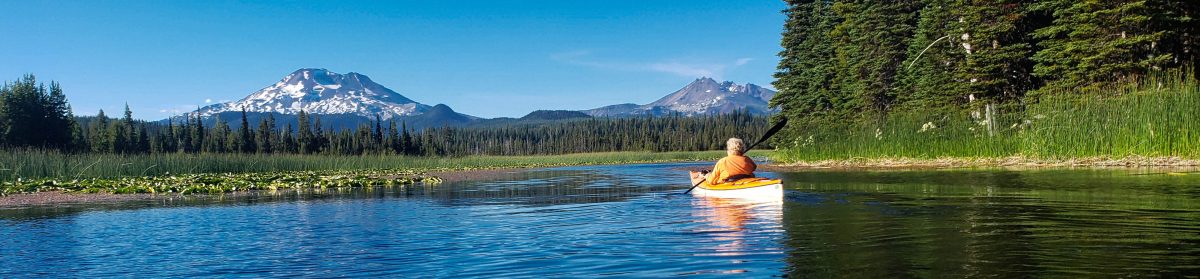
Despite the springtime chores, we still manage to get in at least one trip each month, and Mid-May was no exception. Our destination was close, just a little over an hour east toward the mountains and the lovely Lost Lake Reservoir.  The Joseph Stewart State Park is still called that even though it is now owned and operated by Jackson County Parks.  

Lost Creek Lake is a reservoir on the Rogue River in Jackson County, Oregon. The lake is impounded by William L. Jess Dam, which was constructed by the U.S. Army Corps of Engineers in 1977 for flood control and fisheries enhancement.

Monday midday at Joseph Stewart, with all the Mother’s Day weekend campers gone.

It is a lovely park, with widely space campsites, well maintained grounds, electric and water hookups in about half the campsites, and a dump station that worked better than most we have encountered.

Our campsite, with room for the MoHo, the Tracker, Deb’s adorable Subaru, with her tent, and a partial view of the lake toward the back.

Above, The view of our launch site at Catfish Cove, across the lake from our campground. Below, aerial view of the perfect place to launch kayaks on Lost Creek Lake.

We camped at Lost Lake in 2023, and like that year, the reservoir this year was 99 percent full, a lovely condition which encourages kayaking.  We usually avoid reservoirs because, in years of drought, there are only brown dirt embankments surrounding the water, and it isn’t very pretty from a boat.  Summer may still bring drought if predictions are correct, but in spring during snow melt this year, all the reservoirs in the Rogue Valley system were full.  I wish we had time to go camping and kayaking at every single full lake within an hour or two of home.
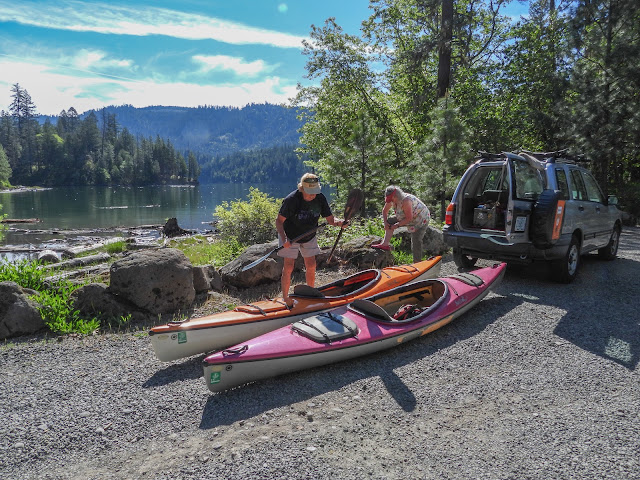
On this kayak trip, however, we initially planned to take turns in the boats, with three campers and only two kayaks, it was the only solution. However, a couple of minor surgeries involving my lower leg and my toe meant I couldn’t get in a bathtub or a hot tub, much less a wild lake. As a result, we had two kayakers, Mo and Deborah, two kayaks, and me.  I helped with the launches, waited in the car with the dog and went on a few short hikes. 

And they are off, on a bright clear morning with very little wind

I drove back to the bridge crossing the lake for a view of the two of them from above.

Watching until they disappeared upstream

Such a beautiful place on a sunny morning, and it was fun to see it all from a different perspective and try to follow them on the trail that parallels the lake on the left side.

Mariposa lilies and lupine lined the trail in the sunnier spots

In addition to kayaking, we had campfires every night.  The winds weren’t as strong as they had been in the past, and the smoke was manageable and even laughable at times as we moved our chairs around the fire to be in just the right spot to avoid it.

Suppers were pre-planned, easy and fun, with the favorite being a bbqed pork loin with my own special marinade, creamy vanilla and maple flavored sweet potatoes, and my signature plum-cherry sauce for the pork.  Steamed and seasoned green beans rounded out the colors.

The second morning of kayaking wasn’t quite as perfect, with overcast skies and a bit of wind shortening the time on the water for Deb and Mo to less than an hour.  They still loved it in spite of the challenges, and I enjoyed more time walking the short trails around Catfish Cove.

Later that day, the clouds lifted and we went for a long walk around the park.  This time, I needed to use the trusty walker on the rough trail, and it added a bit of challenge.  Onward, and keep laughing!

It was Mother’s Day, and Deborah wanted to treat us to a lovely dinner at Mac’s Diner in Shady Cove, just half an hour from the campground.  Deb lived in Shady Cove for some years and had often mentioned wanting to take us there.  We had a good time with a great view of the river, enjoying the unique ambience of the diner.


That night it rained all night, and Deborah used a tarp to keep her tent dry.  We decided that a rainy day might be the best time to do some local sightseeing, and instead, the rain stopped and our sightseeing day was spectacular.

Deb took us to a waterfall that, in all our years of driving up Highway 62 toward Crater Lake, we had never seen.  Just a couple of miles east of the highway is Mill Creek Falls, a spectacular cascade that flows underneath a beautiful historic bridge.

Returning to Highway 62 through the little community of Prospect, we continued to a familiar place where Mo and I often take guests on our sightseeing trips around Grants Pass.  The Natural Bridge area has a lovely trail to the wooden bridge that crosses the wild Rogue River.  There are interpretive signs that explain the volcanic geology of the area and the way the river goes underground through the volcanic rock that makes up the Rogue River Gorge.

The Rogue River is magnificent from its birth, not far from this spot in springs on the east side of Crater Lake, all the way to its meeting with the Pacific Ocean at Gold Beach. For any river nerds reading this blog who might like to get into the weeds about the Rogue River, here is a link to a great article in Wikipedia that describes its beginning, its end, and all the tributaries that flow into it.  (The Rogue River). The great river flows through our town and is a highlight of a drive to the grocery store.  A few miles west of us, the river is designated as “Wild and Scenic” and is a wild run of rapids and beauty for the most adventurous rafters.

A cool, rainy day was the perfect backdrop for a stop at the historic and iconic Beckies Cafe at Union Creek.  Famous for their Marionberry pies in season, this time we had to settle for a simple blackberry pie, also perfect.  Surprisingly, the French fries were the best we had eaten anywhere.  Pie and fries, what could be better?1

Beckie’s is famous all over the world, often mentioned in travel stories about driving to Crater Lake with a stop at Union Creek for their famous pies.  

The cafe has a rich history spanning over a century. It was built in the early 1920s by Ed Beckelhymer and quickly became a popular stop for travelers and locals alike. The cafe is part of the broader Union Creek Resort, which is still a thriving business with lodging and guest cabins. 

Ed Beckelhymer, known to locals as “Beckie,” originally ran the restaurant and a service station. The Union Creek Resort, including Beckie’s Cafe, was a significant part of the early tourism in the area, serving as a popular camping spot and a place to rest for tourists and berry pickers. After Ed’s passing, his wife, Cecil, continued to run the business, also known as “Beckie,” and became famous for her huckleberry pies. Beckie’s Cafe is listed on the National Historic Register.  The cafe remains a popular destination for those seeking a taste of the past and a peaceful setting near the Rogue River and Union Creek. 

After our snack, we continued east and north on Highway 62 just a short distance from Beckie’s, to visit Deb’s favorite spot on the River, the Gorge.  Here, the trails wind along more wild cascades where the river has eroded the volcanic rock into a deep gorge.

Rogue River Gorge Viewpoint has a short, paved path loaded with incredible, close-up views of the river’s rushing waters through the narrow channel. There are incredible views of a portion of the 215-mile Rogue at its narrowest: just 25 feet wide and screaming with the hydraulic force at a rate of about  410,000 gallons per minute. Along the path, there are more interpretive signs explaining some of the science of what’s going on here, including one for The Living Stump, which is exactly what it sounds like, a stump that, because of its interconnectivity with roots of neighboring trees, has continued to live. 

Yes, we ended the day once again in the rain. The two-shoe option had to do with the foot surgery that made it impossible to wear a proper shoe on both feet, but I needed at least one to keep proper balance.

Our camping trip was the perfect balance of sunshine, rain on the roof, kayaking, sightseeing, and excellent food. It was a truly spectacular way to spend Mother’s Day with one of my daughters, and Mo and I agreed the short trip, just an hour from home, was nearly perfect.  We are so very lucky to live where we do.

Deb got a phone shot of the full moon rising on our last night at the park.  

May is just behind us now, and writing about our trip and the cool rain and lovely days reminds me why I always say that May is the very best time to visit this part of Oregon.  Our green grasses are now browning in the lower pasture where we don’t irrigate.  The days have been nearly perfect, with only a few reaching the high 80s in the last weeks of the month. 

Astrological summer begins this year on June 20th at the Summer Solstice.  However, meteorological summer, as defined by climatologists, runs from June 1st to August 31st. This is a fixed, three-month period that is used for more convenient data analysis and comparison of seasonal trends across years. Here, it already feels like summer, and we are expecting triple digits in Grants Pass this coming weekend.  Now it begins.  The sweet spot is over, and now we wait for the heat and the dryness, the possible fires and all the other delights of living in a place that is very nearly perfect, but not quite.

04-19-2025 Final Day on the Columbia, the Locks, and Multnomah Falls

Early morning on the Columbia River east of the Cascade Locks

Something we didn’t really realize until we reviewed our itinerary in detail was that our river “cruise” was more about river ports than actually cruising on the river.  Much of the travel was completed during the night hours with arrivals after midnight and departures after dark.  This is reasonable for most people who are interested in exploring the ports along the Columbia River, but for us, it was a bit of a disappointment.  We were most excited to be on the river, to feel the motion of cruising, and watch the landscape as we passed. 

Our last day on the river gave us the best of everything, thanks to a few minor kerfuffles that required a bit of jockeying around for the ship captain.  First, he notified us that our departure time from the Port of Kalama would be earlier than scheduled because of the heavy river traffic ahead.  The captain hoped to get to the Cascade Locks at the Bonneville Dam before 4 AM to be ahead of some other ships and avoid long waits at the locks.

Mo and I set our alarm for 3:30 AM to be sure that we wouldn’t miss the lock transit, but when we woke we discovered that our ship was quiet in the water and the locks were still more than 6 miles east of our location.  We put on warm coats and watched outside our stateroom for any sign of activity.  

We walked down the hall to the breakfast room for some coffee and finally went back to our room to wait for word from the captain.  After a time, anxious to see how far away we were from entering the locks, we went outside on the lower deck and settled into the rockers to watch the early morning light and wait for something exciting to happen.

The tiny lights of Bonneville Dam and Cascade Locks appeared in the distance just as it was turning daylight.

Passing Beacon Rock on the north shore of the Columbia

The ship was moving very slowly toward the dam, and then once again it came to a standstill

At last, the locks came into view, and we thought we would be passing through the lock

But no, American Jazz passed us into the lock as we waited another hour before entering

The captain told us later that the issue had to do with the Jazz’s itinerary. She had priority since she was heading farther east all the way to Lewiston, Idaho. We learned much about the jockeying of ships on a busy waterway and what gets priority passage at different times.

Once our ship was in the lock, the gates closed, and the water began to rise, lifting the ship to the next level of the river.

Looking west from the lock toward the lower level of the River below the Bonneville Dam

Mo and I have both experienced going through locks on waterways, including the Panama Canal in an ocean liner, and the many locks on the Rhine in Europe.   Each experience is different, and I doubt I would get tired of the engineering magic that allows ships to shift levels on a river or between oceans.

The delight of this extended delay was the opportunity to cruise the Columbia River during daylight hours instead of in the dark as originally scheduled.  In addition to the delay at the locks, we needed to take on fuel, and the port at Stevenson, Washington, was closed for an undisclosed reason.  This necessitated that we travel additional miles to fuel at Hood River.

The Bridge of the Gods that crosses the Columbia from Hood River, Oregon to the Washington side

The extra time cruising the river on this beautiful morning was a highlight of our cruise.  We passed the old Columbia River Highway built by the CCC in the 30’s.  (In the photo below shown above the new interstate highway)

We saw tribal fish traps where local people catch salmon as they have done for centuries.

We saw spectacular views of Mount Hood to the south of our route along the river

We saw a few hardy souls braving the morning chill and the seasonally cold river water to windsurf and windsail near Hood River, an activity that had made the town famous throughout the world.

The previous evening, before our visit on the bridge with the captain, we met his charming wife and listened to a few of her stories about her life with a river captain.  One of the interesting facts she told us in addition to his well-known prowess as a river captain, was his ability to dock the river ship right on the shoreline.

Sure enough, when we reached Hood River, we watched the ship turn perpendicular to the rocky beach wall and saw the captain drop the gangway right down on the side of the dirt road where the fueling trucks waited.  Our captain maneuvered that ship like a kid’s toy.

Because the stop in Hood River was unscheduled, there were no official tours in town.  But the best tour of the afternoon was the included tour of Multnomah Falls, just half an hour by bus back toward the west from Hood River.

Mo and I have visited Multnomah Falls many times over the decades, but never together.  I hiked to the top of the falls in August of 1999 on a road trip from Spokane to Corvallis with daughter Deborah and grandson Matthew.  It was a hot day, and even when I was 25 years younger, that steep hike was a workout!

Sue at the top of Multnomah Falls in August 1999

Matthew and Deborah, after we hiked to the top of the falls in 1999

Since Mo and I have traveled I-84 past the falls, we have only watched for them in passing, never attempting to brave the crowds and the busy parking lot to visit.  We thought that visiting on a cruise tour was the perfect option to do so.  Let someone else drive and worry about parking, and we could simply enjoy the beautiful falls.

Multnomah Falls is the tallest waterfall in the state of Oregon and is the second-tallest year-round waterfall in the United States. However, there has been some skepticism surrounding this distinction, as Multnomah Falls is listed as the 156th tallest waterfall in the United States by the World Waterfall Database (this site does not distinguish between seasonal and year-round waterfalls. The World Waterfall Database disputes claims that Multnomah Falls is the fourth-tallest waterfall in the United States, which has been claimed in such sources as the Encyclopedia of World Geography. So which is it?  Second Tallest, Fourth Tallest, 156th Tallest?  Does it even matter? No matter where it lands in statistics, there is no question that it is one of the most lovely falls in the country.

The land surrounding the falls was developed by Simon Benson in the early twentieth century, with a pathway, viewing bridge, and adjacent lodge being constructed in 1925. The Multnomah Falls Lodge and the surrounding footpaths at the falls were added to the National Register of Historic Places in 1981. 

Looking down from the bridge viewpoint

I got a shot of Mo on the bridge but never managed a decent photo of me

Currently, the state of Oregon maintains a switchback trail that ascends to a talus slope 100 feet above the falls and descends to an observation deck that overlooks the falls’ edge. The falls attract over two million visitors each year, making it the most-visited natural recreation site in the Pacific Northwest.

As a result, there are now timed entry and parking limitations at the main parking lot.  Another reason why we have never stopped in the past few years and why we were especially delighted for the opportunity to take a bus tour to visit one of our home state’s most well-known features.

Our tour allowed plenty of time for those wanting to hike to the top of the falls to do so.  Needless to say, neither of us had any desire to attempt the hike this time, but I did manage to get my walker up to the observation bridge for some great photos.

The trip to the falls was a beautiful way to celebrate the last day of our river cruise on American Pride. Our meal that last night was excellent, with Maine lobster, Seared Farm Raised Beef Tenderloin served with Brandy Peppercorn Sauce, and drawn butter.  Dessert was a choice of many including Oregon Hazlenut Frangelico creme brulee and Merlot Chocolate Mousse.

After dinner, we once again went to the second-deck lounge for complimentary cocktails and another wild hour of incredible music by Mario Carboni. 

Sue and Mo on American Pride with the Bridge of the Gods in the background

Mo and I were very happy with the Columbia River cruise on American Pride.  We enjoyed every moment, enjoyed seeing familiar places in our beautiful state of Oregon from the river perspective.  We enjoyed the relaxation, the food, the stateroom, and the ship.  I am not sure what some folks who left bad reviews experienced, but it was defitely not our experience and I left a glowing review for American Cruise Lines and the American Pride.

04-18-2025 A Day at the Port of Kalama

We arrived at the Port of Kalama at 12:30 AM on Friday morning while sound asleep.  

Above: When we woke and opened our stateroom draperies, this is what we saw.  

It was another brilliant and sunny day in Northwestern Oregon in the middle of April. The gangway is a special one owned by American Pride, and it can be adjusted to the shoreline based on the current river level.

For whatever reason, neither Mo nor I had heard of the town of Kalama until we read our Columbia River Itinerary.  The main included excursion for this port was a five-hour bus trip to visit Mount Saint Helens, the iconic volcano visible from several vantage points along the river.  As I write this story today, we are just one day short of the 45th anniversary of the calamitous eruption of that volcano on May 18, 1980.

Above: the black cloud of volcanic ash overtaking Moscow Idaho on May 18 1980

I have an interesting reason for marking this anniversary.  I was married at 2 PM on May 18, 1980, just after the volcano blew and the ash turned the skies of our town, Moscow, Idaho, completely black.  It was an interesting day and an even more interesting honeymoon.  My new husband and I were trapped in our small home with my three teenage daughters, my own adopted mother, Lance’s mother and step-father, my friend Maryruth, and assorted friends who had traveled from Coeur d’Alene to celebrate with us.  

Above: in front of our house on May 18 1980

Above: Phil and Joanne in the center, Daughter Melody to the right of them, and my dearest friend Maryruth at my wedding on May 18, 1980

Those friends included folks I have mentioned recently in this blog, Phil and Joanne Hartwig.  Phil and Joanne eventually made it back home through all the ash, but we spent three days unable to leave our home unless fully masked, and very few cars were on the road because the ash was causing all sorts of problems.  The airports were closed.  

Above: Notice the black windows outside at 2 PM in the afternoon on May 18 1980

So I do remember this day. I knew St Helens before she blew, and have visited her in the aftermath.  Mo and I have visited a couple of times as well.  Thus, neither of us had any particular need to sit on a bus for the ride up the mountain. We learned later that the Visitor Center was still closed for the season, so there was even less reason to visit.

Above: a view of the Mountain Timber Market

Instead, we decided to take another slow day on our own, exploring the Port of Kalama. Before disembarking, we attended a short presentation in the River Lounge touting all the wonders of the area. The town is small, with just over 8,000 residents, but the bustling port of Kalama ranks as the third largest exporter on the U.S. West Coast.  More than 40 onsite tenants at the Port employ more than 1,400 people, creating economic opportunities and beautiful recreational facilities that draw visitors from around the Northwest.  

Our narrator explained the complexity of building the Mountain Timber Market building, intended to house the 140-foot-tall Lelooska Totem Pole.  The building cost more than 22 million dollars, and Mo and I both wondered how such a building was financed.  The person representing the town said, “We paid cash”.  Wow.  She informed us that the town has a very large disposable income because of the busy port, and they are continuously building and updating public areas to draw in tourists.

The town also built the Port of Kalama Interpretive Center, with exhibits that tell the story of how transportation formed the way the Port and the City of Kalama came to be.  The Center includes immersive display models, replicas, and educational videos. 

After our introductory lecture, Mo and I were looking forward to visiting the beautiful waterfront park, exploring the Public Market at the Mountain Timber Market Building, and enjoying a day that might include a bit of shopping.

Above: the Port of Kalama from the Sky Lounge Deck on American Pride, 

We exited the ship and walked to the Timber Market Building first.  It was big and it was impressive, but the shopping experience was a bit thin.  There were a few small shops, the sort that would need a much bigger population base in order to be successful.  We visited with a few of the shopkeepers and learned that the city had offered grants to the owners in order to make their businesses viable for a few years while the area is being developed.

The Lelooska Totem Pole was definitely impressive, and we laughed after learning that in order to fit it into the building, they had to extend the building a few feet.  The 140-foot Lelooska totem pole, initially located at the Port of Kalama, was taken down in 2018 due to structural concerns caused by weathering and potential safety risks. After being removed, the pole underwent a restoration process led by Chief Lelooska’s family, including re-carving and surface work. The restored totem pole was then moved into the Port of Kalama’s Mountain Timber Market in 2023, where it now hangs horizontally from the ceiling. The rededication ceremony took place on February 16, 2024. 

At one time, there were three totem poles at the port, and two of the shorter ones still remain upright. All of them were carved in the early 1960s by artist Don Smith and were designed to encompass Native American lore and tradition. Smith began work on them for display at the Seattle World’s Fair in 1962, but did not finish in time. Don Smith was not a Northwest Coast Indian but was adopted by the Kwakiutl tribe as an honorary chief in the 1970s. He took the name “Chief Lelooska,”

Above: one of the two remaining LaLooska totem poles still standing in the port

In 1977, Chief Lelooska and his family established the Lelooska Foundation, and each spring they welcome visitors to their Cultural Center in Ariel, Washington.  There, they host living history performances in the fire-lit replica of a Kwa’kwaka’wakw ceremonial house.  Visitors are treated to dramatic narration and dance presentations of traditional Northwest Coast Ceremonial Dances.    Though Don Smith died in 1996, the Foundation still carries on its educational mission, and the Cultural Center, operated by Chief Lelooska’s family, continues to present living history performances each spring.

Above: A traditional “real” totem pole I photographed in Ketchikan, Alaska, in 2010

Traditional totem poles are protected due to their significant cultural, historical, and spiritual importance to Native American communities, as well as their value as artistic expressions and traditional crafts. They serve as visual representations of tribal histories, legends, and social structures, often depicting ancestral figures, animals, and mythological beings. Because these totem poles in the park were works of art rather than traditional, they are not protected in the same way

In Native American culture, totem poles serve as visual records of stories, legends, and teachings passed down through generations. They depict family crests, hereditary titles, and social hierarchies within a tribe. The symbols and names on totem poles are often tied to tribal languages, helping to preserve these languages and oral traditions. Totem poles are powerful visual reminders of a tribe’s roots, history, and cultural values. Totem poles can be used in ceremonies and rituals to connect with ancestors and spirits. The figures and symbols on totem poles often represent spiritual entities or animals with sacred meanings. 

As is true of other forms of Native American art and objects, some totem poles have been taken from their original communities by colonial forces and are now in museums or private collections. Efforts are underway to repatriate these poles to their rightful owners.  

It was surprising to us that in her presentation, the representative of the community of Kelowna never mentioned the fact that the LeLooska poles were simply works of art rather than traditional sacred totem poles. 

However, simply as a work of art by Don Smith, the LeLooska Totem Pole is magnificent, with 140 feet of carving and painting representing traditional stories and mythology. 

After exploring the Mountain Timber Market building, we stepped outside to the heady fragrance of a taco food truck.  Lunch was free on the ship just a few hundred yards away, but I couldn’t resist the charcoal-broiled beef and homemade salsas with fresh corn tortillas.  Heaven!

We then continued our exploration of the port by walking to the opposite end of the park to visit the Port of Kalama Interpretive Center.  The highlight of the center is the huge steam locomotive called the SP&S 539. Once again, we laughed at the story we were told about how the engine didn’t fit the building and they had to retrofit the Center to get it inside. This locomotive was built in 1917 and previously operated by the Spokane, Portland & Seattle Railway. It was part of the Grand Canyon Railway before being purchased by the Port of Kalama in 2019. The locomotive was moved to Kalama in March 2020.

The center was open and well built, with large rooms for community meetings and other spaces for educational lectures.  The displays were interesting, but after our spectacular visit to the Maritime Museum in Astoria, we were a bit disappointed.  All the talk about what was available at the port was a bit exaggerated.  The park was lovely, the buildings were spacious and well built, but the sense is that they need a bit of time to grow into themselves.

The most interesting building at the port, however, is the beautiful McMenniman’s Kalama Harbor Lodge.  Situated between Kalama’s landmark totem poles and the Port of Kalama’s Interpretive Center lies the lodge.  Opened in 2018, the Harbor Lodge was inspired by the Hawaiian heritage of John Kalama, founder of the town, while the property’s architecture was inspired by the Pioneer Inn in Lahaina, Maui. 

Above: Pioneer Inn in Lahaina, Maui, Hawaii

We learned that after the fires that destroyed the Pioneer Inn, there were no blueprints left to use to restore it.  The people of Lahaina requested blueprints from McMenniman’s and are using them to bring the restoration of the Pioneer Inn as close as possible to the original.

Above:  Back to our lovely American Pride

We enjoyed our simple day at the Port of Kalama, with plenty of time for walking in the sunshine, watching people on the small beach and in the park, and relaxing in the late afternoon before dinner as the ship departed.

Above: Our captain on the left posing for a photo op with a passenger

Dinner was scheduled at 5:30, but also at 5:30, just before departure, the Captain offered an invitation to anyone interested to tour the bridge.  There were about 30 of us who crowded into the room to hear his stories.  Our captain has worked on the Columbia River for more than ten years and is considered one of the best navigators of the great river.  Before beginning his tour on the Pride, he was captain of the Song of America, a bigger and newer ship.  He said he didn’t have a favorite, with each ship having its own personality and quirks. 

Above:  American Jazz (same vintage as the Song) moored across from us at the Port of Kalama

Above: Departing the Port of Kalama

After our bridge visit, we went down to dinner, a bit late but still in time to get great food and excellent service at a table with friends we met at previous meals.  

The dinner menu entrees:  

Seared Columbia River Steelhead Trout, served with Smoked Salmon Ragout, Blistered Baby Heirloom Tomatoes, Cheese Tortellini, and English Pea Puree

Veal Schnitzel with Bacon and Thyme Gnocchi served with Braised Washington Apples, Red Cabbage, and a Lemon Caper Butter Sauce.

Red Wine Braised Short Ribs of Beef served with Eagle Eye Farms Whipped Kennebec Potatoes, Roasted Broccolini, and Braising Jus (Mo and I each chose this entree)

Sun-Dried Tomato Risotto with Asparagus topped with Crispy Leeks and Shaved Parmesan.

As you can see, there is a vegetarian option, as was the case for all meals.  I would think this menu rivals any we have enjoyed on much bigger ships, and the food was delicious.

After dinner, Mo and I decided to go to the River Lounge on the Second Deck for cocktails and entertainment.  The cocktails are complimentary, with a specialty herbal mojito, which was superb.  But it was the entertainment that was so good that Mo turned to me and said, “This is worth the cost of the entire trip!”  

Mario Carboni the “Honky Tonk Rebel”

Above: piano with one hand and trumpet with the other, and both to perfection while he added some lyrics 

That might have been a bit of an exaggeration, but not much.  We listened to some incredible music by Mario Carboni, with piano that rivaled Jerry Lee Lewis, and a voice as smooth as butter singing songs we knew and loved.  In addition, the guy was funny, REALLY funny, and we laughed out loud many times. He was so good that we even bought his CD, which he joked about, saying “No one has CD players anymore”, even though we no longer have a CD player except in our car.  

The evening put a great spin on what had been a fairly quiet day, and we knew that we would be sure to get good seats for his performance the next evening, our last of the cruise.

04-16-2025 A Day in Astoria and the Columbia River Maritime Museum

This post might be a bit long to describe a single day, but I don’t want to forget all that we learned during our time in Astoria.

When we woke up in the morning, the view outside our stateroom was beautiful.  The port is directly adjacent to the Maritime Museum, a place we would visit later in the day.

Mo and I have been to Astoria a few times in the past.  Once we traveled by cruise ship around Puget Sound in 2004.  That was my very first cruise, and I was surprised to learn that cruising was much more fun than I previously thought.  We spent our day in Astoria climbing the Astoria column, hunting for beautiful old houses around town, and enjoying specialty coffee in a sweet little restaurant.

The Astoria Column seen from our port in Astoria

The Astoria Column, I photographed in 2004

Above: View from the Astoria Column and the Astoria-Megler Bridge in the distance when we climbed it in 2004

In the years since that visit, we have traveled to Astoria a few times in the MoHo.  We climbed the Astoria column a second time to enjoy the spectacular views.  We drove across the beautiful Astoria-Megler Bridge that crosses the Columbia from Astoria to Megler, Washington.  

We visited Discovery Park on the wild Washington Coast and were thrilled at the informative and artistic Lewis and Clark Visitor Center.  

We visited the historic Fort Clatsop, where the Lewis and Clark Expedition wintered before returning east to St. Louis in the spring of 1806. It took just over three weeks for the Expedition to build the fort, and it served as their camp from December 8, 1805, until their departure on March 23, 1806.

The Astoria-Megler Bridge seen from our ship

Because we have visited Astoria in the past, most of the excursions for the day in port visited places we knew well.  We had no need to spend time in a bus seeing these places again or to climb the Astoria column one more time. Instead, we declined the formal excursions in favor of spending a quiet and relaxing day on our own. 

Breakfast in the Sky Lounge was lovely, and the morning sun on the Sky Lounge Deck was inviting.


For centuries, the Columbia River has served as the defining element of the Pacific Northwest. It has shaped the cultures and industries that exist on its banks.  

The great Columbia River is a source of rich and diverse maritime history, from a central thoroughfare for the varied and complex trade routes of the native inhabitants of the region, to the heyday of salmon fishing around the 1880s to what is has become today – a world class shipping channel tamed by a series of dams and locks all the way to Lewiston, Idaho.

Sometimes, living in the Pacific Northwest within driving distance of the Columbia River, it is easy to forget the spectacular history of this truly mighty river.  The story of Lewis and Clark and their explorations of the Columbia never grows old.  I won’t repeat it here, but if you have time, this website  ​Down the Columbia, is an easily readable summary of that great voyage.  On this river cruise, we had special presentations each day by a historian who shared stories of the exploration. 

In spite of several visits to Astoria, we have never taken the time to visit the Columbia River Maritime Museum. Entrance to the museum, in addition to the 3D films presented in the theater, was included as a free excursion for our cruise. A simple walk down the gangway led to the pier next to the museum.

The first thing you see as you enter is the huge three-dimensional map of what is called “The Graveyard of the Pacific”. Each ship marker represents a ship that has sunk at the Columbia River Bar.

​Since 1792, approximately 2000 vessels, including over 200 large ships, have sunk at the Columbia River Bar.  More than 700 people have lost their lives to the sea.  These dangers have earned this area the title “Graveyard of the Pacific”.  Mariners agree that the combination of high seas, a mighty river, shallow land, and shifting sand bars makes the Columbia River bar one of the most dangerous bar crossings in the world.  The large interactive map provides information about the many historic shipwrecks in the area.

Continuing through the lobby, the next exhibit is called “Crossing the Bar.”

This exhibit takes an exciting look at the legendary Columbia River entrance, where the forces of the mighty Columbia River and Pacific Ocean meet to create one of the most dangerous bar crossings on the planet.  The coastline of the Pacific Northwest is no stranger to violent winter weather, but nothing can compare to the extreme forces at work along the Columbia River Bar. Here, waves can exceed 40 feet in height during the most severe winter storms.  The exhibit features never-before-seen video of rough water passages captured while working with the U.S. Coast Guard and Columbia River Bar Pilots. Also on display is a rare bar pilot pulling boat that was used for decades to transfer pilots to ships. This historic boat is from the Museum’s collection.

The Columbia River is the second-largest river, by volume, in the United States.  The mouth of the Columbia is regarded as one of the most treacherous river bars in the world.  The Columbia River Bar Pilots are a group of 20, based in Astoria, Oregon, chosen for the work of assisting all ships across the bar safely, day or night, in any weather.  The Columbia River Maritime Museum is now home to the retired pilot boat, Peacock.  This pilot boat is legendary in its seaworthiness, keeping the bar open and on schedule through decades of hard winter storms

The Peacock, docked next to our ship, adjacent to the Maritime Museum

Inside the Museum’s Brix Maritime Hall, we saw a life-size display of fish found in the Pacific Northwest. The exhibit in the hall of the Sailing Gillnetter has a mast that towers over 30 feet tall.  

The centerpiece of the Brix Maritime Hall is the 44-foot U.S. Coast Guard Motor Lifeboat shown in action climbing a 20-foot wave, just at the moment of a daring rescue, at the mouth of the Columbia River.​We spent another hour meandering through several exhibits in a maze of halls, including “Shipwrecks” where we learned about what causes shipwrecks, how people have responded to such tragedies in the past, and what can be learned from studying these events.We learned a bit about how maritime archaeologists are using new methods to study these remote sites to learn more about our past.

A another room contained a wall for an exhibit called “ntsayka ilíi ukuk” “​This is Our Place”.  This exhibit of photographs was a collaboration with the Chinook Indian Nation to share Chinook maritime traditions and culture as it is lived today ​through the photography of Amiran White. Even though I live in a part of Oregon that is home to Chinook peoples, I had no idea of the complex history of their fight for tribal recognition until we saw this exhibit.


A favorite exhibit in the museum for me was called “Cedar and Sea: The Maritime Culture of the Indigenous People of the Pacific Northwest Coast”.  There were beautiful examples of clothing and basketry made with cedar bark.  Videos throughout the exhibit made by indigenous artisans explaining their craft added so much to the displays. I had no idea that cedar bark could make such soft fabrics.

Pacific Northwest Coastal Indigenous People used their deep knowledge of their environment to harvest its natural wealth, developing sophisticated technologies that enabled them to create and maintain some of North America’s most complex and rich cultures.

The exhibit showcased tools and implements fashioned from stone, bone, shell, wood, and other natural materials, representing thousands of years of innovation by coast Indigenous People from Yakutat, Alaska, to southern Oregon, as well as present-day materials and practices used by the living descendants today.

I wish I had taken more photos inside this exhibit but I was so awed I completely forgot to use the camera.  Here is a link:  Cedar and Sea Exhibits

I do know of one person who reads my blog who will no doubt love looking at this PDF of the Cedar and Sea Exhibit.  Link is here: Cedar and Sea . Blogging friend Sherry was recently in Albuquerque to visit the Gathering of Nations PowWow.  This is an exhibit that shares much of our Northwest Indigenous culture that isn’t talked about as much as that of the Plains our Southwest tribes.

After our hours in the museum, Mo and I returned to the ship for a very late lunch in the Sky Lounge before spending a bit of time in our stateroom relaxing.  There were a few other free excursions available to us, including a city tour by bus and the local trolley.

We were a bit late for the entire trolley ride, but enjoyed jumping on for a stretch along the port with views of town to the south.  The trolley itself was unique, built in 1913 and beginning her career in San Antonio, Texas.  She was rescued by the city of Astoria from the Trolley Graveyard in Banks, Oregon in 1998.

Once again, dinner in the dining room was delicious, with a crab-crusted salmon as the entree and huckleberry ice cream for dessert.

Our ship was scheduled to depart the port at 5:30, during the dinner hour, and she left right on time.  The views as we traveled back upriver toward the east were beautiful.  We passed several large freighters along the way, before the evening skies darkened after sunset.

04-15- to 04-20-2025 Cruising the Mighty Columbia on American Pride

As always, Mo spent some time thinking about what she wanted to do for her birthday in March.  This year, she spent a bit more time planning and preparing for an extra-special treat to celebrate her day.  The only minor detail is that her day is the 1st of March, and her adventure of choice wasn’t available until mid-April.  So this year, the birthday trip was a month and a half later than her actual day, and I am writing about it even later than that.

Springtime here at Sunset House is a flurry of activity, and spending time at the computer writing about our time on the river keeps falling to the back of the list each day as we work.  Our beloved property requires a plethora of projects to keep our home mowed, trimmed, fertilized, and watered as we prepare for the coming warm days of late spring, summer, and early fall.  We know what we need to do, and we each have our jobs and responsibilities.  I am a bit slower this year, so with the required afternoon rest time (which I find ridiculously irritating), writing has taken a big back seat.  

As always, I have many photos that help me remember each day of this short and sweet little vacation, and in addition, there are the calendars and the few notes that I kept tucked away in my private records. The one job I most often manage within days of returning home is editing and culling the hundreds of photos  I took, unable to limit my excess.

Only a few will end up on this blog, but there are many more for us to share and enjoy, as we look back over whatever activities have taken our attention.  Without the photos, I would barely remember anything.

We were camped on Sauvie Island in 2023 when we saw this American Cruise Lines Paddle Wheeler

In our years living in Southern Oregon, Mo and I have traveled east and west many times, following along the Mighty Columbia River as it flows toward the Pacific along Interstate 84.  We have often seen the sternwheelers with their big red paddle wheel from a distance and said, “Wouldn’t that be something fun to do someday?!” River journeys aren’t inexpensive, and it took a birthday for Mo to decide that she could plan a river trip and make the reservation for the two of us.

Mo chose American Cruise Lines for our trip, and the ship she chose was the American Pride.  Pride isn’t the newest of the ships cruising the Columbia, but in our opinion, it is the most endearing.  There is something about the red, white, and blue color scheme and the bright red rear paddle wheel that felt so romantic.  Pride cruised the Mississippi River for many years, until she was transferred west to cruise the Columbia River.  To get here, she had to cross the infamous Columbia Bar, but more about that later.

Mattie Loves being at Melody and Robert’s House

Our cruise began with a simple drive north to Portland, by way of Brownsville, where Melody and Robert waited with the cats for the arrival of “the dog”.  Melody and Robert love Mattie, but their older cat Kago is a bit less excited when Mattie appears.  

Deja Vu checking out the dog

The newer kitty, DejaVu was even less enamored, but Mattie has learned to give the big kitty a wide berth after a time when Kago put Mattie in her place with a slap to the face.  We are so lucky that Melody and Robert are willing to dog sit for us since sending Mattie to a doggie boarding place isn’t our favorite thing to do.  At Melody and Robert’s house, she is loved, spoiled, and cuddled constantly, and barely notices that she has been temporarily abandoned.  

Throughout our journey, Melody sent photos of Mattie’s adventures in Brownsville, including at least three daily walks in the park.

After leaving Brownsville in the afternoon, we drove north toward Portland International Airport and the Embassy Suites, where American Cruise Lines put us up for the night before our river departure the next day.  Mo’s brother Dan and wife Chere agreed to drive to Portland and meet us at the airport for a short but sweet visit to share dinner and conversation at Famous Dave’s BBQ just minutes from our hotel.  We had such a luscious supper and such fun conversation that I completely forgot to take photos.  We hadn’t seen Dan and Chere since our shared camping trip last summer.  It is always fun to get together with them.

The view of Mount Hood to the east from our suite

After supper, we settled into our hotel, just minutes away.  In our view, the Embassy Suites was quite spectacular, with 8 floors opening on a beautiful atrium filled with waterfalls, fountains, and pools.  When the planes flew over, we understood the reason for all those water features:  they mask the sound of the low-flying airplanes!

Our room was big and roomy, actually a suite with a huge bedroom and a separate sitting room, and that’s obviously why they call it the Embassy Suites and not the Embassy Hotel.  We had a beautiful view of the setting sun on Mount Hood to the east, a big comfy bed with excellent bedding, and two televisions, one in the bedroom and one in the adjacent sitting room. We had no time to watch even one of them as we prepared for our departure the next day.  Breakfast the next morning was quite nice as well, and complimentary. The day seemed to drag along after breakfast because we were not supposed to board the bus to the port until 11:30 AM.  As is often the case with cruises, we needed to have our bags ready to be picked up at 7AM for transport to the ship.  Hopefully, they would be waiting in our stateroom when we arrived.

Our sister ship parked right behind us in Washougal, ready for departure on the next day

The port where the ship was docked was about half an hour away, on the north side of the Washougal Waterfront Park Dock on the north shore of the Columbia River in Washington State.  We arrived shortly after noon and boarded the ship easily.  Lunch was waiting in the sky lounge on the 4th deck, just a short distance from our stateroom 403. When we entered our room, we were happy to see all our luggage, with one minor detail.  There was an extra piece we didn’t recognize, but the stateroom number was just a couple of doors down from us.  I slipped the extra piece into our neighbor’s room and never said a word.

We learned that the lunch served here each day was perfect for us.  Always fresh and delicious, with wraps, sandwiches, yummy desserts, and an unlimited supply of wine on the tray, it was a lovely place to eat the kind of light lunch we like. With only 140 passengers and 45 crew the ship never felt overcrowded and we always found a place to dine and relax.

Pride was scheduled to depart at 2 PM, but as sometimes happens, there were delays, and it was almost 3 before the ship was underway.  I loved the low vibrations of the ship engines and the low hum and gentle movement.  No fears of motion sickness of a river ship makes it even more relaxing for me, with my tendency to have vertigo and motion issues.

The views of Mount Hood from the river were spectacular.  We were thrilled with our weather forecast for the week, with no rain predicted and temperatures at least ten degrees above normal for this time of year.

Above: Sailing under the Glenn L Jackson Memorial Bridge (the I 205 Bridge) that connects Portland, Oregon, to Vancouver, Washington.

Sea Lions resting in the middle of the Columbia River

There was a bit more delay as we waited for the Burlington Northern Railroad Bridge 9.6 or BNSF Railway Bridge 9.6, also known as the Columbia River Railroad Bridge, to open for passage. The bridge was built by the Spokane, Portland and Seattle Railway (SP&S) and completed in 1908, and was the first bridge of any kind to be built across the lower Columbia River, preceding the first road bridge, the nearby Interstate Bridge, by a little more than eight years. The 2,807-foot-long bridge has a swing span, which pivots on its base to allow for the passage of taller ships. 

As we continued toward Portland and the confluence of the Columbia and the Willamette Rivers, we were fascinated by the complexity of the port.  Something surprising to us was how empty the container yards were, even before the tariffs were fully implemented.

We weren’t sure how long it would take for the ship to travel the river toward the small town where Mo grew up.  She has memories of watching the big ships pass her home, and we hoped to get a photo from the water level.  In the meantime, however, while waiting for the ship to reach Columbia City, we explored the ship.

Above: Top deck lounge area adjacent to the captain’s quarters and the bridge

Above- A favorite place for us to hang out on the 4th deck outside the Sky Lounge

I don’t remember the exact number of white wooden rocking chairs there were but it was a LOT!

Above:  There it is, Reeder Beach Campground and RV Park!

The sun was getting low in the western sky as we approached Sauvie Island and passed our campground from the last two trips when we camped there. Within a short time, we passed Columbia City and finally the little town of St Helens came into view.  The sun was in my eyes, and of course, the camera had a hard time focusing on the shadows.  I must have taken 40 shots to try to find Mo’s family home on the hill above the town.  No luck.  When we got home to the computer and perused all the photos, not one of them had a photo of her house.

Above:  There is the lighthouse that is at the end of the trail on Sauvie Island that we didn’t manage to reach when we paddled on the Columbia with Dan and Cherie last year.

Below:  Dan, Chere, and Sophie the pup kayaking the Columbia toward the lighthouse

Below is the best photo I could get of the riverside community of Columbia City.  Mo’s house is up the hill somewhere and probably to the left.  We still had fun trying to find it.  Something is endearing about visiting a familiar place in an unfamiliar form of transportation.  

We made it down to the first deck to the dining room in time for dinner.  On this river ship, dinner is served promptly between 5:30 and 7:30 PM, with tables for 6 or 8 most common and no simple tables for just two, which is usually our preference.  We were delighted that on the entire cruise, everyone we met was enjoyable and interesting.

Above: large ships on the Columbia River near Portland, Oregon

Dinner on our first night on the river was a perfectly prepared halibut with fresh asparagus and roasted potatoes.  Delicious!  It was just the beginning.  We had no expectations for great food, having read a few negative reviews about it on these ships.  We were happily surprised to discover that the food on this trip was a real highlight, with a nice variety of entrees at each meal.  Excellent Pacific Northwest ingredients and cooking styles were always part of the menu, and we loved it. Every meal we had was wonderful.

The dining room was lovely.  This photo is from a breakfast setting. I didn’t manage a photo of the evening setting or the food because everyone was so nice, and taking photos of the meals seemed awkward.

Deluxe balcony Stateroom on the 4th Deck

There was entertainment on the first night, but it had been a long day, and we did not attend.  We settled into our room and were reasonably comfortable.  The bed wasn’t the best feature of the cruise, but it was adequate.  The bathroom in our stateroom was quite roomy, bigger than some I have had in apartments I have lived in.

Our first day on the ship was lovely.  We were encouraged and looked forward to the next three days of cruising the river.